Wednesday, May 14, 2014

Trans Siberian Railway - April 2014

I had planned a trip home in April to celebrate my mother's 95th birthday and Nancy had other commitments so I decided to take the long way home and travel on the Trans Siberia Railway (something Nancy didn't want to do but I have always wanted to do).

I arranged for a visa (not an easy or cheap task) and started making plans. Then Russia took over the Crimea and things looked a bit iffy.  I put things aside and didn't make any more plans but decided to wait and see what happened. While back in the UK, I noticed that things weren't so bad (at least it wasn't the top news item as it was in the USA), so I went ahead and arranged the trip. I decided not to travel by train all the way from London (the Byelorussian transit visit by itself is expensive and it takes time) and I got a cheap Easy Jet flight into Moscow.  

I flew into Moscow's Demidodovo airport on a damp and dreary Wednesday afternoon.  It's always a bit disconcerting when arriving in a foreign country especially when both the language and alphabet are different but somehow I managed to find the train into Moscow and the subsequent Metro ride to my hotel in the Novay Gorod district.   The Metro is a most wonderful feature of Moscow with such beautiful stations and the incredibly frequent trains.  

I was staying in the Novay Gorod Hotel - a reasonably priced basic hotel in this the most expensive of cities and within easy walking distance of Red Square - I highly recommend it.   After checking in, I walked through the damp drizzle to the sights of Red Square - St Basil's, the Kremlin, the Lenin Mausoleum and the GUM Department Store.  

St Basils Cathedral, Red Square
Red Square is indeed a wonder to behold - the multi-colored onion domes of St. Basils Cathedral, the spires of the Kremlin and the Kremlin walls, the somber edifice of the Lenin Mausoleum and of course the GUM department store.  GUM has been renovated and it now has every high end vendor in there - Cartier, Gucci, Benetton, you name them, they are there.  I escaped from the damp and indulged in an expensive latte and cake and watched the shoppers go by.   What a contrast to my previous trip in the 1990's just prior to the fall of the Soviet Union.  

Moscow traffic is a quite intimidating. First there is a lot of it, the roads are wide and multi-laned, and everyone drives exceedingly fast - way too fast.  The pedestrian is a second class citizen and he is forced to wait long times for a green light to cross, or he has to take a detour through one of the many under-ground subways.
Red Square at night
In the evening the skies cleared and it turned into a beautiful night with twilight going on till almost 10:00. I had a very mediocre meal (I wasn't there for the food) and did a lot more walking around the central district.
The Kremlin and Moscow River
Next morning was clear and sunny.  Being Thursday the Kremlin was closed and for whatever reason access to Red Square was restricted (there was some event going on).   I set off on the south side of the Moscow River from which there is a great view of the Kremlin and Cathedral of Christ the Saviour.  
Cathedral of Christ the Saviour
The cathedral is quite spectacular and as I approached they started chiming the bells (the Russian Orthodox people like their bells) and this went on for a good 20 minutes.  All very nice indeed.  Further down (or is it up) the Moscow River is the weird and very wonderful statue of Peter the Great.  This statue, erected in 1997, is quite different and quite controversial - Peter the Great didn't like Moscow and moved the capital to St Petersburg.  It comes up in many lists as one of the ugliest statues in the world.   It is certainly distinctive.
Peter the Great
I walked the length of the Arbat which was not very inspiring - before I remember it as a somewhat artsy area but now it is just a street of fast food restaurants and cheesy tourist shops

Limited access to Red Square was being given to visit Lenin's Mausoleum so I got in line and very respectfully paid my respect to Vladimir Ilyich Ulyanov.  He was a relatively small fellow but he is looking well for being dead for nigh on 90 years. I actually made a second pass round to savor the experience.  Beneath the Kremlin walls there is still a small bust of Stalin there and Trotsky too. Someone had placed red rosess beneath Stalin's statue.

Uncle Joe Stalin
I walked back to the hotel to check out.  I left my bags at the hotel and went back for more walking. This time to the Pushkin Museum of 19th and 20th Century Art. What a great collection - there were multiple examples from just about anyone who was anyone from that era.  A great gallery, well worth the visit.  I wonder if that art was collected before the revolution or was it booty from the Second World War?

By mid afternoon it was time to make my way to the station for the first leg to Nizhny Novgorod. There are three stations that serve Nizhny Novgorod and my ticket didn't say which one I was supposed to leave from.  The Internet came to the rescue and I managed to find the right one.  When I arrived at the station it was terribly confusing - there must have been 30 odd platforms and everything was in Cyrillic.  No one seemed to speak English but after staring at the departure board for a while I figured out the train number was the key to the system and that led me to the right platform. 

It was a short trip (4 hours) to Nizhny Novgorod and there were 6 of us in the compartment. Nothing much was said until we were pulling into our destination and then everyone got very helpful. It ended up with a young woman and her daughter taking me in their taxi all the way to my hotel. Such generosity. 

The modern Ibis Hotel was a bit characterless but perfect for my needs. They spoke English and the restaurant was open until midnight. 

Church Tower - Nizhny Novgorod
Next morning I was off to explore Nizhny on foot. The older parts of town are not that large so it was quite manageable in the one day I had before my evening train departure.  There was a walled Kremlin; the mighty Volga River; several beautiful old churches, a pedestrian street thronged with people, and some very nice old wooden buildings. 

Chkalov Statue and Kremlin
There is a statue to a Russian Aviator - Valery Chkalov (he was the first to fly over the pole from Russia to the US).  It's an impressive statue situated on the bluffs overlooking the Volga River - a great location.  Below the statue there must be a military base and when I was there a military band was playing and they were drilling the troops. They must have been practicing for some sort of official review as every now and then a black car would parade slowly up and down the lines of troops to salutes and cheers from the soldiers. The Russian national anthem played by a military band is certainly a stirring piece of music.

Soldiers Drilling - Nizhny Novgorod
My train left around 10:00 pm. This time for a slightly longer 20 hr trip to Yekaterinberg.  I had the share of a sleeper compartment with a Russian guy named Mikhail (aren't they all Mikhail).   A nice ride through the Ural Mountains which really aren't any more than hills in this part of Russia.  I think the highest mountains are still only 1500ft above sea level.   Hardly noticeable as a hill, let alone the mighty Ural Mountains.

Things were getting colder after shirt sleeve weather in Moscow and Nizhny Novgorod and we passed through snow covered ground and rivers with ice on the banks.

Every carriage on Russian trains has a women (provodnitsa) or more rarely a man (provodnik) who looks after the carriage making sure it is clean and orderly, checking your tickets when you get on, and making sure you get off at the correct stop.  At each station they don their uniform and get out and stand by their carriage policing access to the carriage and signaling when it is OK to leave.  The stops were fairly well scheduled with a predetermined stop - some for 2 minutes, some for 10, some for as long as 20 minutes.  The longer ones gave me time to dash out of the station and walk around the streets in front of the station.  I never came close to missing getting back on the train, but I imagine it has happened, and I imagine it would be pretty disastrous with all your belongings on the train and you in the backwoods of Siberia in the clothes you stood up in and nothing more.

We pulled into Ekaterinburg in the early evening and I grabbed a way too expensive taxi to my not too distant hotel.  In a foreign country you are sometimes at the mercy of these sharks.  Uber will change all that.

Again, Ekaterinburg is relatively small - at least the places you want to see are in the middle of town and are all within walking distance.  The biggest thing to happen here of course is that the Romanovs (Tsar Nicholas and his family) were exterminated here by the Bolsheviks in 1918.   The house in which they were incarcerated for the last year of their lives has been pulled down (by Boris Yeltsin in the 1970's to avoid it becoming a focal point for monarchist supporters) but there is now a beautiful church built on the site and it is presumably a pilgrimage spot for admirers of the now canonized Romanov family members.

Church of the Blood - Romanov execution site

Boris Yeltsin Statue - Ekaterinburg

My train to Vladivostock left Ekaterinburg in the late afternoon so I had the entire day to wander around the city.  Of course I visited the Romanov church, and the Boris Yeltsin statue (he started out as mayor of Ekaterinburg), the impressive city hall, the statue of Sverdlov (Lenin's right hand man until the flu epidemic after World War I took him - or did it, there are suggestions of a plot to exterminate him).   The river here is dammed and it makes a nice lake in the center of town.  A giant keyboard is laid out on the banks of the river, presumably as an art installation - mildly interesting.

The Big Keyboard - Ekaterinburg
I felt I had seen the sights by the mid-afternoon and after stocking up on fruit, yoghurt and biscuits for the journey, I made my way to the station to catch the train which would carry me over the next 5 days to Vladivostok.   There was the same confusion at the station as to which platform the train would arrive at and when it would arrive and again no one seemed to speak English.   Fortunately I had enough time to see how the arrival/departure board worked before my train came in.

For the first part of this leg of the journey I had a compartment to myself.  It was very nice to be able to spread out and relax and not worry about anyone else.   During this part of the trip the carriage never seemed very full, though at various times 2 different people joined me in my compartment for shorter legs of the journey.   It made it nice, a bit of company and a bit of solitude.

The Birch Forest - Taiga
The scenery is not the most exciting or varied.  There were lots and lots of birch trees, and on higher altitude sections some fir trees.  Often times we would follow the path of a river and that made it interesting.   There were frequent villages with lots of very attractive wooden homes, all in weathered wood and some looking quite dilapidated.  The roads in these settlements were often just dirt roads and the inhabitants were obviously quite poor fiscally speaking (but as the film Happy People - a Year in the Taiga points out they are rich in other ways).

The larger cities were a different item - Omsk, Krasnoyarsk, Irkutsk, Ulan-Ude, Chita, Khabarovsk, etc are huge cities with significant populations.  Lots of industry in these places and a significant railway network connecting them (all over-head electrified).  These places did not look quite so attractive with lots of the typical Soviet-era tower blocks and shabby buildings.
The Provodnitsa and Food Vendors
At the stations people would come out to the train and try and sell various food stuffs.   Often times this didn't look too appetizing to me - smelly dried fish, red caviar, dubious looking pastries.  I stuck to my yoghurt and biscuits.

I would have dinner in the restaurant car each evening and to my surprise the food was quite good.   My memories from my trip back in the 1990s was that the food there was awful, but now it was very acceptable.   The high point of the day was borscht soup and a beef stew for dinner washed down with a cold beer.

The Samovar
At the end of each carriage is a samovar to provide hot water at any time.  It is a weird looking contraption that looks way over engineered just to deliver the occasional cup of water, but every carriage has one and at least it provided me with water for my morning coffee.  At the other end of the carriage were the toilets and these were again quite adequate - no showers, but lots of hot water and our carriage was always clean.  The provodnitsa on my carriage did an excellent job of keeping everything tidy during the journey.

There was a lot of talk in the guide book about protecting your valuables from possible theft but really I felt everything was quite safe.  In fact I became quite cavalier about leaving cameras and phones in the compartment while I went walkabout.  Perhaps it might be more of an issue in 2nd and 3rd class, I was slumming it in 1st class.

The Trans Siberian Express in Khabarovsk
The schedule of the train is posted in each carriage and there is an arrival and departure time for each station along the way.  This way I could plan my forays into the station or further afield.  The provodnitsa would always stand guard and tell me a time 5 minutes less than the available time just to make sure I made it back.  Apart from a section in the middle where it looked like they were around 1 hour late, the train ran exactly on schedule.  In fact the train pulled into Vladivostok station exactly to the minute which is not bad for a 7 day trip.  They could show Amtrak a few things.

All railways run on Moscow time throughout Russia, and this gets more and more wayward as you cross the country.  Inside the station the clock would show Moscow time, outside the station would show local time.   By the time we reached Vladivostok there was a 7 hour difference.

Vladivostok
Vladivostok was another city that you can easily walk around the main sights in a day (or even less).  I found a hotel not far from the railway station and got a brief overview of the city on the night of my arrival and then the next day set off early to explore.  A Saturday morning market in the main square with some interesting looking produce, a fine new suspension bridge spanning the Golden Horn (with apologies to Istanbul), a funicular railway up the side of the hill, a WW II era submarine open to the public, a pretty poor looking beach right in the heart of the city.

Submarine - Vladivostok
The submarine was interesting - what incredibly cramped and miserable conditions must have existed when at sea.  The funicular railway was fun to ride but didn't really go anywhere interesting so I immediately walked back down the hill.  The beach was not the best, but when you are ice-locked for 3 months of the year then I don't suppose you can expect much and whatever you have is quite welcoming.   What was really nice was the arts and crafts type decorations on the railway station - beautiful colored tiles, copper spouting and gutters - a real work of art.  The steam engine on the station was World War II era and was actually made in the USA and shipped to the USSR during the war as a part of the Land Lease Act.
Lenin Statue at Sunset, Vladivostok
In Russia you drive on the right side of the road, as we do in the US, and most all cars are left hand drive.   However because Vladivostok is near to Japan where they drive on the left side of the road in right hand drive cars, most cars are right hand drive.  In fact it seemed like almost 90% of cars were right hand drive.   However they still drive on the right side of the road.  That has to lead to a higher incidence of accidents.

There is a fine airport express train running hourly to the airport from the main station in Vladivostok.  I took it out for my late afternoon flight to Seoul.   Vladivostok airport was small but nice and modern.

Arriving in the very large and very new and very efficient Incheon Airport in Seoul was like stepping into another world.   What an incredible airport - they could certainly show the US a thing about designing, building and running an airport.  I can think of none that come anywhere close over here.

A not so exciting stay at a mediocre airport hotel for the night then I was off the next morning to Japan (Narita) and on to San Francisco.   Don't forget to buy the Royce chocolate whenever you are in Japan.

As usual all the photos are on my Smugmug site.


Thursday, January 30, 2014

Belgium - December 2013

I had promised to go back to England for Christmas and the New Year and Nancy and her daughter decided to come along too.  As Staveley at Christmas is not the most inspiring place we decided to take a little break before arriving there and spend some time in Belgium.  We hadn't visited Belgium before (it seems to get overlooked) but ever since watching the movie "In Bruges" I have wanted to go.  So we flew into Heathrow on 19th December and caught the Eurostar from St Pancras to Brussels and then from Brussels a local train across to Bruges.

It was all a bit tenuous as we had tickets for a specific train (no changes allowed) and our trip from the US didn't start well.  The flight from Sacramento to San Francisco was delayed meaning we would miss our connection to London.   United put us in a taxi for the 90 mile trip down to SFO and we made it in time for our London flight which itself was delayed.  We did finally make it to St Pancras with time to spare, which was good as the overseas internet purchase of tickets on Eurostar and the return to Chesterfield on Midland Mainline did not seem to work very well.  It probably took a good 30 to 45 minutes and a lot of human intervention to get the tickets sorted out - a warning to those with close connections on the trains out of London.

Even the impressively fast Eurostar was delayed through the tunnel so nothing was worked out according to plan.   Nevertheless, we did arrive in Bruges around 11:00 pm after a very long day of travel.  Taxis weren't to be seen so we walked through the cobbled streets of Bruges to our hotel - the very fine Dukes Palace.

Next morning we were out and walking around Bruges.   It was cold but there was no snow on the ground.  The wind made it even more bracing.   The main square in Bruges, the Markt, and its Bell Tower is of course the big attraction.   There was a Christmas Market (as there appeared to be in all Belgian towns we visited) and an ice rink and we amused ourselves watching the incredible inept British family negotiating ice.  The line to ascend the Bell Tower was quite long, so we gave that a miss.

The Bell Tower in the Markt in Bruges
Nearby is the Burg Square where there are more fine buildings and the Basilica of the Holy Blood.  A church in the corner of the square that has a vial of Jesus Christ's blood - allegedly.   It obviously was very revered and carefully watched over by a clergyman (what an exciting job that is) but I wasn't impressed.  It all looked rather suspect.

Bruges is certainly a pretty city, and really quite small and compact.   We walked along the canals, visited a few churches and window shopped in a lot of touristy shops and we had pretty much covered the town by lunchtime.  We did a brewery tour around one the older breweries in town (de Halve Maan I believe).

Canal view in Bruges
In the afternoon we toured the Hospital  of St John museum where they have an interesting array of medical tools from the 1500's and some nice paintings by Hans Memling.   I left the ladies shopping to visit the Groeninge Museum - an art museum focusing on artists from the region.   A Hieronymus Bosch and a Rene Magritte were the only two I recognized but still it was a nice collection.

Markt, Bruges
For dinner that evening we had the obligatory Mussels and Frites.  They were great, as was the lobster. However after just one day we felt we had seen most of what there was to see in Bruges and we decided to move on.  We wanted to visit Ypres to see some of the World War I memorials and museums but that proved difficult - no cars to rent, a long (time wise) train ride - so we decided to go back to Brussels.

Next morning we left for Brussels (trains every half hour) and found a nice older hotel, the Hotel Metropole on the Boulevard Anspach.  Brussels is a nice walking city but there are parts of it that are not so inviting, a little bit shabby in places.   The market square, the Grand Markt, is, however, the most spectacular square you could imagine.   Quite large and surrounded by spectacular buildings - each one a gem  We passed through it many times on our 2 days there and it never failed to amaze.

Nancy and Arden in the Grand Markt, Brussels
In the afternoon we visited the Magritte Museum.   A great collection of his work and well worth the visit.  We finished the day off strolling through the streets, a visit to a church (not sure which one), a wander around an antique market, an interesting chocolate shop with very large chocolate penguins in the window, the Mannekin Pis (very small, not so impressive).

Church in the Grand Markt, Brussels
For our evening meal we walked over to the St Catherine/Fish Market area.  It was very busy and there was the usual Christmas Market with lots of people drinking in the outdoors on what was quite a cold and wet evening.  There were a couple of merry go rounds which were quite spectacular.   Probably fairly recent constructions but very elaborate and wonderful rides - beetles, space ships, ocean liners, flying dinosaurs, ostriches, etc.

Carousel, Brussels
The next day we set off for Ypres, although further away from Brussels than from Bruges it was much more convenient to get to being a direct and frequent train.  Ypres was quite a pretty little town though when you consider what went on around there in the First World War it is hard to see it in the same light.  Being the 100 year anniversary of the start of the war, they are making a big deal of it in Europe and I am sure this area will be receiving a lot of attention.

The Menin Gate, Ypres
There is a good museum on the war in Ypres and we spent most of the time there.  Horrific stuff with so many lives lost.  At the entry to the museum you can enter your name and country of origin in their system and at the end they tell you how many people with your name from your country were killed.   There were 648 people with the name White killed in WWI.

WWI Cemetery, Ypres
After the museum we walked through the very pretty town (completely rebuilt after the war, it was just rubble after the war) and visited the memorial, the Menim Gate.   There is a small cemetery of war dead in the town and I paid a quick visit there before catching the train back to Brussels.

Our last night in Brussels I finally got to try the Flemish Stew (an ok beef stew) and we paid another trip to the Fish Market to see the carousel.  Of course I had to bring back chocolate so I squandered a lot of money on some very fine chocolates.   How can a town support so many chocolate shops, it feels like every other shop is a chocolate shop?

The next day we walked to the station down the drab and dreary Boulevard Anspach to the railway station and boarded our Eurostar to London.  A quick hop across St Pancras and we were on the  every so crowded Midland Mainline train to Chesterfield and home for Christmas.

Here are some more photos of the trip.


Wednesday, December 11, 2013

The Last Motorcycle Trip - October 2013

In October I decided to take one last motorcycle trip before I sold the bike.  The initial destination was Kansas City, Missouri to visit Arden, Nancy’s daughter for the weekend.   I would then head south and ride back to California through Arkansas, Oklahoma, Texas, New Mexico and Arizona.

Monday – Sacramento to Eureka

I left Sacramento on Tuesday afternoon around 4:00 pm with the intent to make it to the other side Reno before stopping for the night.  The ride up through the Sierras went well – the weather was perfect, the traffic was light, and the bike was really performing well.   I left I-80 in Fernley grabbed a quick bite before heading out on Highway 50 towards Austin.  

About 10 miles out of Austin it was dark and one of the side panels of the bike came free and started flapping around and crashing into my shin.  Luckily the panel stayed connected to the bike (I would never have found it in the dark) so I drove very carefully for the next 10 miles with one hand on the throttle and the other holding the side panel in place.   I figured that might be easier to limp along than to mess about in the middle of nowhere in the dark at the side of the road.

To my surprise when I got to Austin all the hotels were full (there are only three of them).   There was some sort of bike tour going on and all the hotel rooms were occupied by cyclists.  So I gassed up, removed the panel from the bike, strapped it on the back, and set off for the next town, Eureka, an hour or so down the road.  In Eureka, where there are more and bigger hotels, I got the last room.  Eureka apparently was full of fire fighters.

This was good progress for the first day, but I didn’t need the bike to start falling apart on me and I didn't expect lodging to be a problem.

Wednesday – Eureka to Grand Junction

I was up early Wednesday morning and fixed the bike with tie wraps and duct tape, the two essential components of my tool kit.  It was a cold morning and the weather looked ominous – there were signs that it might rain.  Nevertheless the road from Eureka to Ely was quite spectacular and with clouds looming in the background it was even more spectacular. 

View from Highway 50 near Ely
I had breakfast in Ely and then gassed up for the ride into Utah.   It wasn’t looking like a warm ride so I put more clothes on, including the electric vest (the best piece of motorcycle garb I have ever purchased).  I continued on Highway 50 into Utah passing through Delta, Salina, and Green River.   While the countryside in Utah is quite dramatic the towns are not so inviting.  Green River is particularly dismal and on this afternoon with the wind blowing dust around the town it was not a place to hang around.

Utah between Salina and Green River
I pushed on into Colorado along the Grand Army of the Republic Highway (Highway 70 is its less dramatic name) and stopped at Grand Junction for the night.  There were some nice stretches along the banks of the Colorado River coming into Grand Junction but on the whole it is not a very impressive place.  

Thursday –  Grand Junction to Garden City

An early start again with a ride through some nice countryside in Western Colorado.  I rode as far as Gunnison before stopping for a late breakfast. Gunnison looked like an interesting town – it caters for tourists with hunting, fishing, outdoor activities and skiing in the wintertime.  After Gunnison the road climbed over Monarch Pass at around 11,000 ft.  There was snow on the top of the pass and lower down the aspens were turning and the colors were glorious.  

Aspens near Salida, Colorado
I passed through Salida and continued on to Pueblo.   After Pueblo the land became monotonous and flat - the plains of eastern Colorado and Kansas.  Agricultural land, cattle and feed lots.   I drove through Rocky Ford, Lamar and stopped for the night in Garden City, Kansas.  While most states mark their boundary with some sort of welcoming signage, I didn't notice any welcome into Kansas - it went by unnoticed. 

Garden City is graced by a huge Tyson Foods plant – presumably chickens and the associated processing of them.  There was a distinct smell and the flies were everywhere.  At the hotel check in, I was swatting away flies but the desk clerk didn’t seem to notice them.

Friday – Garden City to Kansas City

On the road the next day driving through Western Kansas was again pretty monotonous – grain silos, feed lots and a few oil wells.   The grain silos in the morning light actually looked beautiful and worthy of a picture.  

Grain Silo between Garden City and Dodge Cite
The first stop of the day was in Dodge City for breakfast.  Dodge City looks like it has some tourism going for it by promoting the links to Wyatt Earp, Bat Masterson, the Chisholm Trail and all the western stuff.   Alas at 10:00 in the morning there was nothing much to see except a renovated historic section of town where just about everything was closed and a lot of smelly meat processing plants.  Dodge City has some of the largest meat processing plants in the US that are capable of handling a huge number of cattle (one plant alone can process 6,000 cattle each day).  The downside of course is that it comes with a certain odor and a large number of flies.  Since the work in the processing plants is not particularly pleasant the town is predominantly Hispanic.  I can’t imagine what goes on behind the walls of those plants – enough to make anyone a vegetarian I am sure.

I continued along Interstate 70 to Wichita where I got a bit confused and took the Toll Road 35 instead of the Interstate 35.  This meant I missed Abilene Kansas where I wanted to visit the Eisenhower Presidential Museum but it did mean I got to drive through the Flint Hills Prairie Lands - some of the last remaining tall grass prairie in the USA.   In the Flint Hills area the rocks are so close to the surface, the land couldn’t be plowed and so it was never converted to agricultural land and it remains as prairie to this day.  

I had a quick look around Topeka (a nice college town) before continuing on to Kansas City and a well-earned rest for the weekend.  I was grateful for not having to ride the bike for the next couple of days.

Monday – Kansas City to Paris

Monday morning I was back on the road again.  Nancy took an early flight back to Sacramento and I headed south through Missouri.  I skirted Joplin Missouri and crossed into Arkansas near Bentonville (home of the Walmart empire).  Southern Missouri and Arkansas was surprisingly pretty country – rolling forested hills – very lush.   After Fort Smith, Arkansas, I crossed into Oklahoma and again I was surprised by the nice countrysie – not at all what I had imagined from my previous visits to the other side of Oklahoma.

The destination for the night was Paris, Texas - a place that had always had some allure for me – perhaps because of the name, or perhaps because of the Wim Wenders film.  However, Paris is not really very impressive.   While it is a fair size, it’s center is a bit run down and has not been restored like many old Texas towns.  The Eiffel Tower on the edge of town is quite pathetic – squat and dumpy and sporting a red Stetson hat – very cheesy.

Paris's Eiffel Tower with Cowboy Hat

Tuesday – Paris to Houston

A short day today.   All I had to do was drive from Paris to Houston.  I passed through Athens and Palestine, both of which seemed to be more attractive than Paris.  At Huntsville I joined Interstate 45 for the 60 or so miles into Houston.   Not a pleasant ride – too many lanes, too much traffic, too fast – not the place to be riding a motorcycle.

Wednesday – Houston to Austin

After visiting my friend Mike in Houston, it was on the road for another short hop to Austin.  A weather front was passing through and I tried to dodge the rain but it caught up with me and I had to hide out under a freeway bridge until it passed.  Austin is quite the big town now and coming into town from the east was quite a mess with heavy traffic and construction. 

I made it downtown and just happened to be adjacent to the LBJ Museum and Library.  Alas because of our government shutdown, this facility, being a Federal facility, was closed.   I will leave that for some other time.

I stayed the night with friends and dined that evening on the banks of Lake Travis – a very low Lake Travis.   There is not a lot of water in the lake after yet another year of drought.

Thursday – Austin to Plainview

Leaving Austin my goal was to reach Taos by Saturday.  The hill country to the north east of Austin is quite pretty along Highway 183 to Lampasas.   I stopped in Lampasas for lunch. It is a nice town with a nice historic area.  From Lampasas it was on to Brownwood, Abilene, Snyder and Lubbock.   Not a particularly interesting road – a lot of cotton being grown around Snyder and a large number of oil wells pumping away.  I remember making a sales trip to Snyder many years ago – it hasn’t improved much.

Just south of Lubbock is the town of Post, founded by C.W. Post, the cereal magnate.   He founded the town as some sort of Utopian experiment in 1907.   Not so Utopian any more however.   I did stop for a milkshake at the McDonald’s to savor the Texas Utopia.

Post, Texas
I rode on to Plainview before I stopped for the night – another Holiday Inn Express.   Holiday Inn Express had become my lodging of choice - clean, modern, motorcycle friendly and reasonably priced.  Plainview is a fairly large town but not at all attractive – hotels, gas and fast food by the highway and an aging and decrepit old town with a railway, a few grain silos and an impressive courthouse.

Friday – Plainview to Santa Fe

Heading north from Plainview, the road passes through Canyon.  Canyon is adjacent to the Palo DuroCanyon.   This is the second largest (after the Grand Canyon) canyon in the USA and it is quite remarkable because for 100’s of miles around there is not a feature to be seen, it is just flat.  And then here outside Canyon there is this big tear in the land.  I took a detour into the Palo Duro State Park and drove around a little.   While it is a huge change in the topography, it is certainly nowhere near as visually impressive as the Grand Canyon. 

Palo Duro Canyon
North from Canyon brought me to Amarillo.  I skirted the town and took Interstate 40 east.   Just outside Amarillo on I-40 is the “art installation” – Cadillac Ranch.  A dozen Cadillacs that were half buried in a field adjacent to the freeway.  The site has changed somewhat since it’s inception and it seems that any would-be graffiti artist (i.e. kid with a paint can) visits the site and sprays their own design or message on the remains of the vehicles.  That is all well and good, but what was surprising was the fact that they discard the aerosol cans in the vicinity.   There were literally hundreds of paint cans littering the adjacent field.

Cadillac Ranch
Next stop was Adrian, which just happens to be the mid-point of the old Route 66.  They make a big thing about Route 66 and I guess a lot of people follow the old route.   There are lots of coffee shops and hamburger places that try to recreate the atmosphere of a bygone era.   It’s all a bit touristy and cheesy if you ask me.  Nevertheless, I did stop at the diner in Adrian and had a so-so sandwich and piece of pie.


After Adrian 40 crosses into New Mexico.  New Mexico certainly makes a big deal about entering the state – there was a marquee banner announcing it spanning the road, there was a wonderful visitor center with all sorts of literature.  There are some wonderful things to see in New Mexico and they can be rightly proud of their natural wonders.

Interstate 40 then passes through Tucumcari.  Since it has been made famous in song (LittleFeet – Willin’). I had to stop there.  Alas it is another sad story of a once vibrant town on the highway and railway that is now a shadow of it’s former self.  Closed motels, gas stations and coffee shops in town with a smattering of modern fast food places and gas stations by the freeway.

I followed I-40 until just before Albuquerque and then left the highway on 64 to cut up to Santa Fe.  It was a nice ride up into Santa Fe but as the evening approached it got very cold.   I had to stop and put more clothes on.  I found my usual hotel – Holiday Inn Express on the main street into Santa Fe.

That night while dining in a Mexican restaurant, I was reading a "Things to do in New Mexico" magazine and found out that the next day, Saturday, was the opening of the Albuquerque Balloon Festival.  I had heard about this and thought that this might be something worth visiting.  The only drawback was that it started before sunrise and I was a good hour away from Albuquerque.

Saturday – Santa Fe to Taos

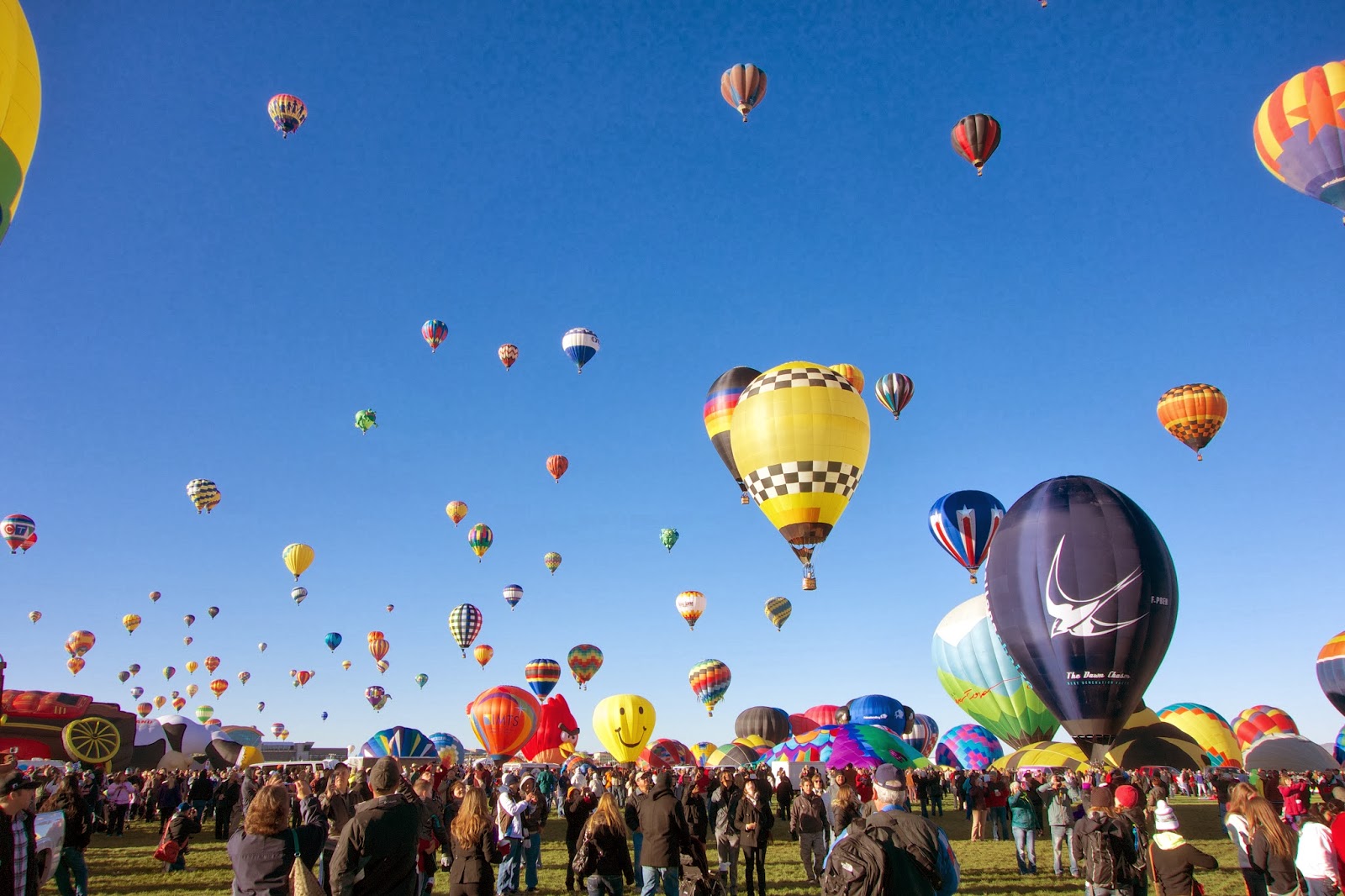
I arose at 4:00 am and set off for a cold early morning drive to Albuquerque.  As we got near to the venue for the balloon festival, the road got busy and the traffic was backed up on the freeway.  This was obviously a big deal – there were thousands of people lining up to get in.  I got parked and entered the event just before dawn and as the sun rose about a dozen balloons took off – the so-called dawn surprise.  That was all very nice but not worth getting up that early until about half an hour later balloons were being inflated all over the place.  There were literally hundreds of them.  What a spectacle and the amazing thing was you can walk among all these balloons as they are being inflated. 

Albuquerque Balloon Festival
After a couple of hours I was pretty much tired with looking at balloons, even tired of the chain saw carvers who were demonstrating their skills (an odd combination), so I headed back to Santa Fe.  It was well worth the early morning start and I would highly recommend this event.   One morning is enough however – apparently it goes on morning and evening for an entire week.

Santa Fe Architecture
In Santa Fe I toured around the downtown area on the bike.   It was nice enough though a bit touristy – lots of expensive artsy shops and a lot of well healed tourists.  I did go through the Georgia O’Keefe Gallery.  In small doses, I like her work and this gallery was not too large to put me off.  One thing I found out there was that in her early days she worked in Canyon, Texas the town near the Palo Duro canyon I had passed through the day before.

From Santa Fe I headed north west to Los Alamos.  This was the headquarters of the Manhattan Project in World War II.   I had expected there to be some remnants of that period, but not a lot remains.   There was a statue of Oppenheimer and Groves in the center of town and Oppenheimer’s old home was still present, though not accessible in any way.  Still Los Alamos was a refreshing change from the tourist-clogged streets of Santa Fe.

From Los Alamos I drove on to Taos where I was to stay with friends (Bart De P. who lives there and John G.who was visiting from Sacramento).  Bart has a beautiful house in the foothills of the Sangre De Cristo mountains near Arroyo Hondo.  I stayed a couple of nights to assist on Sunday with the construction of Bart’s new greenhouse – lots of fun.

Bart and the Greenhouse Project

Monday – Taos to Flagstaff

Monday morning it was back on the road with a destination of Flagstaff.  The drive down to Albuquerque was a repeat of Saturday’s ride and then I headed west on Interstate 40.  Nothing too exciting today, I passed through Gallup where I had lunch at the old El Rancho Hotel.   This must have been a splendid place in its day and apparently it was the stopping of place for many Hollywood celebrities.   They boast “the charm of yesterday, the convenience of tomorrow” and the hotel is a National Historic Site.  The food could be better however.

The El Rancho in Gallup
From Gallup it was on to Winslow and then at the end of the day I reached Flagstaff.   Flagstaff is the nearest large town to the southerly rim of the Grand Canyon.   It was full of tour buses, but they all had nowhere to go – access to the Grand Canyon was closed because it is a National Park and our Government is not working.   Those poor folk who have come from all corners of the world, many on a once in a lifetime trip, and they can’t get to the Canyon.   How sad.

Tuesday – Flagstaff to Twentynine Palms

Tuesday morning was a pleasant morning in Flagstaff.   It is a college town and it has a nice feel to it.  It is a railway town too and the main line passes straight through town – lots of very long freight trains cutting the town in two – like Sacramento, there are no railway bridges in town.

On the road I continued to travel west on I-40.  As the previous day, there wasn’t much of interest, or perhaps I was just getting tired and jaded.  For some reason the handlebars on the bike had worked loose and they were moving when I braked hard.  In Kingman (another Route 66 railroad town on I-40), I found a Napa parts store who just happened to have the right star wrench to do the tightening job - lucky.

Next stop was a turn south towards Lake Havasu and the infamous London Bridge.  This is a relatively new development on the banks of the Lake Havasu reservoir.  The developer heard they were pulling down a bridge in London so he arranged for the facing of the bridge to be shipped to the USA.  A weird idea but apparently it worked – the development did take off and has been reasonably successful.   Not my cup of tea however.

From Lake Havasu it was a late afternoon ride south down to Parker (an interesting looking town) and then west to 29 Palms.   A lovely ride over a nice roller coaster of a road.

Wednesday – Twentynine Palms to Bridgeport

The skies looked a little ominous on Wednesday morning and the forecast was for heavy winds and even rain and snow in the direction I was going.  With nowhere else to go, I set off hoping that the weather report was wrong.   I passed through Joshua Tree (another National Park that was closed) and headed over to Victorville and yes it was windy.   I was leaning into the wind the whole way. 

A Joshua Tree
Victorville is again on the old Route 66 and it was also a railway town.  I didn’t look that welcoming somewhat industrial with a cement works or something on the edge of town and, because of the wind, dust blowing everywhere.   I stopped for breakfast in Victorville at some nice little diner (Emma Jean's).

Just outside Victorville there is a relatively new looking airport, a cargo airport, with all sorts of planes lined up.   Not much traffic today though, just high winds blowing dust around.  I learned later this is the Southern California Logistics Airport  and it is a repurposed old air force base now being used for freight.

Driving north I joined Highway 395 for the ride up the east side of the Sierras – my favorite part of California in the shadow of the High Sierras.  The wind died down but the clouds were looking ominous, and sure enough the rain started around Big Pine.   I suited up with the heated vest and waterproof jacket and pants and pushed on.  The rain made things a bit unpleasant and by the time I got to Bishop I was considering stopping there for the night.   I fueled up in Bishop and warmed up in a Starbucks.  After deciding to call it a day and find a hotel I came out of the Starbucks to find a hole in the clouds and the sun shining through.  I figured that was the sign to keep going so I pushed on northwards.

The weather was fine only for a while and by the time I got near Mammoth it was turning bad again and as I climbed the pass north of Mammoth it started snowing.  I crept over the summit with ice on my fairing and helmet visor.  I made another cautious ride over the pass north of Mono Lake in the ice and snow before dropping into Bridgeport where I did stop for the night.   I stayed that night with friends from Sacramento, Ken and Diane, who were staying in a cabin west of Bridgeport.

Thursday – Bridgeport to Sacramento

The Bike with Snow in the morning
The next day the weather was much better and after a leisurely start to the day, I made the most pleasant ride back over Monitor Pass to Markleville, the Hope Valley, over Carson Pass and down to Sacramento.   This was to be my last long ride on the bike and I was really enjoying it. 

A couple of weeks later, I cleaned up the bike, repaired the broken side panel, and put it up for sale on Craigslist.  It sold within a couple of days.