Tuesday, April 25, 2017

Uzbekistan - April 2017

Uzbekistan was the most difficult country of this trip to arrange travel to.  A visa is required and in order to get a tourist visa a letter of invitation is required.  This requires a contact in the country who can issue the letter, usually a tour company.  A web search led me to a company called Advantour and I had given them a rough itinerary and asked them to provide hotels, transportation and guides for the trip.  They had responded with everything I was looking for - hotel bookings, train tickets, guides and of course the letter of invitation.  This enabled me to get the visa which I had picked up at the Uzbek Embassy in Rome.  However before my arrival in Uzbekistan I had not paid any money so I was a little apprehensive as to whether everything would work out.

My flight from Azerbaijan (via Istanbul) arrived in Tashkent around 1:00 am Sunday morning (2 April).  We were bused from the plane to the terminal and when we arrived it was a mad rush to the customs hall - old ladies, women with children were literally running down the corridor.  I figured they knew better than I so I joined the fray.  It actually was a relatively quick passage through customs and all went quite smoothly.  Welcome to Uzbekistan.

It was a great relief to walk out of the airport and see a waiting driver with my name on a card.  I was taken to my hotel (The Wyndham) and there in the lobby of the hotel I gave the driver $1450 in cash and in return he gave me an envelope of train tickets and hotel vouchers to cover my next 8 days in Uzbekistan.
Khast Imom, Tashkent
 I had a late breakfast and lazy morning and then at 1:00 pm my driver picked me up with my guide for the city tour - a lady named Delia.  She spoke excellent English.  The weather was not particularly good - it was cold and drizzling with rain and as a result the city did not appear that attractive - a rather drab Soviet city.  We drove through the streets of Tashkent to our first stop at a mausoleum and madrassa one of many I was to see in the next few days.  Beautiful tiled buildings and wonderful minarets.  The guide called it Khast Imom.  Uzbekistan is all about the 4M’s - Mosques, Madrassas, Mausoleums and Minarets.
$60 in Uzbek Som
The driver arranged to change some money for me.  There was an active black market for money changing in Uzbekistan.  The official exchange rate was 3,500 Som to the US dollar.  The black market rate was double that at around 7,000 Som to the $ so it didn't make sense to change on the official marketplace.  The main denomination of bank note is 1,000 Som so that makes for a lot of notes.  I literally had a 2 inch stack of notes for changing only $60 - around 400 notes.  Too many to even bother to count, it just felt about right.
Chor-Su Bazaar, Tashkent
 We visited the Chor-Su Bazaar next.  A large domed market with sections for the various products - vegetables, meat, cheese, bread, nuts, dried fruit, spices, etc.  The meat area was the most interesting of course.  Lots of slabs of meat and lots of weird and wonderful looking stuff.  The horse meat sausage looked particularly disgusting.  The Uzbeks like a sweet treacle-like substance made from boiled wheat grass called Sumalec.  I tried some and it was alright by the spoonful but the locals were buying it by the pint.  I bought bread and fruit for the evening’s train journey.
Interior, Museum of Applied Arts, Tashkent
After the market we visited the Museum of Applied Arts.  Some beautiful examples of embroidered and printed cloth, jewelry and metalwork all housed in a wonderful ornate old building.  The rooms in the museum were quite wonderful - carved and painted plaster and wood, ornate tilework - quite beautiful.  
Amir Temur, Tashkent
Next stop was Temur Square where there is a statue of Amir Temur or Tamerlame as we call him in the west.  Temur was quite a violent and ruthless person in the 14th Century but he has been rehabilitated in the minds of the Uzbeks as a great leader and someone who did a lot for Uzbekistan.  The Russian Tsars and the Soviets did nothing that the Uzbeks could be really proud of, so Temur, much like Ghengis Khan in Mongolia, has become a heroic national figure.  Anyway there he was, sitting on his horse in the middle of a square surrounded by examples of Tsarist and Soviet and modern era architecture.

We then drove out to a modern mosque complex.  It was an impressive white marble structure but it was only a few years old and frankly I could have skipped it.  That was the end of the tour and Delia left me with the driver who took me to a restaurant near the train station.  I had some mutton dish that wasn’t particularly appealing washed down with a local Uzbek beer which was quite nice.  After dinner the driver took me to the very modern railway station where I waited for my train.

The train left on time and I had a comfortable night en route for Urgench in northern Uzbekistan.  I remember feeling that it was more like a proper train trip than the Italian trains.  The clickety-clack of the rails, the swaying of the carriage, it’s all much better than the smooth welded track of the high speed trains of Europe.

In the morning, I awoke to find us traveling over a flat desert plain with nothing but the occasional low scrub vegetation.  There wasn’t much sign of habitation either - only the very occasional small settlement.  Just before we arrived in Urgench we crossed the Amu Darya river, the major river of this part of the world flowing north into the now disappearing Aral Sea.   Much of the river’s water has been stolen along the way to irrigate the cotton fields of Uzbekistan - one of the disasters of the Soviet period.  Thank you Mr. Khrushchev whose idea it was to bring a cotton mono-culture to Uzbekistan.

At the very modern Urgench station a driver was waiting for me and he drove me the 30 or so kilometers to Khiva where I was staying for a couple of nights.  We arrived in Khiva in the mid afternoon and I got installed in my hotel, the quite adequate Hotel Asia which sits just outside East Gate to the old walled city.
City Walls and East Gate, Khiva
I went out to walk around the old town in the afternoon.  Within the city walls the old town is fairly small and it that can be walked in a couple of hours.  Beautiful mosques and minarets but since I was supposed to have an official tour the next day I stuck to exploring the back streets.  The streets were primarily earthen, and while the wealthier homes had plastered walls most homes were mud and straw.
Minaret and Satellite Dish, Khiva
In the evening I found a restaurant that was listed in the Lonely Planet Guide.  I was the only diner until at the end of my meal a group of German tourists came in.  I escaped before the ethnic music and dance show started for the Germans.  As for the food, all I can say is that you don’t come to Uzbekistan for the food.
Islam Khoja Minaret, Khiva
 On the next day (Tuesday 4th April), my guide, Ali, showed up and we started a tour of the city.  As I mentioned old Khiva is not a large area and we covered much of the ground that I had walked around the previous afternoon.  This time we took our time and entered the various mosques. madrassas and minarets.  The most memorable thing was the two minarets (Islam Khoja and Juma) which you are allowed to climb - narrow and low spiral staircases, old wooden steps, the absence of any light except for the occasional opening in the wall.  I pretty much felt my way to the top.  No health and safety issues there and fortunately no one else coming down as I was going up.  The incomplete minaret, Kalta Minor, was also impressive - wider than any of the others it was designed to be the tallest in the city until the benefactor of the construction died.  Now it is just the immense fat stub of a minaret with a beautiful tiled surface.
Kalta Minor, Khiva

Tile Decorations Madrasssa, Khiva
While walking around we heard the muezzin call to prayer somewhere outside the city walls.  This apparently doesn’t happen too much.  My guide said they have been clamping down on the overt evidence of Islam as they are paranoid about Islamic fundamentalism taking hold.  He also says that in the big cities the muezzin’s call is banned.  I am not sure that is true but then I didn’t hear the call anywhere else.

We stop for lunch in a restaurant and I sample the local speciality - plov.  A bed of rice and vegetables with lamb/mutton.  It was actually quite tasty and the meat was good quality.
Mausoleum of Makhmud Pakhlavan, Khiva
 After the tour of the city was completed Ali left me and I wandered around the old town for the rest of the day.  By the North Gate you could climb up onto the old city walls and walk around the perimeter.  The entire construction is earthen mud and straw and there were signs of serious erosion in places.  It left me wondering how often they have to shore up the walls.  Surely they need some frequent maintenance, but who does that.
Islam Khoja Minaret
 The next day (Wednesday 5th April) a driver arrived to take me from Khiva to my next stop in Bukhara some 450 km away.  We drove back to Urgench and then picked up the main road south to Bukhara.  For the first 30 km or so the road was in very bad condition then it suddenly changed to a very modern dual carriageway where we made very good time.  The driver had a radar detector which saves him from a ticket a couple of times.  

Nearly every car in Uzbekistan is a Chevrolet and nearly every Chevrolet is a white one.  Apparently the Korean company Daiwoo built a factory in Uzbekistan but later sold it to Chevrolet.  Now Chevy dominates the car business in Uzbekinstan.

The drive to Bukhara was relatively unremarkable.  We crossed the Amu Darya river just south of Urgench and from time to time we saw signs of it in the distance to the west.  We cross the large expanse of the Kyzylkum Desert so there was not a lot of variety in the landscape.  In places we must have been very close to the Turkmenistan border.  About 40 km outside Bukhara the road turned bad again and we slowly dodged potholes the rest of the way into the city.  
Kalon Minaret, Bukhara
 I am dropped at my hotel, the Omar Khayam, in the center of old Bukhara.  In the afternoon I walk around the old town to get a feel for the city.  Bukhara is larger than Khiva and there are some wonderful sights - again mosques, madrassas, minarets and mausoleums.    In the back streets the houses are similar to the ones in Khiva but perhaps a little more prosperous.  More of them have plastered walls and more roads are paved.  Lots of overground piping throughout the old homes which supply gas to the homes - that seems a little scary.

I had a nice meal in the evening.  The dish had the unfortunately name of Jiz but it was basically beef and fried vegetables.
Mir i Arab Madrassa, Bukhara
 The next day, Friday April 6, my guide for the tour of Bukhara arrived at the hotel and we set off on foot to explore the city.  The guide, Jama, is a young guy with pony-tail (very unusual in Uzbekistan) also with an iPhone, and an Apple Watch (not so uncommon).  First place on the tour was Lyabi Hauz around the old pool, one of many that once provided water to the old city and that were supplied by a series of canals.  We spent a lot of time there talking about everything from caravanserais, Sufi teachings, Soviet control, and modern Uzbek politics.  Jama had a lot of opinions.
Lyabi Hauz Pool, Bukhara
 Next stop was a small synagogue in the Jewish section of the town.  Not a very impressive building though I don’t really know what a good synagogue looks like, but there are pictures of Hilary Clinton and Madeleine Albright paying a visit so perhaps it is an important one.  Possibly because there aren’t many Jews in this part of the world.

We walk through town through various bazaars each specializing in different products or trades - woodwork, metalwork, carpets, jewelry, gold, spices, hats (hats must be very important in Uzbekistan).  
Kalon Minaret, Bukhara
The Kalon Mosque and the adjacent Kalon Minaret and Mir i Arab Madrassa are the most spectacular sights in the city.  Definitely the highpoint of the old city.  They are impressively large and impressively well restored.  The tile work is wonderful.  Unlike the minarets of Khiva you could not go up this one.

We visited the Citadel (or Ark as it is sometimes called).  It is basically a walled complex within a city.  It houses the King’s Palace, a couple of sections of which are now relatively mediocre museums.  The Guide indicated that the Citadel has the honor of being the first place to suffer an aerial bombardment when it was bombed by the Red Army in 1920.  Searching on the internet later finds that this was not the case.  The Italians dropped grenades on the Ottomans in Libya much earlier.

We walked out towards the old city walls and a couple of mausoleums that are nearby - Chashma Ayub and Ismael Simani.  

That was the end of the day’s tour and I headed back to the hotel.  I had a late lunch of Plov at the Minzifa Restaurant  - quite good.  The afternoon was spent walking around the backstreets of the city.  I wanted to buy a silk scarf - the ladies at the stall were such good sales people that I ended up walking away with three of them.

In the evening I visit the local hammam bathhouse.  It was in a very old building with a large room with large marble massage slabs and a series of hot, warm and cold rooms leading off from it.  After warming up for 15 minutes I was laid out on one of the marble slabs and soaped, rinsed, pummeled, stretched and twisted into all sorts of contortions.  It did feel very good - and this is from an Englishman who is not entirely comfortable with having another man touch his body let alone being naked at the time.  It all finished off with a cool down and dry off before partaking of a cup of tea.   Very nice and relaxing.

The next day was a Friday, the day for Friday Mosque, so the mosques we visited today were busy.  Since we were going further afield we (Jama my guide and I) had a driver for the day.  The first stop was the Bakhoutdin Naqshbandi Mausoleum and Mosque.  It was fairly impressive but I was getting used to these beautiful buildings by then.  We couldn’t go into the mosque as it was Friday and prayers were in session.  The Mausoleum was a series of unadorned mud/straw graves as I had seen in many places previously.  
Prayer Times at Mosque, Bukhara
 Onward to the King or Emir’s Summer Palace.  This was built in the Russian Imperial time and it was an interesting mix of Bukharan and Pre-Revolutionary Tsarist architecture.  Behind the Summer Palace a group of women were making a huge vat of Sumalec.  This is the sweet treacle like substance I had tried in the bazaar in Tashkent and is basically boiled wheat grass.  The boiling process takes 24 hours and it needs to be stirred continuously so it is an all night affair and they make a bit of a party out of it.  In an adjacent cauldron they were preparing a huge cauldron of Plov - the meat, carrots, raisins and rice dish.
Summer Palace, Bukhara
 We next drove to the Chor Bakr Necropolis.  A not very memorable collection of grave sites.  Apparently some religious person of note was buried there - I don’t know who - and then everyone else wanted to be buried nearby so it turned into a large graveyard.

As we drive back into town we pass a lot of small single story modern homes.  Apparently these are made available to young couples to encourage them to settle in the suburbs.  
Char Minar, Bukhara
 That was the end of the guided tour and so I spend the rest of the day walking around.  I did explore a couple of new places.  One was Char Minar, a wonderful small mosque with a minaret on each corner.  It is apparently modeled on an similar building in India.  The other was the Zindon - the old jail nearby the Citadel.  Zindon is where Stoddard and Connolly were imprisoned in the so-called “bug pit” before being executed.  The Stoddard and Connolly story is well worth reading about.
Stoddard and Connolly's Bug Pit
 In the evening I again visited the hammam bathhouse.  The prior day I had been the only customer and it was nice and quiet.  On this day it was full of boisterous Russians who made a lot of noise.  I like it when it’s more peaceful.

On the next day (Saturday 8 April) it was an early start to catch the train to Samarkand.  The very modern train station is quite a way out of town.   Also traveling on the same train were the two Pakistani ladies (Durdana and Shurdana I think) that had been following the same route and hotels as me from Khiva to Bukhara.  The train we were on was not one of the fast modern Sharq trains but we did get the privilege of being shunted into a siding for an hour while the Sharq train sped by.
Amir Timur's Mausoleum
In Samarkand I was picked up by another guide and driver - both were named Anvar so it made things easy.  We started our tour with a visit to the mausoleum of Amir Timur (Tamerlane).  This is a magnificent structure with wonderful tile work.  The tile work here was radically different from the work previously seen in Khiva and Bukhara.  The patterns were created as a mosaic which gave nice sharp lines to the design.   The work up to this point, the so-called majolica tiles, were made by painting colors patterns on tile prior to firing the tile and the edges tended to bleed a little and give a more fuzzy edge.   
Detail of Mosaic Tile
 We walked from Tamerlane’s mausoleum down to the Registan.  The Registan is the most impressive site - three immense madrassas facing a large square.  The tile work, again mosaic tile, is stunning and has been impressively restored.  This one site is probably the most spectacular location in Uzbekistan.  We spend considerable time here visiting each building and marveling at the splendour of the place.  
The Registan Complex, Samarkand
Madrassa at the Registan, Samarkand
From the Registan we walk to the Bibi Kharym mosque and mausoleum.  This is not so spectacular but it has not been restored to the same level as the Registan buildings so you get a good idea of how these buildings were prior to the recent renovation.  

A short distance away was the Siob market and we wander around and visit the various sections spices, dried fruit, nuts, bread, meat, dairy and, an unusual section, snuff.

That completed the tour for the day and I went to my hotel - the Grand Hotel Samarkand.  Not too grand but good enough.  In the evening I dine with the two Pakistani ladies (Durdana and Shurdana) and their guide (who went everywhere with them) at a restaurant nearby my hotel.  It was a bit up market for Uzbekistan and we had a wonderful meal.  We even had a decent bottle of Uzbek wine - very drinkable.
Sound and Light Show at the Registan
After dinner we went to the Registan again where an impressive Sound and Light show was being put on for a group of visiting Japanese tourists.  We get to stand at the back and witness a wonderful program about the history of Uzbekistan and the Silk Road projected onto the backdrop of the wonderful madrassas of the Registan.  The story omitted entirely any mention of the Tsarist Russian period or the Soviet period.  That is why Tamerlane is so popular - he is the last person that did something just for the advancement of Uzbekistan.

Samarkand is a larger city than Khiva and Bukhara.  It is very modern and there is no remaining old section of town as far as I can see.  It feels quite safe.  I walk the couple of kilometers to my hotel late at night and feel perfectly safe.  One of the Pakistani ladies left a bag on the morning’s train and after a couple of phone calls it is located intact in Tashkent.  We all speak of how safe and secure it feels.  Back in my hotel room I turn on the TV to find news of a Terrorist attack in Sweden, the perpetrator of which was an Uzbek citizen.  The prior week’s terrorist attack in St Petersburg, Russia was also perpetrated by an Uzbek living in Osh in Kyrgyzstan.  Perhaps things aren’t quite as calm as they appear.

On Sunday morning I took a walk around some of the places I saw on the previous day - Amir Timur’s statue, Timur’s Mausoleum, the Registan.  It is Amur Timur’s birthday so his statue was bedecked with flowers.

At midday I am picked up by the guide and driver, the two Anvars, and we visit a few more sites.  First is the Observatory of Ulugbek.  Ulugbek was a king in the 1400’s who was quite the astronomer.  The Observatory houses what is left of his impressive 30 meter astrolabe.  Ulugbek was well known in Europe as one of the greats of early Astronomy.

Next stop was a paper making museum which made quite a nice presentation about making paper from mulberry bark (a sideline of the silk business?).  The final step where the paper is polished with a smooth stone makes all the difference to the end product.

We moved on to the burial site of St. Daniel.  How he ended up there I don’t know but he is there in the longest tomb you ever did see.  From the graveyard on the hill above Daniel’s tomb you can see the location of the old city which was once on the hills outside the current city.  They moved to lower ground to take advantage of a better water supply.

Next stop was the Afrosiab Museum where there are the remnants of a 7th century mural or fresco of the Sogdian King Varkhouman.
Shakhi Zindha Complex
 The final stop for the day was the Shakhi Zindha Mausoleum complex.  There are about 6 or 7 mausoleums and a mosque in an avenue stretching up the hillside.  We go inside the mosque and sit and listen to a cleric chanting a prayer from the Koran.  Though I and presumably all the Uzbeks there do not understand the meaning of the Arabic prayers, the sound was indeed quite moving.
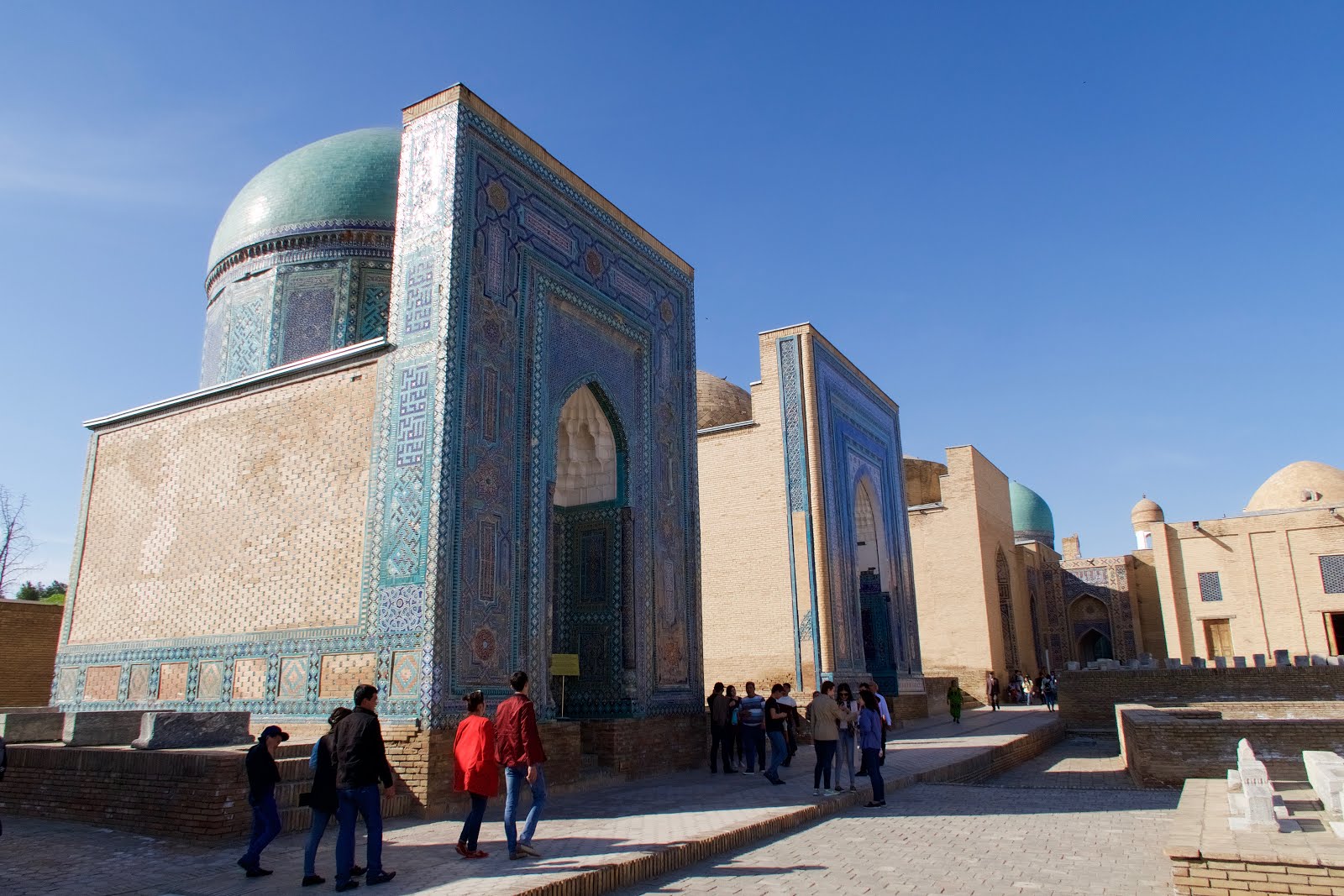
Shakhi Zindha Complex
 We killed some time in a coffee shop in the late afternoon before going to the station for my train to Tashkent.  Again the train station was quite modern and this time my train was also a new high speed train - the Sharq train that was recently built by the Spanish.  We sped along through the late afternoon countryside - mountains in the distance, springtime green lowlands, setting sun behind us.  Quite wonderful.  It was dark when we arrived in Tashkent and again my driver was waiting to whisk me off to my hotel one last time.

The Sharq Train to Tashkent
 The next morning, my last in Uzbekistan, was sunny and warm and the city looked so much better than my first day there the prior week when it was cold and grey and damp.  I walked towards the train station where nearby there is a train museum.  It had a nice collection of old steam engines from the Soviet era with a few lesser interesting diesel locomotives.  It was pretty cool because you could climb all over some of the steam trains - again no health and safety worries there.

Tashkent Railway Museum
On the way back to the hotel, I walk past the Temur Square, the Romanov Palace, and some very modern government buildings.  There are some nice parks and pedestrian streets but you couldn’t get near to the government buildings and they didn’t look very welcoming.

My driver arrives one final time to take me to the airport for my short flight to Almaty, Kazakhstan.  This trip in Uzbekistan was quite the collection of cities, trains, drivers and guides and everything worked perfectly - great job Advantour.


Sunday, April 23, 2017

Georgia and Azerbaijan - April 2017

After leaving Rome I flew to Tbilisi, Georgia by way of Istanbul on Turkish Airlines.  The timing of the flight was not ideal as I arrived in Tbilisi at 3:30 am.  It wasn’t really worth getting a hotel at that time of the morning so I decided to wait in the airport until the sun came up.  Not the most comfortable of airport seating but I did manage to doze a little until it was daylight.  I got a little money out of an ATM at the airport (1 Georgian Lari = $2.5) and found a taxi dropping someone off at the airport to take me back into town.  He started with a price of 10 Lari but by the time we had got to my hotel he wanted 25 Lari.  Since the guide book indicated 35 Lari was a good price I didn’t complain too much.


I dropped off my bags at the hotel and set off for a look around the town.  It was quite cold and very windy in the early morning as I walked around the old city.  Lots of coffee shops but they were all closed.  It appears that they don’t start the day too early in Tbilisi.  There were several Orthodox Churches and some shabby housing in the old part of town but then lots of renovated old buildings and some spectacular modern architecture.  It looked like the town was just coming out from the thaw after a cold snowy winter - dusty and dirty and decaying a little.
Mother of Georgia Statue above the old town
I finally found a coffee shop where I could get a hot drink and warm up.  I wandered around some more until 12:00 when I could get into my room at the hotel (the Old Tiflis Boutique Hotel).  I was pretty tired after the night of travel so I took a little nap.
The Peace Bridge
Later in the afternoon I set off again to explore the city.  Lots of restaurants and bars and signs of renovation of the old part of town.  There were also several very modern buildings and a very modern bridge across the River Mtkvari (the Peace Bridge).  The modern structures looked interesting juxtaposed with the old parts of town but getting up close to them showed that the new materials don’t always hold up so well over time.  Already there were signs of wear and damage.
Tbilisi = view from the Cable Car
I took the cable car up the hill to the Narikala Fortress and the statue of the Mother of Georgia.  Wonderful views of the city on the way up.  It is a very windy day and the people holding the hawks, peacocks and monkeys for photo opportunities are having a bit of trouble with their animals - particularly the peacock, the poor thing was getting severe buffeting from the wind.  The Mother Georgia statue or Kurtlis Deda as it is known locally has a sword in one hand and a glass of wine in the other - sending very mixed messages.
Trinity Cathedral
Back down the hill again, I walked up the other side of the river to the largest Georgian Orthodox Church, the Trinity Cathedral (Sameba to the locals).  It’s an impressive church but quite modern (Post-Soviet - 1995 - 2004 apparently).
Pay Box
All throughout the city there were lots of “Pay Boxes” - wifi enabled terminals where you could perform all sorts of transactions - pay bills, transfer money, top up phones, place bets. There were even references to Bit Coins on one of the screens.  We have no equivalent in the USA but they were everywhere in Tbilisi.


In the evening I found a restaurant that looked good and the food was indeed good but it looked really nasty - pigs cheeks and potatoes in some sort of black sauce.  Tasted great, but looked awful.


Next day, Thursday, was not so windy and cold, so the whole town felt much more pleasant.  I walked again through the old town which was now becoming quite familiar to me.  I visited the oldest Orthodox Church in the region and inside the priest was chanting prayers.  Then four women started singing - what a beautiful sound.  I stayed for the duration of their recital in awe of what a wonderful sound they were making in this old church with shafts of sunlight coming down through the windows.  The only problem with Orthodox Churches is that there is no seating - you have to stand the whole time.  I prefer Catholic Churches where at least I can sit in a pew and rest my feet.
The Choir in the old Orthodox Church
I walked further north out to the Dry Bridge where there is a flea market selling all manner of things.  Lots of Soviet Era memorabilia and military stuff and lots of total junk that you couldn't imagine anyone buying.  Nothing caught my eye. I never did find out why they called it the Dry Bridge - there was certainly lots of water.
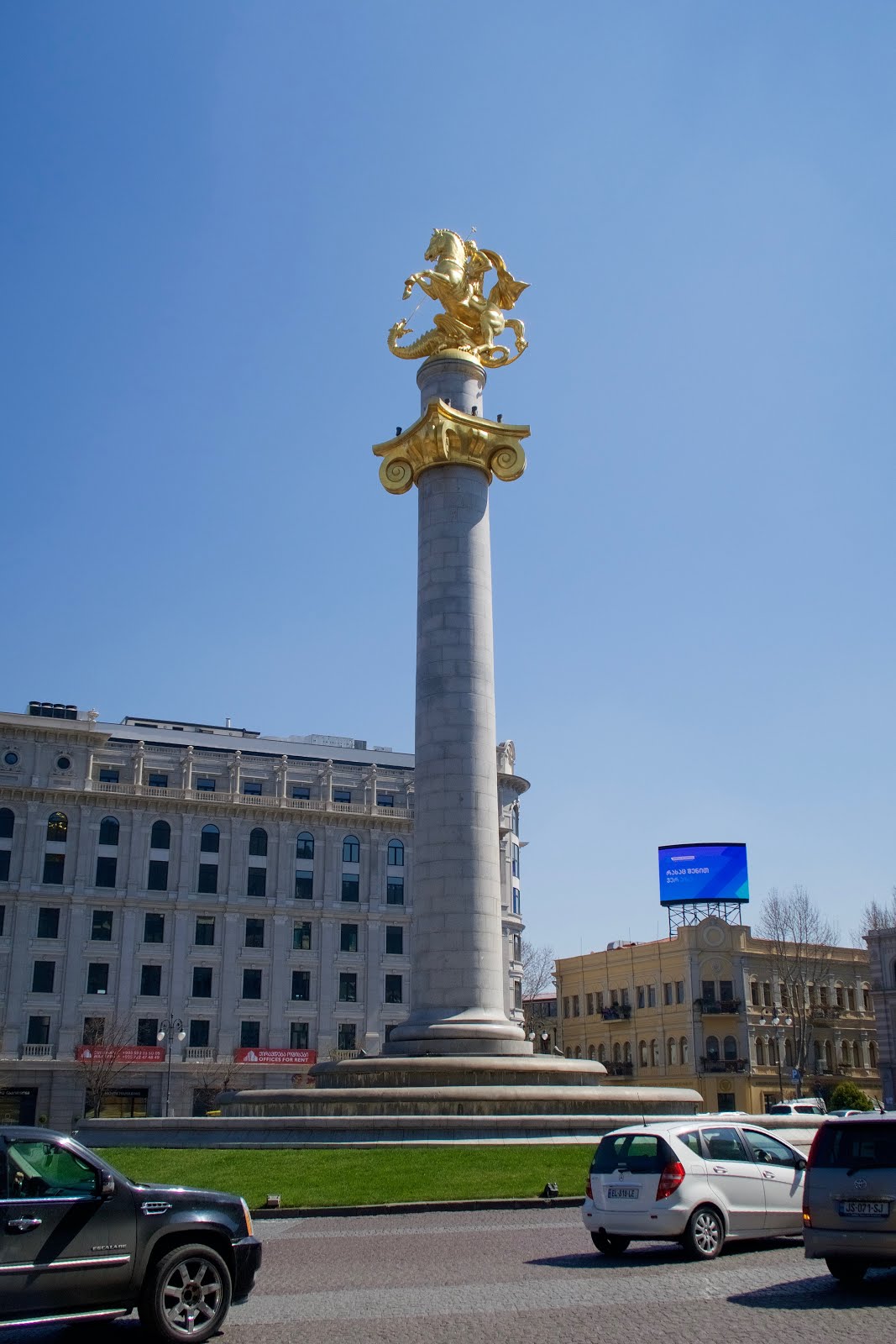
St. George slaying the Dragon
Back in the center of town I walked up Rustaveli Avenue to Rustaveli Square.  Here there were lots of fine buildings - theaters, concert halls, government buildings, and hotels.  Rustaveli is the preeminent Georgian poet from the 12th Century and they are obviously quite proud of him.  At the other end of Rustaveli Avenue, in Freedom Square, I realized whose golden statue is on top of the column - it is Saint George slaying the Dragon.  That makes sense in Georgia.
Khachapuri
I had lunch and tried something called a Khachapuri - a kind of cheese pie.  And what a pie it was - huge, I could barely consume half of it.


In the mid afternoon I took a taxi out to the train station for my overnight train to Baku.  The train station was very disappointing - quite disheveled and run down.  There were only 3 or 4 platforms and they didn’t even seem to be numbered.  I found my train and got installed in my compartment.  It was quite comfortable though not a particularly modern carriage but at least I had the compartment to myself.
Overnight Train to Baku, Azerbaijan
As we pulled out of town, I realized I had only seen fraction of Tbilisi, the old part.  There was a lot of the city I had not experienced - not particularly attractive but certainly different to the historic center.


Within a couple of hours we were at the Azerbaijan border.  The border proceedings took an hour or so on each side.  On the Azerbaijan side the Customs officials came through the carriage and collected passports and then one by one we were called into a compartment for processing which included being photographed.  There was a rudimentary bag check in my compartment.  Interestingly all vents and panels in the carriage were sealed with a customs label and the customs people checked all of them to see they were intact.


I had a good night’s sleep and awoke to us traveling across a featureless plain with few signs of habitation.  As we neared Baku we skirted the edge of the Caspian Sea before coming into the city.  The station in Baku was very modern, very clean, and quite the contrast with Tbilisi.  We arrived around 7:30, again too early for my hotel.  I walked around until I found an ATM where I got a little money (the Azerbaijani Manat - 1 Manat = $0.6).  Then I got a cab to my hotel so I could get rid of my bags.  They have a lot of purple London cabs in Baku.
Maiden Tower, Baku
Walking around town it was obvious that Baku has a lot of money, presumably from their oil resources.  Everything is clean and tidy and perfect, too clean and tidy and too perfect perhaps.  The old part of town has been renovated extensively and while they have tried to keep the flavor of the old city it just doesn’t have a lot of character anymore.  I walked around the old town and took in the sights of the Maiden Tower and Shirvanshah’s Palace but I found it all a bit lacking. Starbucks are there and I did get a caffeine fix as well as warming up and using their wifi.
The Flame Towers from the Old City
The city is dominated by the Flame Towers, three immense modern structures that are visible all across the city.  They are truly impressive modern buildings but although the guide book says at night they are illuminated by 10,000 LED lights, while I was there, they were dark.
The Carpet Museum
The Carpet Museum is also an impressive new building.  I didn’t go inside where there are apparently 10,000 carpets, but from the outside it is quite wonderful being built in the shape of a carpet - very novel.
The Flame Towers
From the Carpet Museum I took the funicular up the hill to the base of the Flame Towers and the war graves cemetery.  The Flame Towers look even more impressive when you get near to them.  In the cemetery I was looking for a British War Memorial commemorating the dead in World War 1.  I didn’t find it.  There is also supposed to be a memorial to the Turkish dead from that same war but I never found that one either but it’s nice of them to commemorate both sides in the conflict.  There was a memorial to the dead from the 20 January 1990 Black January massacre when the Soviets suppressed an uprising against the Azerbaijan Government.  The memorial contains markers for each of the dead in along avenue known as Martyrs Lane.
Martyrs Lane
After the morning’s walking I went to my hotel to recuperate. The Shah Palace Hotel had a great location just inside the old city walls, but alas the room did have an odd smell.


Later in the afternoon I explored the town to the north of the hotel.  This was again all very clean and tidy.  I believe most of the buildings would have been Soviet era buildings and they now have been re-skinned with new sandstone facades.  Amazing what a little oil money can do.  There was a fine Soviet era Government Building whose best side was masked by a construction project.  It took me a while to figure out it was the construction of the pit facilities for the upcoming Formula 1 event in Baku which takes place on the streets of the city.


Dinner for the evening was at the not very typical but very nice Cafe de Paris.  Salad and Onion Soup - just perfect.  


The next morning (Saturday) the weather was so much better - no wind and not as cold.  It made for a pleasant walk around many of the same areas as the previous day.  There was a lot of traffic in town and some of the roads are difficult to cross.  Fortunately there are quite a few subways for pedestrians - marble floors and walls, all very clean and tidy, some of them even had escalators.  This is a prosperous city.  
The Caspian Sea in Baku
I was not overly aware that Azerbaijan is a moslem country.  There were a few mosques in the old part of town but I didn’t notice them elsewhere and you didn’t see much of the veil.  This contrasts with Georgia where in Tbilisi you were very aware that it was an Orthodox Christian country.


I went back to the hotel around 11:00 and took a cab to the airport.  A very modern and busy and yet high speed freeway out to the very modern airport.  At the airport there was an extensive security check including a device you stood in that presumably checked your shoes for suspicious substances. I had never seen such a device before.


The flight to Tashkent was not really very direct, I flew back to Istanbul and then flew out from Istanbul to Tashkent.  I have flown through Istanbul a few times now and they have the most wonderful lounge with an outstanding selection of food and drink.  Many thanks to my United Gold Status.


There was another security check in Istanbul too and I realized that in both Baku and Istanbul I had forgotten to remove my penknife (Swiss Army type) from my carry on bag.  Neither of the checks discovered it.  That’s not particularly comforting.


Photos from the trip to Tbilisi are here, and Baku here.

Wednesday, April 12, 2017

Italy - March - April 2017

In mid March Nancy and I went to Italy to hike part of the Francigena Way.  The Francigena Way is an old pilgrimage route from Canterbury in England to Rome in Italy.  That’s a long way but we just did the last 100 miles from Orvieto to Rome.  Before starting the hike we spent a couple of days in Venice.  This worked out well as it was a relatively inexpensive RyanAir flight from East Midlands airport in the UK (just 45 mins from my mother’s home) to Venice.  Of course RyanAir drop you in Treviso which is not quite Venice but that’s OK both the price and the timing were good.

Venice
We stayed at the Hotel Metropolitan which sits by the water just a few blocks from St Mark’s Square.  It doesn’t look great from the outside but on the inside it is a wonderfully luxurious place.  One of those off-season deals from Hotels.com that was a real steal.

I hadn’t been to Venice since I was 20 so it was nice to be back.  Not too much has changed in 45 years, it has all become much better preserved.  What a wonderful old city kept alive by tourism.

That night at dinner we talk with a Belgian couple at the next table.   The conversation turns to Brexit and President Trump.  We agree Brexit is bad but that the EU has considerable problems.  Their impression of Trump - he’s a clown.

Venice - view from the Academy Bridge
Our first morning in Venice we walked over to the Academy Bridge and over to the Guggenheim Museum.  I think that it is a wonderful museum - not too large, manageable in an hour or so, and it contains some wonderful pieces of art.  Mostly 20th Century stuff but a little bit from just about anyone who was anyone in that time period. Simply wonderful.


In the afternoon I headed over to the St Mark’s and the Doge’s Palace by myself as Nancy had been there the year before.  A truly remarkable square with truly remarkable buildings, works of art in themselves.  Surprisingly they cathedral and the palace were not too crowded.  I guess early April is a good time to visit - nice weather and modest crowds.  There was an exhibit of Hieronymus Bosch paintings at the Doge’s Palace.  Only about 6 paintings and not too remarkable ones either.  Apparently he became renowned down south in Venice before he became famous in his home in the Netherlands.

St Mark's Venice
That night at dinner, the waiter refuses to give me Parmesan cheese for my seafood pasta - “no sir, that would not be good”.  Nice to have a waiter who knows what’s best for his clients.


We spent two nights at the Metropole and then on the Thursday morning we set off for the train station and the train to Orvieto.  It was a high speed train from Venice to Florence where we switched to a slower local train to Orvieto.  The high speed train was wonderful - very modern, very clean, very, very fast (of the order of 200 km/hr at times).  A real treat for an Amtrak traveler.  What was also surprising was the amount of track that was in a tunnel - from Bologna to Florence is 78 km of which 74 km is in tunnels.


The train arrived in Orvieto around 3:00 in the afternoon and we took the funicular up the hill to the old town.  The ticket also included the bus ride from the funicular to the main square by the duomo.  And what a duomo - the most magnificent cathedral you can imagine just sitting there in the square - the front facade all gilded mosaics, sculptures and carvings, the sides and back alternating layers of black and white stone.

The Duomo in Orvieto
We checked into our very lovely hotel (the Magnolia B and B) and then wandered around the town.  Another town, at least the old part of town that sits on top of the hill, that is dominated by tourism.  Still there weren’t so many tourists this early in the season and it had a nice feel.  We sampled some local wine and for dinner (at LaPalomba, recommended by Rick Steves) we tried the local speciality of wild boar pasta.


The next day was the start of our hike.  We breakfasted in the coffee shop next to the hotel and set off on the route.  The trail guide lead us down the hill out of town and eventually out of the urban area up a road into a oak woods and lanes through small farms.  We got in the way of some sheep being moved down the lane and caused the shepherds a bit of trouble getting them back into the right field.  They had beautiful white sheep dogs that we later saw a lot of over the next few days - the Maremma Abruzzese Sheepdog apparently.

Pine Trees on the Francigena Way


Nice walking and for the most part the trail was well marked or well described in the guide book.  In the mid-afternoon, Lake Bolsena appeared in the distance, our destination for the night.  As we entered the town of Bolsena I realize that I didn’t bring the hotel voucher for the evening’s stay, and I don’t have the name of the hotel.  That could have been a problem, but wifi in the town square and a Skype call to our tour company in London provides our hotel destination for the night, the quite adequate though nothing exceptional Hotel Lorina.  I didn’t make that mistake again.

Markers along the Way 


The next morning we left the town and the lake behind us and gradually climbed up on a nice track in the woods into open rolling farmlands.  We picnicked for lunch outside some sort of hostel that was closed (we were early in the season) before descending through oak woodlands again.  We were caught by two Germans and their baby in a backpack and we foolishly followed them off the main trail for a while until we realized our mistake.  Generally there are a lot of Francigena Way markers but sometimes things got a bit sketchy and other trail markers take over.  Thankfully we realized our mistake and doubled back before getting too far off route.


In the mid afternoon we saw our destination, Montefiascone, sitting on the top of a hill in the distance.  Unfortunately it wasn’t the hill we were on at the time and it did seem a long way away.  We eventually reached Montefiascone and walk through the outskirts to the old part of town (on top of the hill as is usual in Italian towns).  The church we had been seeing for the last couple of hours, church of Santa Margherita is on top of the hill and just behind it is the Rocca dei Papi gardens.  We wander around the church and gardens and climb to the top of something called the Pilgrim Tower for a nice view of the surrounding countryside.  The skies look a little grey and foreboding.


The nights hotel, the Urbano V Hotel, was quite nice but it’s restaurant was closed and they arrange for some transfer of our meal voucher to the Stuzzio Restaurant nearby.  The Stuzzio is a great restaurant and we have a wonderful meal (soup, pasta, meat course, dessert) all washed down by a bottle of the local wine, Est, Est, Est.  Est is short for “bonum est”, so this wine is triply good.  Legend has it that a monk who liked wine sent his servant ahead to sample the local wines and report back.  The wine is Montefiascone was so good he gave it a three star review.  The monk arrived some time later and drank the wine and promptly died, hopefully well satisfied.  The wine was very good.


The Cassia Way
The next morning we left Montefiascone and headed gently downhill along an old Roman Road (the Cassia Way).  What an impressive road - still intact after a couple of thousand years or more of use.  The large boulders of the road were a little hard to walk on however.   Not the most comfortable road.  Leaving the Cassia Way behind us we walk up farm tracks through more nice countryside.  We took our lunch on the crest of a hill at a table by an old farm building.  After lunch and just before the town of Viterbo we pass a thermal hot spring full of Italians out for the weekend.  I dozed at the side of the trail while Nancy went in to soak in the hot springs.  They didn't look that appealing to me - too many Italian men in Speedos.

We arrived in Viterbo our home for the night a little earlier than expected and we had time to visit a couple of churches and the Papal Museum.  The churches as always were wonderful, the Papal Museum, not so great.  Our hotel was a small B and B in the old quarter of town.  Very nice and we were the only residents.  Dinner was in town where we ordered way too much food - Octopus, Boar Ragu, Pizza.  A situation not helped by the happy hour snacks in a bar next to the hotel.


The next day, Monday, we were en route from Viterbo to Vetrella.  After leaving Viterbo through the old gate in the city wall we walked on a road between high tufa walls.  Very nice walking in this very narrow high walled gorge.  As the road opened out we do a spell of walking alongside a freeway, fortunately not for too long.  As we head uphill through olive orchards away from the freeway we pass a couple who are searching the undergrowth for wild asparagus - very fine and thin asparagus.  I search the undergrowth for the rest of the day and I couldn’t find one.  We walk on through old olive orchards and we get an abbreviated day as our hotel for the night (Antica Locanda della Via Francigena) is 1.5 km before the town of Vetrella.

The Road out of Viterbo


As we were finished and at the hotel by 2:00 pm we walked into town to get some food - a late lunch.  We found an unassuming place called La Lanterna del Santo and just got in before they closed for the afternoon.  We had some wonderful food even if the waitress was not particularly helpful - lasagne, pasta, salad, wine.  Quite unexpected and very cheap and quite tasty.  


We sauntered around the town, had a couple of Aparols (fast becoming our signature drink), and then back to the hotel for more food - dinner in the hotel’s large and very tacky dining room.  Too much food again today.


Tuesday’s hike from Vetrella to Sutri was the longest yet some 27 km.  That was significantly longer than the other days which had been around 18 km.  We left Vetrella and walked through nice woodlands until we came out into an area of hazelnut orchards.   We had lunch in the orchard and walked on until we reached two large towers.  They were the ruins of an old Roman mausoleum - the Torri di Orlando.


More walking on a well maintained gravel road lined with lots of majestic Stone Pine trees.  We reached the town of Capranica, at first the very ordinary modern part of town, and then the very beautiful old town.  After Capranica the trail headed towards a valley with a flowing stream which was quite beautiful but had lots of downed trees that make navigating the trail a bit tricky.  The downed trees got even worse and we reached a section that had been logged that required climbing over and under the obstacles.  Apart from the downed trees this section was some of the most beautiful trail so far.  Lots of colorful flowers.  

The trail before Sutri


Our destination Sutri is again a lovely town with Roman ruins on the outskirts.  Our day’s hike ends at a Roman Coliseum excavated out of the soft tufa rock.  We then had a bit of trouble finding our hotel.  It was some distance out of town, on a road that was just too busy to walk along.  We headed into town check in at the tourist information office.  Apparently there were no taxis in town so that option was out.  The TI call the hotel and find out we should eat in town at a certain restaurant and then the proprietor of the restaurant would transfer us to the hotel.  We then checked email to find that we should have been picked up at the amphitheatre at the end of the hike and taken to the hotel.  I called the tour company and they arranged to pick us up in town, take us to the hotel, Il Borgo di Sutri, and then the hotel brought us back to town for the evening meal.  It was a lot of ferrying about but it worked.  It was just a shame we didn’t realise we had to do all this shuttling around earlier.  It would have been a lot less stressful.


On Wednesday morning we left the very fine Il Borgo di Sutri and took a shortcut out of the back of the hotel to the Francigena Way.  Nice walking to the town of Montorosi where we stopped for an espresso.   Walking on through nice country until we reached a waterfall, the falls of Monte Gelato, where we took a break.  The trail guide told us that we have only 2.9 km to go but that 2.9 turns into at least 7 or 8 km.  That was a bit frustrating - at the end of the day when you think you are nearly done but in fact you have quite a ways to go.


As usual the end of the day was a slog up the hill to the old town of Campagnano di Roma.  This was perhaps the least attractive old town that we visited.  Not so much charm in Campagnano.  Our hotel, the Hotel Benigni, was just outside the old city gates.  The hotel also was not very impressive.


Since we didn’t like the look of the hotel we decided to have a small snack in town at one of the nicer looking restaurants.  I have Grecia Pasta with Pigs Cheeks - quite nice but not the best.  Since we also had a meal paid for at the hotel we decided to see what it was like - surprisingly it wa very good - beef steak with arugula.  The manager of the hotel was a nice guy from Albania - he spoke perfect English.


Next morning we headed out of Campagnano and, again, we walked through some nice countryside  considering that we were so close to Rome - farm tracks, parklands, gravel roads.  Just before lunchtime we arrive in the town of Formello.  We took the opportunity to buy some foccacia for lunch which we ate by the gates to the old part of the city.  We discover that the bitter green leaf we had previously been calling bad quality spinach (as in our meal in Orvieto) is actually chicory.  I hadn’t tasted it in the green form before (only as an addition to coffee in post war England - Camp Coffee), it was very bitter and not a favorite.  


The descent out of Formello was very pleasant.  We passed an area with some early Etruscan ruins.  Another bitter salad green is encountered as we passed by a field with an old lady collecting leaves.  She gave me a sample - perhaps they were dandelion leaves, I am not sure.  They were also very bitter.


Another error in the guide book at the end of the day as the final kilometer turns into 2 or 3 km.  We finally make it to the Hotel Cassia in La Storta.  La Storta is not a pretty town, we were quite close to Rome now and La Storta sits on what must be one of the main roads leading towards Rome - lots of traffic.  We did find an excellent Aparol Spritz before dining at a pretty average and nondescript restaurant (by Italian standards).
Afternoon Drinks - Aparol


Friday, the final day of the hike, we left La Storta for our destination at the Vatican, some 12 miles away.  A little more urban walking as we are so close but we still managed to find some nice parklands and green belts.  Strangely the Via Francigena signs which were quite prolific since Bolsena became quite scarce.  We got a bit off route in La Giustiniana but with the help of Google Maps on the iPhone we recovered.  


The guide book again proved to be problematic and we decided to ignore it and follow what few VF signs we see.  We were getting frustrated by our guide book - when you pay for a tour like this the one thing of value they provide should be an accurate guide, while we didn’t encounter anything we couldn’t figure out, it was sometimes far from clear where we were supposed to go.


We walked up through a park that provided us with nice views of the north side of Rome.  The Olympic Stadium and the Tiber were below us and while the Vatican was not visible it should be just around the corner.  We dropped into the suburbs again and had lunch before climbing through another park, this one with great views of the Vatican below.  Walking into the city, the trail passed through what looked like a homeless camp which Nancy wanted to avoid, so it was Google Maps to the rescue to navigate a small diversion.  
Our destination, the Vatican
As we got close to the Vatican we realised something was different.  St Peter’s Square was closed because all the EU leaders were getting together to celebrate the Treaty of Rome’s 50th anniversary.  So the last 100 meters of our hike into the square was not going to happen.  We wandered around the outside of the square and as we were doing so several motorcades of EU leaders come speeding into the square.  The only I recognize is Angela Merkel, so for the second time in my life I get to see Angela.


We walked the last kilometer or so to our hotel which was on the south west side of the Vatican and our hike was done - 100 miles in 8 days.  A nice moderate daily mileage.  I wouldn’t have wanted to do much more each day and 8 back to back days was enough.


Since there were all the EU leaders in town parts of the city, including the Vatican, were closed the next day so we decided to get out of town for the day.  It was a couple of hours by fast train to Bologna and apparently it is a nice city for a day trip so off we go.  The train was quite comfortable and incredibly fast and we were in Bologna in time for lunch.  Bologna was thronged with people, not tourists, locals.  The streets and squares were quite busy.  The town itself is wonderful too - lots of great churches, lots of arcades of shops, a great central square and the towers, there are several towers that are quite distinctive.
The Towers of Bologna
We had lunch sitting outside a small restaurant and, of course, I had the Pasta Bolognese - it was wonderful.  
Pasta Bolognese in Bologna
In the afternoon, I walked around the sights while Nancy toured the shops.  The main square, Piazza Maggiore, was thronged with young people.  Just hanging out on a nice Saturday afternoon - musicians providing the entertainment.  We walked back to the station and caught the 6:00 pm train back to Rome.  Back in Rome we discovered you can have a bad meal in Italy - the restaurant was conveniently on the way back to our hotel, but the food was far from good.


On Sunday morning we went to St Peter’s to check out what had been closed the previous day.  On the way we got our Testimonium - the document that certifies that we have completed some part of the Francigena Way.  At each night’s stop on the walk we could get a stamp in a “passport” to validate we have made the ‘pilgrimage’.  In Rome this was checked and they gave us a certificate on parchment paper.   All very official.


In the square people were waiting for the Pope to bless them so we joined the throng.  While we were looking at the center stage in front of St Peter’s the Pope popped out at a window high up and to the right.  You could barely see him but there were large screen TVs in the square that showed him in close up.  The crowd seemed enraptured by him; there was a group from some South American country that were quite lively in their support.  To me the atheist, this was all very strange.
In St Peter's Square, the Pope is at the top window, 2nd from Right
After our papal blessing we went into St Peter’s.  Certainly one of the most amazing man-made structures in the world.  It is mind bogglingly beautiful and so incredible to think it was built so long ago.  As Nancy wanted to do Communion, I decided to accompany her, and we got to go through a roped off area to the main altar.  While Nancy had communion, I sat respectfully in awe of this most wondrous place.


The Pieta in St Peter's
After St Peter’s we walked over to the Trastavere area for lunch.  We found a really nice restaurant, La Lucia, and had a wonderful lunch (with a bottle of Est, Est, Est wine).  Our faith was restored in Italian food.


Back to the hotel via the Trevi Fountain which was incredibly crowded.  While it is a wonderful fountain, the crowds take away from the splendour of it all.  I can’t imagine what it's like in the peak season.


In the evening more walking around - the Spanish Steps, the high end shopping below the Spanish Steps, the Trevi Fountain again, still crowded.  Then we had a nice meal in a restaurant close to our hotel.


On the following morning, Monday, I was scheduled to pick up my Uzbekistan Visa from the Uzbek Embassy.  We walk over to the Embassy which is close to the Vatican.  Google Maps actually takes us to the Somali Embassy, not quite what we want but a check on the address shows the Uzbek Embassy two or three blocks away.  At the Embassy, which is very non-descript office on the third floor of an old building, I find all is well with my Letter of Invitation and Visa Application but that I need a bank draft for $70.  So it's off to a bank to make the payment which is an experience in itself.  To get into an Italian bank you have to put your bags into a locker outside the bank, press a bell to get them to open a door into a cubicle big enough for one person, look into a camera in the cubicle, If you are acceptable the door on the other side of the cubicle opens to let you into the bank.  That is quite the security procedure.  Same thing in reverse to get out.  The bank draft is quite a bureaucratic process involving lots of pieces of paper and signatures and passport photos but I eventually get it and go back to the embassy where I get my visa.  What a process.


Before lunch we made a quick visit to the Cappuchine Monk’s Ossuary which is a group of chapels adorned with human skeletal bones and mummified monk’s bodies.  All very weird and wonderful.


A quick lunch then we took Nancy to the station to catch her train to Puglia and her bicycle trip.  I was then alone in Rome.  Since my new camera had failed back in Venice I decided to purchase a new one and somehow try and return the old one for credit when I get back home.  After calling just about every camera store in Rome I found a camera at a store not too far away.  When I arrived in the store there was a person in front of me who was looking at the same camera, a Canon GX7 Mark II, and he bought the only one in stock.  Apparently it had been on the shelf for a couple of months and on this fateful day two people showed up to buy it,  I was the unlucky one.


In the evenings I had a flurry of notifications from the Uzbek Embassy, they want me to return.  Apparently they want more money.  They charged me the European price and not the US price.  US citizens pay $90 more.  So the next morning I was off to the Embassy again, and of course then to the bank as they don’t accept cash.  Still it was good to have the paperwork sorted before I arrived in Tashkent with an imperfect visa.


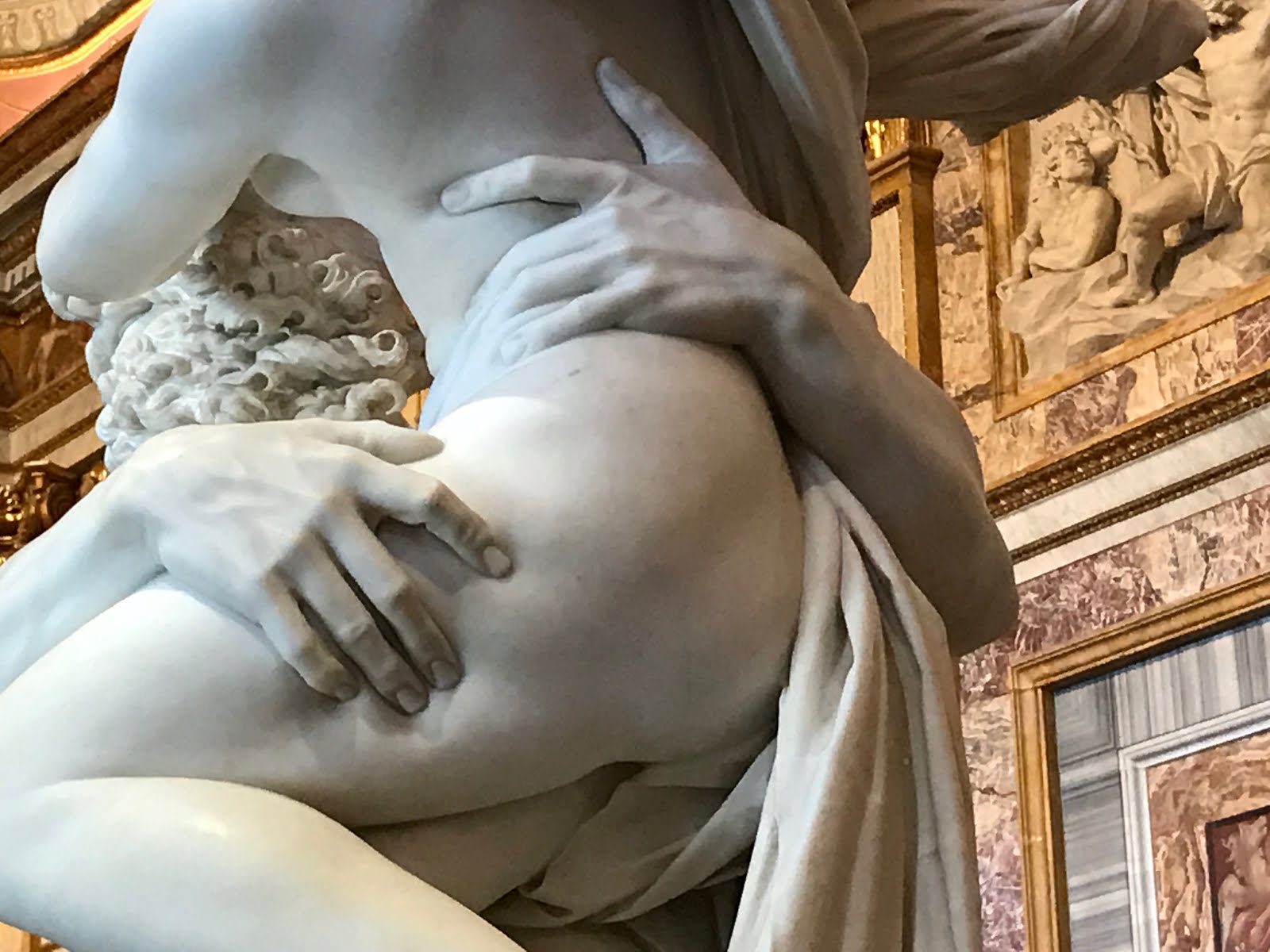
After the Embassy I paid a visit to the Borghese Museum.  This was a real treat, the Borghese park itself is wonderful and the museum in the Borghese Palace is a treasure.  A few Caravaggio’s and a few Bernini sculptures and assorted miscellaneous items in a wonderfully over the top ornate palace.  I was particularly impressed at how Bernini could make a marble statue look so lifelike - the flesh looks so soft.

Bernini's Sculpture

Marble made to look like flesh


On the way back to the hotel I was accosted by a man in a car who said he knows me, he had been to the US and after I said I live in Sacramento, he had been to Sacramento, his brother has a restaurant there called Tony’s.  I can’t imagine what scam he was trying to pull but he wanted me to get in his car.  I bade  him farewell.


In the late afternoon I took the train to the airport and my flight to Tashkent for the next part of my trip.

Many more photos are here.