Monday, April 19, 2021

Portland - April 2021

In mid April, Mary Ann and I decided to take a trip to Portland, Oregon.  Rather than fly we took the train.  While a flight is less than 2 hrs and costs around $300 for two, a sleeper on the train takes some 16 hours and costs over $900.  So it is not for the economy of time or money that one takes the train, it is for the experience of train travel and the scenery that you can see on the way.

We boarded the train in Sacramento around midnight on Wednesday night.  We had what Amtrak calls a Roomette - basically a small two person compartment with face to face seating in the day that converts to an upper and a lower bunk for sleeping at night.  As it was night we climbed into our bunks as the train moved slowly north from Sacramento to Chico and Redding.  As the sun came up we were in the Sacramento River Canyon near Dunsmuir passing through the Shasta Trinity National Forest.  Shortly thereafter we had splendid views of Mt Shasta over to the east.  


Mt Shasta and Shastina

After breakfast in the Dining Car (in these Covid times there was no cooking going on, just microwaved prepared food) we stopped in Klamath Falls and had a chance to stretch our legs and get some fresh air outside.  The next stop was in Chemult and after that we had a beautiful stretch of country as we moved down the Willamette valley to Eugene.  We lost over 4000 ft from Chemult at 4700ft down to Eugene at 430 ft.  It was particularly scenic alongside Lookout Point Lake which is a long skinny reservoir on the damned Willamette River.


Lookout Point Lake

After Eugene the countryside was not so exciting - just a flat plain of agricultural land through Albany, Salem and on into Portland.  We arrived in Portland around 4:30 Thursday afternoon.  It was warm and sunny.  Perhaps not quite the typical weather one expects of Portland.


The Benson Hotel

We walked up to our hotel, the Benson, and checked in before going out to explore the city.  The hotel is named after Simon Benson, a local businessman and philanthropist who made his money out of the lumber industry at the end of the 19th Century.  He gave his name to the hotel and to the Benson Bubbler, a type of water fountain found around Portland, and to the Benson Seagoing Raft, a huge seagoing log barge used to move lumber from Oregon down to Southern California. 


A Benson Bubbler

Portland is a nice city but there are not any major sights in the tourist sense.  We visited Powell’s Books (a city block of books that must be one of the best bookstores in the world); we walked along the banks of the Willamette River with great views of Mt Hood in the distance; we admired the Portland Building, a fine Michael Graves post-modern building with an impressive statue of Portlandia clinging to its side.


The Portland Building

Finding food in this foodie city was not easy in this time of Covid.  Limited indoor seating and a lot of closed restaurants.  We had to settle for a hamburger and fries -  albeit a fine hamburger and fries.  Similarly the next morning finding a decent cup of coffee was not easy and I had to settle for Starbucks.  Don’t think ill of me.


Multnomah Falls

We picked up a rental car Friday morning and we headed out of town along the Columbia River gorge.  The gorge itself is quite spectacular and the river here is impressively large.  We stopped at Multnomah Falls and took a hike up to the top of the falls and then a short way up the trail beyond the falls.  It is certainly beautiful countryside - lots of streams, lots of waterfalls, and very nice trails.


Above Multnomah Falls

Back at the car we drove further up the Columbia Gorge past the Bonneville Locks and Dam, the Bridge of the Gods (spanning the Columbia River), the old Cascade Locks and on to the town of Hood River (where the Hood River joins the Columbia River.   Hood River has a really nice feel to it.  It was a beautiful afternoon and we enjoyed walking through the small downtown area.


Mt Hood from the Hood River Valley

We turned up the Hood River valley towards Mt Hood.  The valley here is the home to many apple orchards and the apple trees were in blossom.  With the apple trees in blossom and Mount Hood in the background it was a wonderful sight.
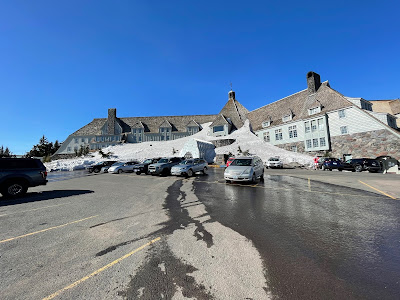

Timberline Lodge

We wanted to visit the Timberline Lodge, the WPA built lodge on the side of Mt Hood that was the location for the film - The Shining.  We got as far as the parking lot but the lodge was closed because of Covid restrictions so we didn’t get to see its splendid interior.  The lodge was above snow level but the ski resort there was also closed. 


Mt Hood from Timberline Lodge

Timberline lodge was the start of the Hood to Coast Run which I took part in a couple of times in 2003 and 2004.  It is a 12 person relay for 200 miles from Mt Hood to the coast at Astoria.  The first time I did the race I took the first leg, straight downhill from the lodge to the main road 6 miles below.  I remember it was my fastest ever 6 miles but the constant downhill did a number on my quads for the rest of the weekend.  I would not do such a thing so aggressively these days.


Driving back into Portland we paid a visit to Mt Tabor.  This is a hill that is an extinct cinder cone on the east side of the Willamette River that is a popular park and a great place to watch the sun going down over the city of Portland below.  


The Bust of York

There was once a statue of one Harvey Scott in Mt Tabor Park.  Mr Scott was the owner and editor of The Oregonian newspaper.  His statue, by Gutzon Bordlum of Mt Rushmore fame, was torn down by protesters during the BLM protests in 2020 (along with the statues of Jefferson, Lincoln and Teddy Roosevelt in the same year).  A bust of York, the slave of William Clark, of Lewis and Clark fame, and the first African American to have crossed the USA to reach the Pacific was secretly installed on the site sometime in 2021.  The bust is quite impressive and I am sure it will be a permanent installation on the site.


Again in this time of Covid we found it difficult to find a place for dinner in Portland.  We did however stumble across the Tabor Tavern which had outdoor seating and pretty fine food.


Shattered Glass and Paint outside Starbucks

Driving back into Portland we left our car near the car rental office and walked back to our hotel.  On the way we came across the rear of a protest march, fortunately moving away from us.  We then saw the damage done by the protesters - broken windows, paint spilled on the pavement, graffiti spray painted on the buildings.  The scary thing was that some of the windows showed signs of bullet holes - that is not your everyday protest march.  In Portland they have a very organized group of protesters - they are all uniformed in black T shirts, they have pre-arranged meeting points and routes through the city.  The random and indiscriminate property damage does not seem to work in their favor however.


Portland Museum of Art

Next morning, Saturday, we had tickets for the Art Museum.  The walk up to the Museum passed many fine art deco buildings but no artisanal coffee shops that were open (Starbucks again).  Portland is certainly a beautiful city.  The Museum was nice but didn’t really have anything spectacular, in my humble opinion.  


Voodoo Doughnuts

After the art museum we walked down to the river and walked along the riverfront to the Saturday Market.  Apparently, Portland is famous for its Saturday Market and this Saturday was the first day it had been held since Covid.  There was the chance of interesting people watching but nothing else was too interesting to me - lots of jewelry stalls, T shirt stalls, and of course CBD oil vendors.  Portland has a reputation for doughnuts and one of the more well known establishments is Voodoo Doughnuts.  The line outside the store was long enough to deter us from wanting to try them out.


Who is Missing?

Back at our hotel we just had enough time to look at the display of historic photos in the hotel’s staircase before leaving for our train.  The staircase from the 13th floor down to the ground has photos of Portland history and famous hotel residents.  Many presidents have stayed there - at least FDR through Obama and the current President.  Missing thankfully was Mr Trump. 


The Coast Starlight

We boarded our train for Sacramento around 2:00 pm.  There was a problem with the lift bridge over the river that delayed our departure by an hour but we made that up over night and arrived in Sacramento on time at 6:00 am.


We were lucky on our “roomette” assignments on the right side (odd numbers) going up to Portland, and on the left side (even numbers) going down to Sacramento.  Most of the good scenery was on our side of the train.


Tuesday, April 06, 2021

San Francisco - April 2021

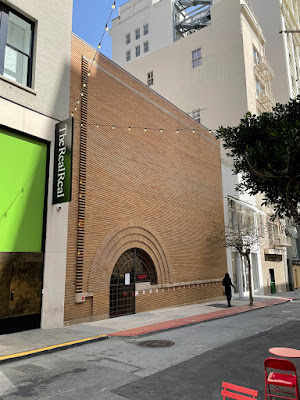
 In the first weekend of April 2021, Mary Ann and myself, went down to San Francisco for a quick post Covid lockdown getaway.  We drove down to our hotel, the Petite Auberge on Bush Street  near Union Square, parked the car and set off to explore on foot.  We had booked a 2:30 entry into the De Young Museum so that was our ultimate destination.  On the way we walked over to Union Square and down Maiden Lane to see the Frank Lloyd Wright building there, the V.C. Morris Gift Shop.  Unfortunately the building was closed so we could not see the interior which apparently is impressive and it was a prototype for the curving staircase in his later Guggenheim Museum in New York.  

Frank Lloyd Wright's Maiden Lane building

Walking the streets of San Francisco that Sunday afternoon we immediately noticed a two things; one that the streets were not at all busy - where there would normally be throngs of tourists, today there were hardly any; the other that lots of businesses were closed - with all the tourists staying away and with many office workers working from home it has been difficult for many businesses to stay alive and one wonders how many will reopen when this pandemic is over.  In some ways that made it nice to be around when there weren’t many people, but then on the other hand it was quite sad to see what a toll the pandemic had taken in the city.


We walked in the general direction of the De Young and went through the Tenderloin District.  At the best of times this is a pretty sketchy area but right now it looked particularly bad.  There are just so many people having a hard time these days and they are accumulating on the streets, particularly in the Tenderloin.  It was almost a third world-ish scene plus there was plenty of evidence of drug usage too - culminating in one guy injecting himself, between the toes, in an alleyway off the main street in the middle of the day.  It was not a comfortable walk.


We grabbed a bite to eat at one of the few places open, Max’s Opera Cafe.  It was a mediocre lunch in a place where I had previously had decent food.  We then Ubered over to the Golden Gate Park and the De Young.  The park was more crowded with people out and about enjoying the fine Spring afternoon.  People were wearing masks too.  That message had obviously gotten across to everyone.  I can’t say the same has happened in Sacramento.


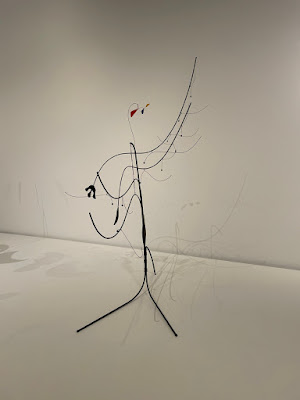
The exhibit at the De Young was a combination Picasso and Alexander Calder exhibit.  I had only been aware of Calder as a maker of intricate mobiles but he was much more - a painter and a sculpture and a talented bender of wire.  I liked the wire sculptures the best - from lengths of wire he formed shapes that were so expressive.  Viewed from different angles and with carefully lighted projections of their shadows on the gallery walls they took on remarkable form.  Picasso, of course, dabbled in everything, including sculptures and mobiles and his work is always enjoyable.


Calder Mobile

Calder Sculpture

Picasso - Portrait of a Young Girl

After the main exhibit we went into an AI exhibit that should have been more interesting to me, but I think by then I had had my fill of gallery viewing.


From the gallery we walked back towards the hotel through Golden Gate Park and then down onto Market Street before getting an Uber back to the hotel.  At the hotel wine and cheese were awaiting.  For dinner in the evening, we got take out food (paella) and ate it in our hotel room - that’s a common way to do it these days.


In the morning after breakfast we set off to view some of the more obscure highlights of the city.

Isadora Duncan birthplace

We started with the building where Isadora Duncan, the dancer, was born.  A plaque commemorates the place and an alley has been named after her. 

The Bohemian Club

Then it was on to the Bohemian Club, the boys club for the wealthy and the powerful of this world.  A nice enough building with nothing to identify it as explicitly the Bohemian Club.  There is a plaque on the outside with a line from Shakespeare’s Midsummer Night’s Dream - “weaving spiders come not here”, implying that concerns from the outside should not be brought inside the building.  


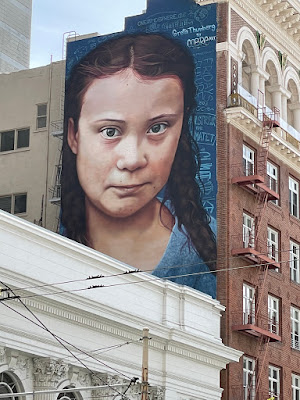
Greta T.

On the way over to our next location there was a mural of Greta Thunberg.  Not a very flattering mural but nonetheless there she is on the side of a building in San Francisco near Union Square.  She has certainly made an impact on all of us.


450 Sutter Street Entry

450 Sutter Street

Next was a quick look at the building at 450 Sutter Street.  This is a high rise building (26 floors) designed by Timothy Pflueger.  Its exterior is impressive but not the most impressive you will find in the city but the entry doors and the interior lobby are extravagantly wonderful.  I guess the style is known as Neo-Mayan Art Deco.  We were ushered into a lift and so off we went up a few floors but these upper floors are just unremarkable medical offices, it's the main lobby that makes it well worth the visit.


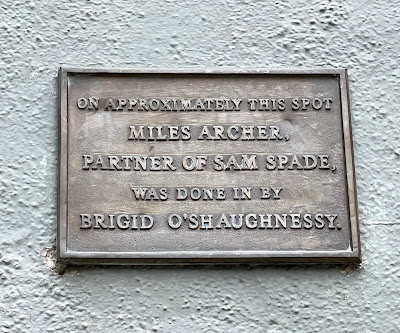
Maltese Falcon Plaque

A few blocks away in a small alleyway called Burrit Street is a small plaque commemorating a fictional murder.  In Dashiell Hammett’s Maltese Falcon, Brigid O'Shaughnessy “did in” Sam Spade at this location.  It is a pretty seedy location and one could well imagine that sort of thing happening.


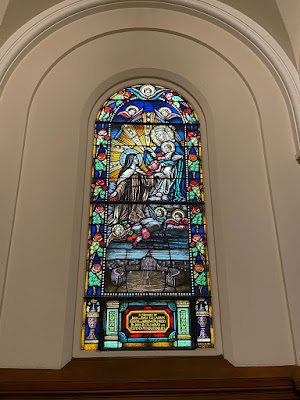
Eglise Notre Dame des Victoires


Eglise Notre Dame des Victoires

We next stepped inside a nice little Catholic Church further down Bush Street - the Eglise Notre Dame des Victoires.  A lovely church with some beautiful stained glass windows.  The church was built by French Catholics in the late 1800’s, it was destroyed in the earthquake of 1906 and then rebuilt.  It still offers French language services.


The Corporate Goddesses


On California Street on the top of a high rise building designed by Phillip Johnson are a series of sinister draped figures.  The artist that created them called them “Corporate Goddesses” but they look more like grim reapers.

The City Club/Stock Exchange

At the City Club Building in what was once the Pacific Stock Exchange we tried to get in to see the first mural painted by Diego Rivera in the USA.  Alas we were not allowed in.  We will have to make an appointment to view it the next time.


We then walked over to the Ferry Building stopping at Blue Bottle Coffee, a mecca for coffee enthusiasts, on the way.  We found the Ferry Building and the nearby Embarcadero Center to be almost deserted.  What typically is a very busy tourist and workplace location is now very different.  Many businesses are simply closed either temporarily or perhaps even permanently and there were relatively few people around.  


Amazon Go Store

There was one of the new Amazon Go stores around so we tried that out.  You check in with your smartphone app and then just wander around picking up whatever you need.  There is no check out but as you leave you are billed for whatever you pick up.  The ceiling of the store has an array of cameras that are tracking your every move through the store and identifying whatever you pick up or replace.  It is not done by bar codes or anything like that but perhaps by shelf location and some product packaging recognition.  Is this the future?  I don’t know but it was a fun experience.


Dennis Sullivan Memorial

Back at our hotel to pick up our car we noticed a plaque on the building across the road.  It was a memorial to Dennis Sullivan who was the Chief of the San Francisco Fire Department at the time of the 1906 earthquake.  He and his wife were in bed at the time of the earthquake and they were buried in the rubble as buildings around them fell.  As if that weren’t enough, poor Dennis was also badly scalded by a broken radiator that continued to pour out steam and hot water after the quake.  He later passed away some 4 days later.  This took place at a firehouse further down Bush Street but the memorial is here, across from the Petite Auberge in what also looks like an old firehouse.


Standard Gas Station

In the car now, we drove over to Van Ness to see the one and only Standard Gas Station in California.  This gas station is in almost every way a Chevron station but the signage shows Standard.  It is maintained as such so that Chevron can have an active trademark of the Standard name.  Standard Oil being the name of Rockefeller’s monopolist company that once controlled 90% of the US oil supply and that was divided up in 1911 by the U.S. Supreme Court.


Rincon Annex Post Office

Rincon Mural

After an abortive attempt to find the Defenestration Building which sadly has been demolished we moved on to the Rincon Post Office.  This is a beautiful Streamline Moderne building once occupied by the U.S. Post Office.  While the exterior is wonderful what is inside is even more wonderful.  The building houses some 27 murals painted by a Russian artist, Anton Refregier, who won a contest to paint the murals sponsored by the US Government.  The murals were controversial in that some of them portrayed events that some did not like to be reminded of (like labor unrest) and it was even discussed that they should be completely removed or destroyed.  Fortunately they have survived and the most beautiful of post offices is now on the National Register of Historic Places.


Rincon Mural

Interior Rincon Post Office Annex


Tuesday, March 30, 2021

Death Valley - March 2021

At the end of March Mary Ann and I decided to go on a road trip to Death Valley together.  March/April is the best time to visit the park as it is not too cold and not too hot and since it was also my 70th birthday weekend it made sense to get out of town to avoid the rapturous celebrations that would no doubt be taking place.  I also wanted to do a final trip in my Land Cruiser before selling it and Death Valley would be a great place to exercise it for the last time.


Mono Lake and the White Mountains

On Saturday morning (20 March 2021) we set off in the damp and the rain and made our way up I-80 to Tahoe and out to Spooner Summit and down to highway 395 into Nevada.  By the time we had reached the Lake the bad weather was behind us and we had fine weather for the rest of the day.  We drove down 395 through Bridgeport, past Mono Lake, which was looking spectacular, and on to Mammoth Lakes.  At Mammoth we turned east on Benton Crossing Road and headed over to our overnight stop in Benton Hot Springs.  Benton Hot Springs is an interesting place.  It is just a few old buildings, now mostly deserted and derelict but it has a hotel and we had a room there for the night.  It was the quirkiest hotel I have stayed in for a while.  We had the cowboy room with a wonderful mural above the bed and all sorts of cowboy and Native American artifacts in the room.  


Benton Hot Springs Hotel

The hotel has several hot pools around the property and the hot water for the hotel and the underfloor heating all comes from the hot springs.  They actually have to cool down the water in a tank for the hotel’s cold water supply.  That evening we dined al fresco on the patio of the hotel and soaked in the hot tub behind our room.

Benton Hot Springs

The next morning we set off towards the northern entrance to Death Valley.  We gassed up in Dyer and then entered the park via Eureka Valley.  A couple of burritos strategically placed on the engine before we left our hotel provided us with a nice warm breakfast on our way into the Eureka Valley.

Eureka Dunes

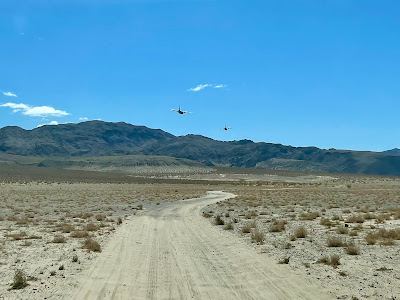
The Eureka Dunes at the southern end of Eureka Valley are quite tall and impressive - significantly larger than any of the other dunes in the park.  From the Dunes we headed up towards Dedeckera Canyon and Steelhead Pass.  As we passed by the south side of the dunes we were startled by a pair of C-130 Transport planes flying low, very low, over the road.  The Air Force uses the valleys around Death Valley for its low altitude flight training.

Low Altitude Flight Training

Dedeckera Canyon has a few tricky spots on its ascent to Steelhead Pass but the Land Cruiser handled them perfectly.  On the way down the other (south) side of the pass there is a strange installation - up an unmarked side canyon, a bath tub sunk in the ground and filled with blue marbles.  Who put that there and why they did it, no one knows.  It’s just one of the things that makes Death Valley so interesting.

Blue Marble Bath

Heading down the trail into the Saline Valley we came across a hiker.  I first thought he was wearing a too short pair of shorts, but no, as we got nearer we found that he was not wearing any shorts at all - just a T shirt and a pair of hiking boots, nothing else.  Death Valley attracts the strangest of people.

Saline Valley Hot Springs

We set up camp for the evening at the Upper Saline Valley Hot Springs.  There were quite a few folks there already so we found a more secluded spot to pitch our tent.  We didn’t go into the hot springs as they seemed to be quite busy and there were way too many naked old men around.  Instead we dined on a fine meal of Spaghetti Bolognese and retired to the tent.  In the night I was awoken by a burro walking by the tent - he didn't come in.  There are quite a few burros around in the valley.  They were left there by the miners and they have been quite successful in their breeding.  The park has a plan to remove them as they are considered non-native invasives.

Fine Dining in Saline Valley

The next morning we packed up and prepared to drive south down the Saline Valley.  Before we left camp we had a fun discussion and education on the ways of Hot Spring Life from Denis, a colorful and very chatty character who puttered around the springs on his motorbike.


Denis and his motorbike

The road south is a washboard road that is not much fun to drive on but the valley is beautiful in a Death Valley barren and extreme kind of way.  We passed the site of an old tramway that was built in 1911 and operated until 1930, that transported salt gathered from the valley floor up and over into the Owens Valley where it was shipped further afield.  Very little remains of the tramway now, just a few old towers out in the salt flats, but what an impressive operation that must have been.


Lippincott Pass down to Saline Valley

At the foot of Lippincott pass we dined on another engine warmed burrito before making the ascent up the pass and over into the next valley, Racetrack Valley.  In the bottom of this valley is a playa, the Racetrack, that displays a strange and unique phenomenon.  There are several fairly large rocks that show tracks of their movement across the playa.  The tracks of the stones are many yards long and for a long time no one knew how they were created.  However, scientists have recently discovered it was a combination of ice, followed by the melting of the ice at a time of very strong winds with of course a very flat playa.

Moving Rocks on the Playa

At the northern end of the valley is Tea Kettle Junction.  A place where people adorn the road sign with various tea kettles.  Judging by the messages on them it looks like they are mostly recent additions.  Perhaps the Parks Service removes them periodically and people slowly replace them.

Tea Kettle Junction

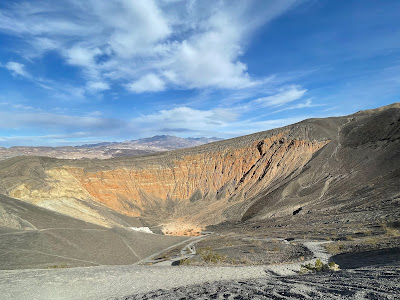
It was then more of the washboard road up to Ubehebe Crater.  This is a magnificent volcanic crater created by an eruption of steam (a phreatic crater) and it is nearly ½ mile wide and some 700 ft deep.  The date of the eruption is not clear but it may be quite recent - 700 to 2000 years ago.

Ubehebe Crater

From Ubehebe we joined the tarmac road through the valley so we aired up and sped along through Furnace Creek and out towards Death Valley Junction.  On the way we stopped at Zabriskie Point to view the beautiful erosional landscape there.  It was close to sunset and the place was quite busy with everyone snapping a photo of the great light conditions at that time of day.

Zabriskie Point
We stayed the night at the Amargosa Opera House Hotel in Death Valley Junction.  This is quite an interesting place.  It was originally the accommodations for executives and investors associated with the local borax mining operations.  When the industry failed in the 1940’s it fell into disrepair until a Marta Becket, a Broadway performer and ballerina, happened to see it and decided to buy it.  She decorated it with her murals (she was a talented artist), opened it as a hotel and began performing there in the associated meeting room now called the Opera House regardless of whether she had an audience or not.  Her last performance was in 2012.

The Amargosa Opera House Hotel

The hotel is struggling now and it is quite run down.  Death Valley Junction is a long way from Death Valley itself and there is nothing else in the town.  A non-profit is trying to keep the hotel alive but it needs a lot of upkeep and some serious renovation money to make it viable.  That being said we enjoyed our stay in this most quirky of hotels.  Sadly because of Covid the Opera House itself was closed so we could not see the murals that Marta painted in there.


The Amargosa Opera House

Our next day we headed north from Death Valley Junction up towards Beatty.  Beatty is an old mining town and it is the largest population center on the east side of Death Valley.  It has a few hotels, a couple of casinos, gas stations but surprisingly no grocery store.  I don’t think there are many fresh vegetables eaten in Beatty.  After gassing up, we headed west and entered Titus Canyon.  I had been to Titus Canyon a couple of times before, most notably to run the Death Valley Marathon in 2008, and I always enjoy it.  The views at the head of the canyon are spectacular and the canyon itself is wonderful as it narrows down before emptying out into Death Valley itself.

Titus Canyon

After we got out of Titus Canyon we drove south through Furnace Creek, stopping briefly at the Devil’s Golf Course to see the weird wind driven salt formations, and Badwater the lowest spot in the USA at 282 ft below sea level.  Then it was down to the southern end of Death Valley and up Warm Springs Canyon to Butte Valley.  The wind was really blowing hard and the views at the southern end of the valley were obliterated with blowing sand.  We got out to air down the tires at the start of Warm Springs Canyon and got abraded with fine sand.  Not an environment you want to be outside in for too long.

Blowing Sand in Death Valley


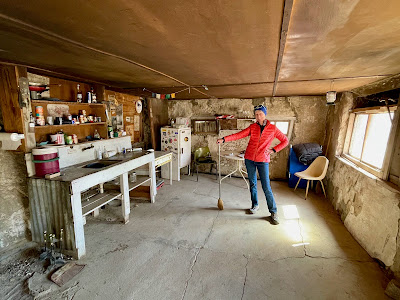
We stopped to examine a couple of mining operations on the way up Warm Springs Road, some perhaps quite recent, and then climbed over the pass into Butte Valley.  Butte Valley is named after the striped rock butte that sticks up in the middle of the valley.  I had hoped to stay that night at the Geologist’s Cabin that overlooks the valley but someone had already taken up residence there so we moved on.  A short distance away is Stella’s Cabin and we stayed there.  There are several of these cabins around the more remote spots in the Valley.  Usually old miner’s cabins that have been retrieved from total deterioration by fellow off roaders.  The idea being that they are made available on a first come first served basis with an understanding that you try and leave the place a little better than you found it.  Stella’s Cabin had a wood stove and a good supply of wood, a table and sink for cooking, an old refrigerator (not functioning) for non perishable food storage and most of its windows were still intact.  It provided a great shelter from the winds that night.  The tent would not have been a good place.


Stella's Cabin

The next morning was beautiful and calm and we dallied a long time over breakfast admiring the views over Butte Valley.   Mary Ann did a wonderful job of sweeping out the cabin making it look a lot better and we left some food in the refrigerator for any subsequent visitors.  The road from the cabin then went over Mengel Pass and dropped down into Goler Canyon.


Stella's Cabin

Goler Canyon is the home of Barker Ranch, a one time ranch house that was first a miner’s cabin and then the retreat for a family, the Barkers, from Oklahoma.  It is now more famous for being the place where Charles Manson was arrested back in 1969.   Alas the once impressive looking ranch house burned down in 2009 and it is now only a shell.

The remains of Barker Ranch

Surprisingly there was quite a lot of water down the lower part of Goler Canyon and it was nice to see some green trees and bushes for a change.  On the way down the canyon we saw several burros wandering around and then a couple of big horned sheep.  The latter were quite spectacular and didn’t seem too perturbed by our presence.

Bighorn Sheep

The canyon empties into the lower end of the Panamint Valley and from there we drove north to Ballarat.  There’s not much happening in Ballarat, though the store/trading post there has been cleaned up a little and the owner now sells a few trinkets and T-shirts.  The truck belonging to Tex Watson (of Charles Manson gang fame) with the stars painted on the interior roof of the cab is still sitting there.

Tex Watson's Truck in Ballarat

Traveling further north in the Panamint Valley we took the side road to Wildrose Canyon to see the charcoal kilns there.  They are quite beautiful structures - 10 of them all lined up in a row - and they are very well preserved.

Wildrose Charcoal Kilns

That was the end of our Death Valley adventure and we drove out of the park that evening through Panamint Springs up and over to highway 395 where we stayed the night in the very fine Trails Motel in Lone Pine.  That evening we had our first meal inside a restaurant in over a year.  It wasn’t a particularly good meal but it was nice to sit inside a restaurant for a change.  The seating was limited and the waitress at least had her mask over her mouth, but sadly not over her nose.


The next day we awoke to a magnificent view from our hotel room over to the High Sierras (room no 5 at the Trails has the best view).  The entire trip has been one great view after another and this one was surely one of the more remarkable.  One of those peaks up there was Whitney, the highest point in the lower 48.  We also awoke to the smell of patchouli blowing in the wind.  The owner of the hotel, an Indian gentleman, was burning a clump of joss sticks outside his office - a nice touch.


The High Sierras behind the Alabama Hills near Lone Pine

Driving north we skipped the Lone Pine Movie Museum, and the Manzanar Internment Camp and landed in Bishop at Schatt’s Bakery where we bought bread, sandwiches for lunch and had our breakfast outside the bakery.  The bakery does an incredible trade even in these Covid days.  The staff all looked over worked and over stressed however - perhaps it is not a great place to work.


Driving north on 385 I was hoping to get into the ghost town of Bodie.  I have been there lots of times and it never fails to amaze me, and Mary Ann had never been so she needed to see it.  The main road to Bodie was closed but I had hoped the southerly entrance from the north side of Mono Lake would be open.  Alas they were working on the road and it was closed off.  Plan B was to then try and find the miner’s cabin at Bass Camp so we set off into the hills to the east of Mono Lake.  We bounced along for a while and Mary Ann had a taste of off road driving but Bass Camp was too far away so we abandoned that idea and turned back towards Mono Lake.  We did see a lot of wild horses in this section so we did get to complete the trifecta of large Nevadan mammals on this trip - the burro, the bighorn sheep, and the wild horse.

.

Wild Horses

We stayed this last night of our trip in Bridgeport where it was snowing.  Poor old Bridgeport was struggling through the Covid pandemic.  Most things were closed and when we walked out in the evening the only place open was the convenience store at the gas station.   With the snow coming down it looked quite bleak.


Next morning we had one more attempt to get into Bodie, this time from the northern route but after climbing a good way up into the Bodie Hills and getting quite close to the town we decided to turn back.  The snow was getting quite deep and there were no tracks going further up the road.  We didn’t want to finish our trip by being marooned in the snow outside Bodie.


Snow in the Bodie Hills

The drive up 395 to highway 50 was uneventful apart from a Bald Eagle sighting as we climbed up to Spooner Summit.  We were home just after 2;00pm.  Another great trip and the Land Cruiser performed wonderfully.   Should I really sell it now?

There are more photos here.