On the last day of October, Mary Ann and I flew from San Francisco to Mexico City. This was my fourth trip to this incredible city, Mary Ann's first. We stayed at the Gran Hotel Ciudad de Mexico on the Zocalo - a fine old hotel that I had stayed in before. The best thing about the hotel is that in its previous life it was a department store and it has the most amazing stained glass ceiling and the most beautiful art nouveau elevators. The building is a work of art in itself.
 |
| The beautiful ceiling of the Gran Hotel |
Being October 31, the Dias de los Muertos celebrations were in full swing in the city and they were to continue until November 2. The Zocalo square was thronged with costumed people and there were all manner of weird and wonderful decorations. We were a bit apprehensive about the crowds in these Covid days but we were pleasantly surprised to find everyone masked. Unless you were eating or drinking everyone we came across was masked - both inside and out.
 |
| Crowded Streets with everyone masked |
In our first evening there, we walked around the old town taking in all the Day of the Dead decorations and watching all the costumed people. We walked around the Zocalo, the Cathedral, Francisco Madero Street (a pedestrian street), the Palacio Bellas Artes, the Torre Latino-Americano, the blue tiled Casa de Azuelas. We had a beer in the Casa Azuelas which is now a Sanbornes store and restaurant. There is a beautiful Orozco mural in there above the stairs (just outside the banos).
 |
| Orozco Mural in Casa de Azuelos |
 |
| Mystery Meat at Victoria's Tacos |
For dinner we had street tacos at Victoria's Tacos on Calle de Tacuba. They were incredibly cheap and incredibly good. Afterwards, I bought a pan de muertos to satisfy my sweet cravings.
 |
The Zocalo at night from the Terraza
|
Before retiring for the night we had margaritas on the roof top terrace of the hotel overlooking the festivities in the square below.
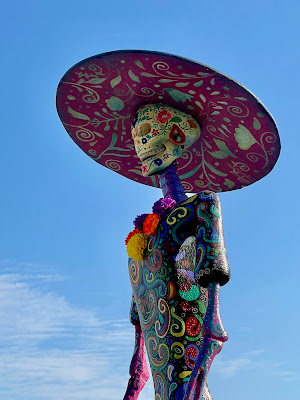 |
| Day of the Dead Figures on the Zocalo |
The next morning was sunny and clear and we walked around the now less crowded Zocalo examining the Day of the Dead statues and sculptures.
 |
| The very fine and very popular El Cardinal |
We had breakfast at El Cardinal, a very popular breakfast spot, where I sampled their famous chocolate drink - very rich and creamy and sweet but a great way to start the day.
 |
The Cathedral on the Zocalo
|
 |
| Interior of the Cathedral |
We then went over to the Cathedral and spent some time looking around inside. It is a wonderfully extravagant church and though I have been inside many times before it never fails to amaze me. Unfortunately they have stopped offering tours of the bell tower and roof top which was a great thing to do. Instead we went on a tour of the crypts below ground. Not as impressive as the bell tower but interesting all the same.
Many of the museums were closed on Mondays and many, like the Palacio National and the Templo Major Aztec site, were closed all the time because of Covid concerns.
 |
| The Palacio de Bellas Artes |
We walked again out towards the Palacio de Bellas Artes which also was closed (but just for the day). There was a camp of indigenous people (I think) outside Bellas Artes protesting some awful violent crimes that had occurred. The posters were all a bit gruesome.
 |
| The Angel of Independence |
We walked further on towards Paseo de la Reforma which is one of the major thoroughfares in the city. On La Reforma it is an entirely different city - modern buildings, fewer tourists, more expensive cars. We walked all the way down to the Angel of Independence, which is the monument to commemorate the independence from Spain (built by Porfirio Diaz in 1910).
We dined on more tacos for a late lunch before heading back to our hotel. Since we were quite a way away from the hotel we took our first trip on the Metro. What an efficient and cheap means of transport that is. It was only 5 pesos (25c US) for a trip. The trains are clean and safe, they arrive every few minutes and they move a lot of people - a great system.
Back at the hotel we again took a walk around the Zocalo to marvel at the Day of the Dead celebrations once more before retiring to the hotel terrace for beers and guacamole.
 |
| Sand Art |
On Tuesday morning we again went for a walk around the Zocalo. Tuesday being the 2nd of November was the official Day of the Dead and the celebrations would be over after the evening. We finally got a chance to walk around the fenced off area where there were many elaborate colorful sand patterns laid out on the floor - like some large scale Tibetan Mandala.
 |
| Dancing and Drumming in the Zocalo |
There was an area over by the Templo Major where the local indigenous people congregate and chant, sing, drum and dance. We watched their most interesting dances and drumming for quite some time.
We then went inside the smaller chapel to the east of the Cathedral to look at the interior. Whilst not as impressive as the cathedral it was still pretty amazing.
 |
| The Waitress Nun |
For breakfast we went over to the Cafe Tacuba - a wonderful restaurant that has been around for a long time (since 1912 actually). Since it was day of the dead half of the waitresses were in costume dressed as nuns. The coffee lechero was particularly good. To top breakfast off a mariachi band came around to entertain us.
 |
| Breakfast Mariachi Band at Cafe Tacuba |
After breakfast we tried again to get into the Palacio de Bellas Artes but it was still closed so we set off to visit the Frida Kahlo Museum. This entailed a metro ride to the Viveros station and a walk through the Coyoacan district to the house once occupied by Frida. Alas once there we discovered that all tickets should be bought on-line and that there are no tickets available until the next week after we would have left Mexico.
We moved on to the center of Coyoacan itself and wandered around the market and square. We visited yet another church and in the market we both bought small pieces of art. The artist was a guy who looked about our age who turned out to be an American born draft dodger from the 60's who still lived away in Mexico.
 |
| On the Ixtapalapa Cable Bus |
I then wanted to go to the new Ixtapalapa Cable Car system which I had read about in the New York Times. Mary Ann was not so interested so I slipped off to Ixtapalapa while she went back to the Centro Historico. Ixtapalapa is at the end of one of the Metro lines and they have recently added a Cable Car system to take people further out into the more mountainous parts of the city. What an excellent non-disruptive and relatively low cost way of moving people around. For a relatively cheap price (7 pesos) I got a 6.5 mile trip out to the end of the system. Once there I just turned around and came back down again.
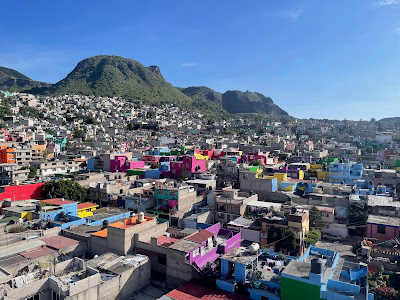 |
| Colorful Houses heading up the hills |
The houses and buildings are quite colorful and there are many murals that have been painted to beautify the once poor, dangerous and crime ridden neighborhood. The arrival of the cable car, or cable bus as they call it, has done a huge amount to benefit the area.
 |
| Lucha Libre Wrestling |
That evening we had tickets to go to the Lucha Libre event at the Arena Mexico. Lucha Libre is Mexican Wrestling that is choreographed and scripted so that it looks like they are inflicting great pain on each other when in actual fact they are doing nothing of the sort. The wrestlers wear colorful full face masks. I would never entertain watching wrestling in America but the Mexican version is so over the top that it is a wonder to behold.
After the event we caught the Metro to the hotel. Now Day of the Dead was over and the square was being swept clean.
 |
| The Sun Temple, Teotihuacan |
On the next day, Wednesday, we visited the Aztec pyramid site of Teotihuacan. We caught the Metro to the Northern Bus Station and then caught a bus out to the pyramids. We arrived early and it was quite quiet but soon the site was inundated with people. Because of Covid they were not allowing anyone to climb up the pyramids of the Sun and Moon - too many people on top at the same time - and the Museum unfortunately was also closed. Nevertheless it is an impressive site and it was well worth the trip.
 |
| The Moon Temple, Teotihuacan |
 |
| Man at the Crossroads by Diego Rivera |
We caught the bus back to the city and finally, this being a non-holiday, we got to visit the interior of the Palacio de Bellas Artes. The building itself is a wonder with a spectacular exterior and a beautiful art deco interior, but the real treasures are the murals. There are works by Rivera, Siqueiros, Tamayo and Orozco. All of them quite wonderful but the gem for me is the Rivera mural, Man at the Crossroads. It was originally commissioned for the Rockefeller Center in New York but Mr. Rockefeller didn't like it's left wing leanings so he had it destroyed. Diego recreated it here in Mexico City.
 |
| The Palacio Postal |
The adjacent Post Office building was also open now so we got to look inside at the wonderful metalwork. I should really call it the Palacio Postal as it really is a palace. A most wonderful building.
In the evening we splurged on a nice dinner at La Casa de las Sirenas - a nice balcony table overlooking the back of the Cathedral.
On Thursday morning we needed to take our Covid tests for reentry into the USA. There were a few hiccups with one code number not working (fortunately I had another I had purchased for my next UK trip) but in the end all turned out fine and we were pronounced fit to travel.
We then walked some of the interesting streets to the east of the Zocalo. We visited a church or two along the way. There are churches everywhere in Mexico. One of them had an interesting modern art exhibit. As well as a modern sculpture it had an interesting sonic installation - hums, buzzes and clicks from a turntable playing on a tablet. Interesting in such a large empty old church space.
 |
| Diego Rivera Murals at the Secretariat of Education |
We were anxious to see more Rivera murals and since the Palacio National murals were closed to the public, we walked over to the Secretariat of Public Education building where there is a most impressive collection of his murals. There are some 235 panels that he painted here between 1923 and 1928 depicting all aspects of Mexican life and history. It is truly an amazing place and I had not heard or seen this place before. What a treat.
 |
| Frida and Diego's House in San Angel |
Since we couldn't get tickets to visit the Frida Kahlo Museum we decided to go to Frida and Diego's house which is also a museum. The house is in San Angel which required a Metro ride and a walk up the hill to the house. It is an interesting and colorful building in itself - designed by Diego's friend Juan O'Gorman.
 |
| Inside Diego and Frida's House |
The contents are some of the weird modern artifacts that belonged to Diego and Frida along with part of Diego's collection of ancient Mexican native pottery and statues (he apparently collected a lot of historical artifacts). It is well worth a visit and it was nice to see a different part of the city.
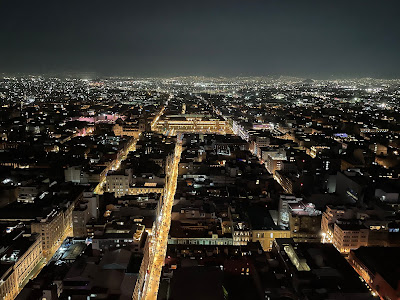 |
| View towards the Zocalo from the Torre LatinoAmericano |
 |
| View of Palacio de Bellas Artes at night |
Back in the old town again we walked down to the Bellas Artes which was all lit up in the evening light. Then we went up the Torre LatinoAmericana to get a view of the city from above. The observation deck is on top, on the 44th floor and it provides a great view of this vast city stretching out in the distance to the far hills.
Dinner that night was a late one at our favorite Cafe Tacuba.
 |
| Cafe La Habana |
 |
| Plaque in the Cafe la Habana |
On Friday morning, our last one in Mexico City, we walked east on Republica de Uruguay (and Victoria and then Morelos) to the Cafe La Habana. This is an older coffee shop where Fidel Castro and Che Guevara used to meet when they were plotting the invasion of Cuba. Octavio Paz and Gabriel Garcia Marquez also used to hang out there. It is a great coffee shop with wonderful cafe lecheros and, not to be overlooked, cream filled pan de muertos.
 |
| Museo Diego Rivera Mural |
From the coffee shop it was a short walk to the Museo Mural Diego Rivera. This is the museum housing Diego's mural "Dream of a Sunday Afternoon in the Alameda Central". The mural was originally in the Hotel del Prado but that building was seriously damaged in the 1985 earthquake. It is a terrific mural with all sorts of characters from Mexico's history displayed in one huge grouping.
We then went back to the hotel to check out and make our way by taxi to the central bus station (TAPO). There we bought tickets for the next bus to Puebla. The buses run quite frequently and they are quite luxurious. Bus travel in Mexico is way different to the same in the UK or USA.
We climbed out of the Mexico City basin and dropped down towards Puebla about 80 miles away. On the way we got our first glimpses of the perfect cone shape of the volcano Popocatepetl.
There was a young man on the bus who befriended Mary Ann and he helped us get a taxi from the bus station to our hotel, The Purificadora. It was a nice enough hotel but it tried a little too hard to be modern and trendy. The bad smells from the sewer in our room didn't help in our appreciation of the hotel.
 |
| Cathedral de Puebla |
That night we walked around the old part of town. There is a nice Zocalo square with an impressive cathedral. It started to rain, the first we have had in Mexico. At the end of the evening we went to a fine restaurant, El Mural de los Poblanos. Since Puebla is known for chocolate mole sauces, I had the mole pork - very nice.
 |
| Cathedral, Puebla |
On Saturday morning we went out early to explore Puebla. There is a history of ornamental tile production in Puebla and as a result there were many fine buildings decorated with colored tile. We walked up to the Zocalo and then went inside the cathedral. As expected this was quite impressive on the inside. Thank you to the Catholic Church for making so many wonderful things for this heathen to look at. That doesn't excuse them from the many terrible things they have done over the years but I am seriously impressed with their churches.
 |
| Biblioteca Palafoxiana |
 |
| Old Anatomy text in Biblioteca Palafoxiana |
We also visited an old library, the Biblioteca Palafoxiana. This is an impressive collection of old books that was initiated by the bishop of Puebla, Juan de Palafox y Mendoza, in 1646. The woodwork in the library was amazing and I always find the smell of the old books quite distinctive and not at all unpleasant to me. The oldest book in the library is dated 1493.
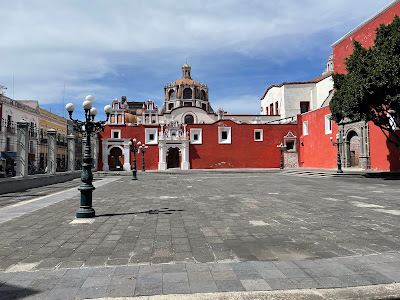 |
| Chapel of the Rosary |
 |
| Chapel of the Rosary |
 |
| Chapel of the Rosary |
Walking further on through quite crowded streets of Puebla we came to the Chapel of the Rosary. This fairly nondescript church from the outside reveals inside one of the most amazing chapels you could imagine. It was described back in the 17th century as being the 8th Wonder of the World and that is not much of an overstatement. It is a truly over the top chapel - ornamented and gilded from ceiling to floor.
 |
| The Railway Museum |
A little ways out of town there is the Museo Nacional de los Ferrocarriles Mexicanos (Railway Museum). I always like such things as this and Mary Ann was indulgent of me. We walked around the 5 or 6 steam engines they had on display and climbed on the footplate of a couple. There was some nice rolling stock too - a Presidential Coach and a Postal Sorting Coach.
 |
| The Uriarte Talavera Pottery |
 |
| Artists painting pottery |
On the way back into town from the railway museum we came across a beautifully tiled building. It turned out to be the Uriarte Talavera pottery. Talavera Pottery is type of pottery that originated in Spain but has become associated with the Puebla area because of the presence of high quality clays in the region. The tiles and crockery from the pottery are quite beautiful and they are seen all over the area, even on the fine buildings like the Casa de Azuelos in Mexico City. We wandered around the pottery for some time, apparently reaching places we were not supposed to visit until someone came along and escorted us out. We almost bought a few pieces but then decided against it.
 |
| The Serdan House, Museum of the Revolution |
Our next stop was the Museum of the Revolution. This is a house not far from the Zocalo which is recognized as the place where the Mexican Revolution started. This is the revolution against Porfirio Diaz in 1910. In 1910 it was the home of the Serdan brothers who were agitating against the continued presidency of Porfirio Diaz. They had secreted a store of arms in the house and when the police learned of this they decided to attack the house. In the ensuing battle, many on bothe sides were killed including one of the Serdan Brothers. The revolution did not immediately catch fire after this encounter but it is recognized as the first conflict of the revolution. The museum was most informative and for once there was English language information.
 |
| The bullet riddled wall inside the Serdan House |
We moved on next to some retail therapy. We had admired some tiled mirrors and pottery earlier in the day and we set about to negotiate a deal. We ended up purchasing two mirrors and one piece of pottery for what we though was a good price. Since the shop owner was quite happy with the transaction we likely didn't get too much of a deal.
In the evening we had another fine meal. This time at the Hotel Casareyna where we shared a mole sauce sampler. Four different mole sauces of increasing strength. Each one being quite different and each one quite wonderful.
On Sunday we had the morning in Puebla before our bus to Mexico City and our flight home. We decided to go to the nearby town of Cholula where there is the ruin of the largest pyramid by volume in the world today. We arranged for an Uber and drove the short distance over to Cholula. Unfortunately Sunday was also the day of the Puebla Marathon which runs from Puebla to Cholula and back. As we got near to Cholula all roads were closed for the marathon and we could not get anywhere close. We aborted the mission and headed back to Puebla. It was a bit of a shame but since both of us have run many road races ourselves it only is appropriate that we, ourselves, should have some inconvenience.
We checked out of the hotel and took a taxi to the very modern Paseo Destino bus station for our bus to the airport. The bus (Estrella Roja) was even more luxurious than the prior one - so comfortable, so clean. Bus travel in Mexico was certainly a surprise to me. There was a modern terminal, security checks, a waiting room, seat assignments, baggage check in, and above all on time departures.
 |
| Popocatapetl |
The bus trip to the city was uneventful. A few miles out of Puebla, we had great views of Popocatepetl and its sister volcano Iztaccihuatl.
The trip home was similarly uneventful and we arrived safely around midnight after a tiring drive back from San Francisco.