At the end of April I made a trip to Japan. The trip was instigated by my friends Peter and Lisa from London, who were planning a trip to Japan and asked me to tag along. Lisa is Japanese and grew up there and Peter, an Aussie, has visited there many, many times. They would be able to provide a great introduction to Japan, a country I was always a little intimidated to travel to. Since the trip was in two halves - the first half with Peter and Lisa and the second with me out on my own, I will describe it in two separate posts.
I left the USA from LAX (the prices were so much better out of LA compared to SF) on Sunday 23 April. It was a direct flight on United, operated by All Nippon Airway, to Tokyo Narita. I landed in Tokyo around 3:00 in the afternoon. Customs and Immigration were pretty quick and easy and all I had to do then was transfer to another terminal for my onward flight to Osaka.
I landed in Osaka’s Itami airport late in the evening and then I had to get to Kyoto where I was in the same hotel as Peter and Lisa. That was easier to achieve than I expected. The tourist information lady at the airport pointed me to the bus stand where I bought a ticket from a machine and the bus took me straight to Kyoto - about a 1 hour trip. Everyone was so helpful and everything seemed so straightforward.
From Kyoto;s Train Station I caught a taxi to the hotel, the Toyoka Inn. Toyoko Inns are a chain of hotels in Japan referred to as business hotels. They are uniform and simple, have western style beds and bathrooms and are relatively inexpensive. I was more than a little tired when I got there so it was straight to bed for me.
Of course with jet lag I was awake early so I went out for a walk. It was already light and a little after 6:00 so I expected to see things coming to life. That was not the case. Very few people were out and the coffee shops, of which there were many, didn’t seem to open until 9:00 or later. The only place that was open was a 24hr McDonalds and I didn't want that to be my introduction to Japan.
 |
| Shrine near Maruyama Park, Kyoto |
I walked down the main street outside the hotel and crossed the Kamo river. The road continued on to a temple and garden area called Maruyama Park. The park was quite beautifully manicured. I sat on a rock by a pond for a while and a beautiful blue heron came and sat right by me - quite unperturbed by my presence.
 |
| Heron in Maruyama Park, Kyoto |
On the walk back there was another temple area - the Kodak-ji temple. Two temples before breakfast - Kyoto is, after all, the city of temples.
At the hotel, breakfast was included. However it was Japanese style and not my usual fare - rice, miso soup, salad, cold eggs, bread, no jam and very weak coffee. I got used to this fare after a few days but at first I was craving for more sweet stuff.
After breakfast we did a short subway ride to Kyoto Station where we converted my Japan Rail pass certificate into a usable pass and got seat reservations for all the major trains that I had planned for my visit. The assistant was so patient and helpful. For each leg of my journey she provided me with multiple options and then gave me a seat reservation for the train of my choice. I was so impressed by the patience and helpfulness of the people there.
I also bought a travel card - an ICOCA card - that would allow me to pay for travel on buses and subways throughout the country. Tapping the card is so much easier than playing around with real money or my own credit cards.
 |
| The Ainkakuji or Silver Temple, Kyoto |
From Kyoto Station we took a bus to one of the more impressive temples - Ainkakuji Temple. It is nicknamed the Silver Temple, but it never achieved its silver status; it is just a plain wooden temple. The gardens were beautiful and there was a nice rock/sand garden - carefully and perfectly manicured.
Leaving the Ainkakuji Temple we set off on what is called the Philosopher’s Path - a footpath alongside a small canal for 2 or 3 km. We ambled along stopping and looking at various temples and shrines along the way.
 |
| Nyakuoji Jinja Shrine |
We entered the grounds of the Nyakuoji jinja shrine. I soon realized that Kyoto was going to be one temple after another, one shrine after another and I wasn't even sure of what was the difference between a shrine and a temple. Maybe the words are interchangeable.
 |
| Monks at Eikando Zenrinji Temple |
At another temple, the Eikando Zenrinji temple I believe, there was some kind of ceremony going on and I sat at the back of one of the temples watching. The monks had very elaborate costumes and some very strange golden hats.
 |
| Aqueduct |
 |
| Giant Torri on the way to Heian Shrine |
We had a late lunch in a noodle shop before moving on to the Heian Shrine. This shrine had a massive torii over the main road at the entrance to the shrine (a torii is a large gate, typically at the entrance to a Shinto shrine).
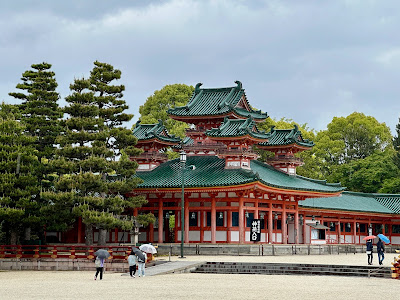 |
| Heian Shrine |
All day the rain had been on and off making it not the best of walks and by this time my feet were gettin quite soggy.
 |
| Too many umbrellas |
At the Kyomizu-dera temple complex the crowds got quite large. When the rain came it made moving around with everyone’s umbrellas up a little tricky.
 |
| Kyomizu-dera Temple |
This complex was perhaps the best shrine/temple of the day and of course that meant it was crowded. It is an entirely wooden structure and it is built on a hillside. Some impressively large lumber was supporting the structure.
 |
| Kimonos in the street |
Kimono rental among the Japanese is quite popular - both for men as well as women. This day wasn’t the best weather for wearing a kimono but despite the rain there were a lot of them around. All vying for the perfect kimono picture in front of a temple in the rain.
This was our last stop of the day and I felt like I had seen so many temples that I could no longer distinguish them. Kumiko was not feeling well so we called it a day and took a taxi back to the hotel.
In the evening, Peter, Lisa and I dined adjacent to the hotel, Kumiko was still feeling a little under the weather. I forget precisely what the meal was, some sort of barbecue, but I do know there were some obscure parts of a chicken involved.
 |
| The most beautiful Shinkansen Train |
The next day, Peter, Kumiko and I set off on our little hiking expedition. Lisa, with her bad hips, stayed back in Kyoto visiting friends. We took the train from Kyoto to Nagoya. My first ride on a Shinkansen high speed train. What an impressive rail system they have in Japan. The Shinkansen trains themselves are things of great beauty - sleek and slender. They are very fast, run precisely to schedule and are spotlessly clean.
 |
| Pointing to ensure attention while driving |
In Nagoya we changed to a local (non-Shinkansen) train to Matsumoto. We had the first row of seats behind the driver and could see how he worked. Japanese train drivers have a system of pointing to make sure they are awake and cognizant of what they are doing. They deliberately point at various items along the way. I don’t know if they are monitored by cameras that require this activity but it certainly looks like a good system for making sure the drivers are attentive.
 |
| The best Udon Noodles, Matsumoto |
In Matsumoto it was raining quite hard. Peter knew of a good noodle place for lunch so we took a taxi to the restaurant and had a great lunch - Udon noodles.
 |
| Matsumoto Castle |
After lunch we walked, in the rain, to Matsumoto Castle. I didn’t know they had castles in Japan and I wasn’t sure what to expect but what a wonderful thing they are. Matsumoto Castle is 6 stories high with each story being smaller in area - like a pyramid. We entered inside and made the climb up the many flights of stairs - narrow and steep - to the top where we had a nice view of the city below. They were/are masters of wooden construction.
After the castle we had a coffee break and then caught another local train to Shiojiri which was going to be our base for the next few days. In Shiojiri we stumbled around looking for our hotel, the Asahi Kan, before finally finding it in a quiet street off the main area. It was a very quiet hotel and it felt like we were the only guests in the entire property. During our entire stay we only saw a couple of other people.
In the evening Peter had organized a rather epic meal at the hotel. The hotel really didn’t have a restaurant but you could book ahead for this rather elaborate meal. It turned out to be 8 courses.
An appetizer of squid, pork belly and fried shrimp
A broth with fish paste and asparagus
Sashimi
A small dish of mushrooms, potato, rice and peas
Wagyu beef and vegetables cooked at the table
A small pickle salad dish
Rice, seaweed and hot broth
Mochi ice cream dessert
 |
| Wagyu Beef |
It was my first time eating Wagyu beef. It was extremely fatty or marbled as they say. It’s texture was unlike any steak I had eaten before. You didn’t have to chew it much it almost dissolved in your mouth. I am not sure I am a great fan of it.
 |
| One of the ubiquitous 7-11 Stores |
The next morning Peter and I walked down the street to the 7-11 store for breakfast. The 7-11 stores are everywhere and they sell everything you might need. What is more, they are open 24 hrs a day. They have a coffee machine that dispenses a quite reasonable latte. There are ATMs where you can get cash on your US bank card. The whole shopping experience there is good - the assistant scans your purchases, a machine displays the cost, you insert your money into the machine and it automatically dispenses your change.
 |
| The 7-11 Cash Register |
This was the first day of our hike on the Nakasendo Trail. The Nakasendo Trail is an ancient trail through the mountains and hills from Kyoto to Tokyo, some 330 miles long. We were doing three different sections, each day coming back to our hotel in Shiojiri at night.
 |
| Torri and Shrine in Yabuhara |
We caught a local train from Shiojiri to Yabuhara, a small village on the trail to start our first day’s walk.
There was a shrine and temple complex on the outskirts of town with a nice torii that we spent some time exploring, then the trail headed uphill into the woods. There was a short cobbled section of trail but mostly it was a nice dirt trail.
 |
| Peter pointing out the snow on Mt Ontake |
There was snow to be seen on the higher peaks, particularly Mt Ontake.
 |
| Monuments in a shrine adjacent to the trail |
The trail passed through a nice shrine complex with beautiful old grave markers. In the adjacent Maruyama Park there was a memorial to Basho’s haikus. I was unaware of Basho but he lived in the late 1600’s and was the master of the haiku.
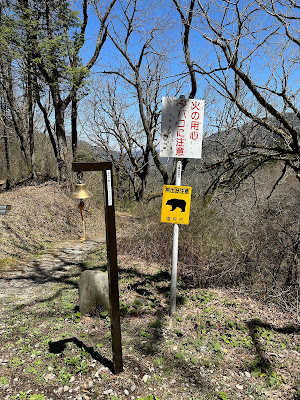 |
| Bear Bell |
Along the way, we came across several Bear Bells. These were bells attached to posts with instructions to ring them to scare away any bears on the trail. There were probably enough people on the trail to make the bells unnecessary but they were fun to ring anyway. We continued to climb up until we reached the Torii Pass at 1197m (3927 ft) and then we headed down to the town of Narai-juku.
 |
| Narai-juku |
Narai is a beautiful old town with a lot of older wooden homes. There were still some cherry blossoms out in these higher towns which made things even more beautiful. We visited yet another shrine and paid our respects. One of the old houses was preserved as a museum depicting what life in these older homes might have been like. I was surprised to find it quite a large home with many rooms, each very sparsely decorated.
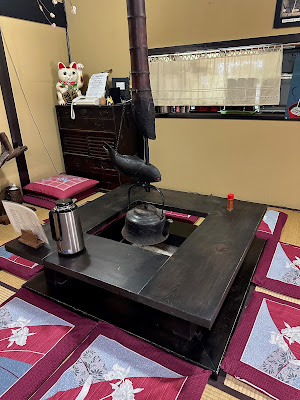 |
| Fish Kettle |
We had Soba for lunch in a small restaurant in Narai. There was a kettle over a fire. Attached to the chain supporting the kettle was a model of a fish. This was something we saw again later on. I do not know what the significance of the fish is.
 |
| 200 Buddhas - Narai-juku |
At the far end of town there was a shrine area with 200 small Buddha statues.
 |
| Wooden Bridge - Narai-juku |
In the center of town there was a fine arched wooden bridge over the river.
 |
| One of the many Drink Vending Machines |
While waiting for the train back to Shiojiri I indulged in a can of hot coffee from one of the ubiquitous vending machines. The Japanese are the masters of the vending machine. Most have a hot section for coffee and an ice cold section for water and soft drinks. They are everywhere.
In the evening Mariko stayed in the hotel while Peter and I ate down the road from the hotel. Sashimi and salad - not the best meal but quite adequate.
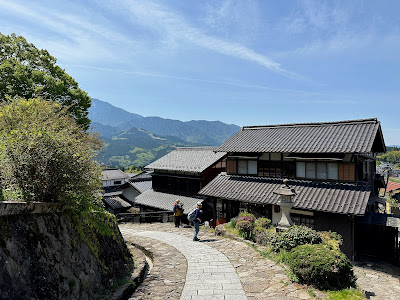 |
| Magone |
The next day, after breakfast, we took the train to Nakatsugaura where we then caught the bus to Magone, another old town on the Nakasendo Trail. Magone is quite the manicured and well preserved old town and there were a lot of tourist shops along the way. There were also a lot of tourists and schoolchildren too. It was quite busy.
 |
| Schoolchildren - 2 x 2 |
We headed up through the town into the woods up the hill. This was the start of Golden Week when many Japanese take a holiday. We were not the only people on the trail. We were passed by several groups of schoolchildren. Walking in twos in a relatively orderly fashion up the trail - everyone was very well behaved.
 |
| Magone Pass |
We passed through several small settlements as we wound our way up the hill until we reached the top at Magone Pass at 790m (2600 ft).
 |
| Nice Wooded Trail on the way down |
The trail then wound down the hill and as we descended we met the schoolchildren coming back up the hill looking a lot more tired and disheveled and now no longer walking in twos.
 |
| Another Fish Kettle |
We stopped at a tea house for a cup of green tea and a rest. Again here we saw the kettle over a fire with a fish on the chain.
 |
| Tsumago-juku |
We got talking to a girl from Sydney, Australia - Lamice. She walked with us for the rest of the hike into the town of Tsumago-juku, the end of our hike for the day. Tsumago-juku was another nice small old village with some lovely old wooden houses. I tried something called geicho mochi. Geicho mochi is another mochi concoction that looks like something savory but really was mildly sweet. Japanese food is so deceptive.
 |
| Geicho Mochi |
We then took the bus from Tsumago-juku to Nagiso and then the train from there to Shiojiri.
In the evening Peter and I explored around Shiojiri. There was an interesting industrial area with some impressive old buildings. A chemical company apparently.
 |
| Shiojiri's Chemical Plant |
The next morning we again had breakfast from the 7-11 store. Their coffee is quite reasonable and they do have sweet options like raisin rolls which, of course, is my normal breakfast food. I was also growing to like the onigiris in the 7-11s. These are rice wrapped in seaweed with some sort of fish filling (tuna was my favorite).
 |
| A 7-11 Onigiri |
We then took the train to Kisu Fukushima, another town on the trail. Today we were going to stay within the confines of Kisu Fukushima as there were enough interesting places there to keep us busy.
 |
| Cakes in Kisu Fukushima |
We walked through the town, stopping at a bakery for some sweet cakes. Then it was across the river to a museum dedicated to the history of the local festival celebrations in the town. Some sort of dueling between rival teams of men carrying huge wooden carriages was al I got out of it.
We then stopped for a coffee at a small coffee shop and strangely enough a guitar museum. Not really a museum, just a room with a dozen or so acoustic guitars on the wall. I tried to play one but I think the Japanese fretboards are too thin for my fat European fingers.
I tried an interesting looking green matcha mochi cake. They do a lot of things with mochi in Japan and I was getting a taste for it. In this case not so much of a taste for the matcha though,
We continued on to the Takaseke Museum. This museum was on the site of an old customs house back in the day when this was one of the control points for people traveling the trail. The lady who guided us around the museum was a descendant of the old inhabitants of the customs house. She was also related to a famous Japanese author, Toson Shimazaki. I later ordered a book by Toson on the history and his life in this area. One day I will read it.
 |
| The Museum Guide Script |
The museum guide had an exercise book with a handwritten script for a tour of the museum and she read from the script while taking us around the two or three rooms of this quite small museum. It was actually quite interesting and entertaining.
We then went next door to another museum, the Sekisho Museum. This was a more formal museum but alas there were no English explanations so I didn’t get as much out of it. We did, however, get a photo of ourselves with silly Japanese hats on.
 |
| Nice Hats |
We crossed over to the other side of the river and up the hill to the Kosenji temple. This was a beautiful temple complex with a most exquisite rock garden. That looks like the ultimate low maintenance garden, if you can prevent the weeds from growing.
 |
| The Kosenji Temple Rock Garden |
There was one museum/gallery type building open to the public that had some beautiful handicrafts - lacquerware, paintings, carvings, etc.
We walked on through a large graveyard to the next temple, the Chofuku-ji temple where the most notable thing was a massive bell mounted in a small tower.
 |
| Chofuku-ji Bell |
Returning into town we stopped at a saki factory for a saki tasting. I had previously not been able to distinguish one saki from another, but tasting 6 of them one after the other made me realize there is a wide range of flavors from sweet to dry, just like wine.
We climbed back up the hill to the station and waited for the next train which took us to Kiso Hirosawa. This Kiso Hirasawa is famous for its lacquerware and I was looking for a wedding present for my friends Dave and Carol. I wasn’t too optimistic about finding something appropriate and small enough to fit in my already full luggage but I actually did pick out some beautiful lacquerware cups and some beautiful lacquered chopsticks. The careful boxing and wrapping of these items was a wonder to behold. The wrapping was so perfect and precisely done.
 |
| Lacquerware in Kiso Hirosawa |
With the purchase made we went back to the station and caught the train to Shiojiri.
The next morning, Sunday, was a little damp. It had been raining hard throughout the night and in the morning it was still raining though not quite as hard. We had breakfast at 7-11 and then checked out of our hotel and took our bags to a storage locker in the station.
 |
| Hiraide dwellings |
Then we set off to find Hiraide, an archaeological site where a pre-historic settlement had been discovered. It was a bit of a damp walk but we eventually found it and spent a few hours looking at the primitive housing - mud walls, reed roofs and dirt floors. There were examples of homes from the Heian, Kofun, and Jomon periods.
 |
| Hiraide dwellings |
We walked up the hill to the associated museum. This mainly contained old pottery artifacts that had been unearthed at the site. Without English explanations it was a little difficult to get a lot out of it, other than the fact that they had pottery skills. The elongated kiln outside the museum was however quite interesting - stretching up a gentle slope - fired at the lower end with a vent at the top end.
Back in Shiojiri we walked to the city hall where there was an old steam engine mounted for display.
Then it was a stop at a nice French bakery for some treats for lunch before going on to the station for the train back to Kyoto via Nagoya.
 |
| Steam Engine - Shiojiri |
In the evening we had a western style meal of salad and pizza. A nice change from all the noodles and fish.
The next day, Monday 1 May, we went to visit the temple complex at Nara (different to Narai where we visited a few days earlier). This required a train from Kyoto station. The Nara train was in the station as we arrived but it was absolutely packed with passengers. Just like all the videos of people being squashed into Japanese subway trains except it was a surface train. We decided to wait for the next train.
 |
| We will wait for the next train |
Then we somehow got on the wrong train, but fortunately it was in the right direction. We got off the train in Joyo and changed to the correct train sometime later.
 |
| Deer in Nara |
In Nara we walked up the busy tourist filled streets to the Kofuku-ji temple. In the parks around the temple the deer are somewhat sacred and they are allowed to wander freely around the streets, and parks where they are petted and fed by the tourists. The area smelled of deer urine and excrement and, if you ask me, was a little unsanitary in such a spotlessly clean country as Japan.
 |
| Kofuku-Ji Temple |
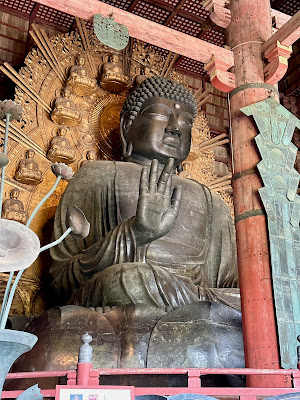
The Kofuku-ji temple is the home of an immense 50 ft bronze Buddha - Todai-ji - the largest in the world completed in 751. This statue is seriously impressive - a massive bronze casting that is etched in fine detail. This was perhaps the most impressive thing I saw in Japan and I saw some pretty impressive things.
 |
| The Toda-ji Buddha |
After walking around the Buddha and taking too many photographs we wandered up to another temple, Shunjo-do. Here there was a massive bell - another amazing piece of metal casting. There were lots of school kids touring the area. They all seem so well behaved and didn’t mind posing for photos.
 |
| Schoolchildren posing beneath the bell |
We stopped for lunch at a restaurant near the railway station and had a nice bento box lunch. Then on the walk to the station I tried mochi covered fruit. It was quite expensive but looked so wonderful I had to try it.
 |
| Moshi Fruit |
We took the train back to Kyoto and the subway to the hotel and then explored the Nishiki market near the hotel. This street was full of shops, mainly selling food of all types. It was very busy and there were many wonderful things you could buy to eat. I did try Taco Balls, which were deep fried balls of chopped octopus in some sort of cream sauce. Not bad but not great either.
 |
| Fish on a Stick - Nishiki Market |
I did manage to find some Koiobori - the Boy’s Day Fish Flags - for my friend Howard. It took a bit of searching but I did find them. On the way back to the hotel we stopped into the Daimaru Department Store. The Department Store era is nearly over in the USA but here in Japan they still exist and they are wonders to behold. All manner of high end goods for sale and like everything in Japan it is all so well presented. Walking around this high end department store, the likes of which are disappearing or have already disappeared in the UK and the USA, was truly a cultural experience.
 |
| The elegant Daimaru Department Store |
That evening we dined at a nearby noodle shop and I had a great bowl of Nabeyaki Udon.
The next morning, Tuesday, we went to yet another temple, the Kinkakujicho-ji temple - otherwise known as the Golden Temple. To get there we caught a bus from outside the hotel and again the ICOCO card worked flawlessly - a quick tap of the card on the bus entry sensor and another when you exit and you are good to go.

The Golden Temple was the best one yet, it was so splendid on what was a nice blue sky day. It is a relatively modest temple who’s exterior is entirely covered in gold leaf. It sits near a lake with beautifully manicured gardens. The area was fairly busy and everyone walked around taking lots of pictures. You could not go inside the temple.

All the tourist shops were selling something gold leaf related. There was saki with flakes of gold leaf in the bottle and then matcha tea with gold leaf flakes. I tried a free sample of gold matcha tea - I doubt the gold affected the taste at all.
 |
| The Rock Garden at Ryoan-ji Temple |
We walked over to another temple next - the Ryoan-ji temple. This temple area had a really nice rock garden and some nice gardens too. We didn’t go into the temple.
We got the bus back to Kyoto Station and then got a train out to Fushimi Inari just a few stops outside Kyoto. Here there is yet another shrine - the Fushimi Inari-Taisha shrine. We were a little tired of shrines so we didn’t pay too much attention to it. However, what is remarkable about the area is that from the shrine there is a trail of literally thousands of toriis going all the way up to the top of Mount Inari. It is a 2.5 mile trail with approximately 10,000 toriis along the way.
 |
| The Toriis on the trail up Mount Inari |
It was quite busy but nevertheless it was a wonderful sight. To refresh ourselves on the way down the hill we tried a matcha ice cream wafer (matcha is not my favorite) and then near the bottom we had a butoman. A butoman was something Peter had been going on about all week. It is a steamed bread roll filled with pork - quite tasty.
 |
| The Toriis on the trail up Mount Inari |
Back in Kyoto I visited the Daimaru department store once again for a hat - I had left mine in a restaurant somewhere along the way. I also bought a present for Lisa, some Manuka Honey. I figured it was a Japanese thing since we were in Japan and had been talking about it. When I returned home I found it is originally honey from nectar of the Manuka tree which is indigenous to New Zealand. It is supposed to be very healthy and good for you, and, of course, it is quite expensive.
 |
| Shabu Shabu Dinner |
In the evening we went to dinner at a Shabu Shabu restaurant. Lots of meat and vegetables cooked at the table in our own bowls of broth over a gas stove on the table.
That was the end of my time in Japan with Peter and Lisa. The next morning it was an early rise for me and I left for my solo trip around Japan. Peter, Lisa and Kumiko headed to Tokyo and on their way to London. They had given me a great introduction to a wonderful country.
.