Tuesday, March 12, 2024

Florida - February 2024

In mid February, I made another trip to Florida to visit Diana in St Petersburg.  Springtime is usually pretty nice in Florida before the onslaught of the summer heat and humidity, however, this year it was unusually cool and on top of that there was wind and rain.  

I paid a couple of trips to the Pas-a-Grille beach while Diana was at work.  A nice long shell beach running north-south along the Gulf of Mexico.  For me the only reason to visit the beach is to swim, but while there were plenty of people there sunbathing and walking no one was in the water.  Except for me.  I made a point of going for a dip both times.  

The Don Cesar Hotel

The highlight of the Pas-a-Grille beach is the magnificent pink hotel, the Don Cesar.  Built in the mid 1920's and opened in 1928, the hotel is a  thing of great beauty among a sea of less than wonderful construction.  In its early days it was a playground for the rich and famous including F Scott Fitzgerald, Al Capone, Lou Gehrig and FDR.  It then fell into disuse until the Army bought it and converted it to a hospital in WWII.  It has undergone many restorations and now will cost you north of $500 for a room for the night.

Columbia Restaurant, Ybor City

Early in my stay we went out to dine at one of the local landmark restaurants, the Columbia in Ybor City.  The Columbia claims to be the oldest Spanish restaurant in the USA, being in operation since 1903.  The building exterior is quite beautiful and the interior is equally beautiful, provided you like colorful tile work.  The food was OK but not exceptional.
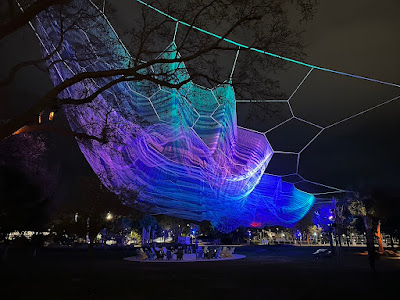
Bending Arc by Janet Echelman

Near the pier in St Petersburg is an art installation of netting strung from poles, the Bending Arc.  In the daytime it is nice but it really turns into something special when illuminated at night.

Sponge Boat in Tarpon Springs

When Diana started her days off and when the weather stopped raining, we drove up the coast to Tarpon Springs.  This is a coastal community that is the center of the sponge fishing industry.  Apparently the town was first populated by Greek immigrants that had experience in diving for sponges back in their homeland of Greece.  Sponge Diving and the Greek heritage are now a major part of the tourist industry of Tarpon Springs.  There are many Greek flags and many opportunities to eat Greek food.

The next day we headed south from St Petersburg to Sarasota.  Sarasota became the winter home of John Ringling, the circus magnate.  He built an impressive home and art museum there and they have now added a circus museum to the grounds.  Normally a circus museum would not be high on my list of things to visit and when I got inside and found out that the museum was primarily a model of a circus I was even less enthused.  However, it turned out to be really quite interesting and it opened my eyes to a form of early 20th century American entertainment that I was not particularly aware of.

Circus Advertising

Circuses were very popular in the late 1800's and early 1900's.  There wasn't a lot of entertainment in the pre-TV and pre-movie days and so circuses provided one of the only entertainment options available.  They became a major operation with three rings inside a huge tent.  Ringling and Barnum and Bailey grew into significant operations and they eventually merged into one company.  At it's height there were some 1500 employees traveling along with animals, acts and equipment.  They had a 60 carriage train that moved everything overnight into the next town where they would offload everything, feed everyone, including the animals, and perform a couple of shows before packing it all up and moving on to the next town where they repeated the whole process again.  What an amazing logistical exercise.

The model of the Ringling Brothers Circus

The model of the circus in the museum was the life's work of one Howard Tibbals.  It is a complete replica of the entire circus as it would appear in the 1920's. It is built to a 1/4in to 1 foot scale with the train, the big top, with three rings inside, all the animals, the performers, the audience, the canteen, everything.  I was totally surprised at how fascinating it was.

Human Cannonball

The other parts of the museum had less impressive exhibits - a canon for the human cannonball, Mr Ringling's private railcar, a steam organ, and a tightrope width rail to test your balance - I failed miserably.

Banyan Trees

The museum is in the same grounds as the Ringling House and the Art Museum.  There was a lake, a rose garden, the Ringling's family graves, and lots of wonderful Banyan trees with their many vertical limbs draping down to the ground where they take root and presumably provide stability and food to the tree.
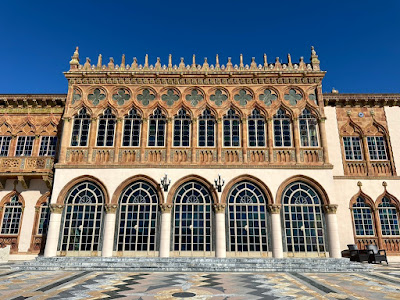

Ca d'Zan (rear facing the sea)

The Ringling mansion was designed and built in the 1920's.  It's design exhibits elements of the Italian Renaissance and Venetian Gothic architecture, both favorite styles of John Ringling.  It is referred to as  the Ca d'Zan, which apparently translates to the "House of John" in the Venetian dialect.  Ringling and his wife traveled extensively in Europe as did many wealthy Americans of that time.   They were quite wealthy and as they toured they purchased all manner of furnishings and art to decorate their new home, just like Citizen Kane and William Randolph Hearst.
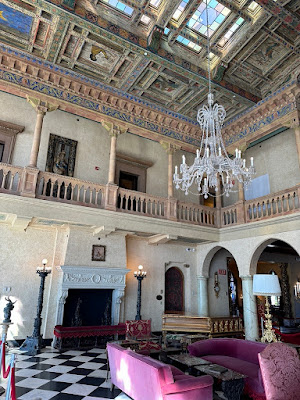
Interior of Ca d'Zan

The garden and the house are located on the edge of Sarasota Bay so it is a beautiful setting.  Sarasota became the circus's winter home when cold weather prevented circus shows in the northern states.  Life must have been quite nice there during the first half of the 20th century.  It is still pretty nice today, though the surrounding area is now built up with high rise condominiums.

The Ringling Museum of Art

Mr Ringling and his wife also built an art museum adjacent to the house and today this houses an impressive art collection.  Much of it was purchased by Mr Ringling but there have been many subsequent additions to the collection.  It is an impressive building enclosing a central quadrangle with lawns, trees, fountains and sculptures.

The Ringling Museum of Art

There was a nice combination of old pieces from Mr Ringling's collection (a couple of Canaletto's too) and modern pieces too.  A delightful art museum that is well worth a visit.
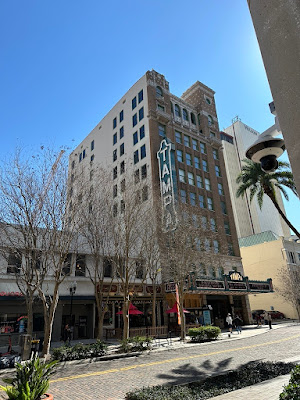
The Tampa Theatre

The following day we paid a visit to Tampa.  The first thing on our list was a tour of the Tampa Theatre.  This 1920's picture house is a wonderful example of what was then referred to as an atmospheric theatre, a theatre where the interior was so exotic and wonderful that a visit to the theatre would have been more than just watching a movie.  The theatre opened in 1926 and it was the first commercial building in Florida to offer air conditioning, another reason it would have been a great experience to pay a visit.  Apparently you could stay all afternoon or evening with the price of a single ticket.

Tampa Theatre Stage

We had signed up for the theatre tour.  The guide took us around all parts of the theatre (including back stage) and told us all the stories of what a wonderful experience it must have been to visit the theatre in its heyday.  

Above the Exit Door

Water Fountain

Ornamented edge of a row of seats

The decorations were quite elaborate and exotic but we were told that most of it was done at minimum cost.  Much of the ornamentation was simply painted plaster.  The tapestries were not woven but printed and some of the decorations were just made of papier mache.  Those responsible for the restoration had done an excellent job in recreating and preserving the building.

The Wurlitzer Organ

The tour finished off the tour with a recital on the Wurlitzer organ.  They cranked up the air pumps backstage and raised up the organ from below the stage and we had a little education on Wurlitzer theater organs.  Of course, no organ recital in USA could omit the old classic "Take me out to the ball game..." and ours was no exception.

The Hillsborough River, Tampa

After the theatre tour we walked down to the Hillsborough river and over to the west side and the grounds of the University of Tampa.  Walking along the river by the University was all very idyllic.  Students were lounging on the lawn or lying in hammocks.  Many females were sunbathing in bikinis.  All very distracting for the male students I am sure.

The Tampa Hotel and Plant Museum

The University occupies part of the old Tampa Bay Hotel.  This majestic old hotel was built in the late 1800's by the railroad and shipping magnate, Henry Plant.  The design of the hotel is quite exotic - there are towers, cupolas and minarets.  It certainly looks very distinctive among the remainder of modern buildings in the city.  

The Mens Reading Room, the Tampa Hotel

Part of the hotel, the part not occupied by the University, is now a museum, the Henry Plant Museum.  The museum depicts how fine the hotel was in its glory days.  It was one of the first all electric buildings in Florida.  There was electricity and telephones in all rooms and most rooms had private baths

During the Spanish American War many of the old veteran soldiers stayed in the hotel, including Teddy Roosevelt, and they used to relax on the veranda in rocking chairs while they were waiting for the action to begin (it took a while).  This gave the name "Rocking Chair War" to the conflict.

The Newman Cigar Factory

The next day we went back to Tampa again.  This time to tour the Cigar Factory in Ybor City.  During the late 1800's and early 1900's there were a lot of cigar factories in Tampa, particularly in the Ybor area.  The cigars in those days were all hand rolled mostly by Cuban immigrants.  However, today only one cigar factory survives, the J.C. Newman Cigar Factory.  

Cigar Manufacturing

We signed up for the tour and had a great education in the various processes of the cigar making business.  While initially the cigars would all be hand-rolled the process was automated in the mid-1900's.  The machines are still in use today but they are no longer being built.  With so many moving parts, I am sure it is a demanding process to keep them working continuously.  Interestingly, the machines were actually made by the AMF Company, the maker of 10 Pin Bowling machines.

Cigar Storage

We were shown through the basement where the cigars are aged, and where the raw tobacco is stored until it is ready to be processed. 

Stripping the tobacco leaf veins

Then we moved up to the main factory level where machines strip the veins from the tobacco leaves (by women who are called strippers), and where the cigar machines turn out a nice cigar every few seconds.  There are three components to the cigar - the filler which is smaller irregular pieces of tobacco leaf, the binder,  a paper and tobacco composite sheet that binds the filler together, and a wrapper leaf, a finer quality leaf that gives the cigar its smooth outer edge.

The Hand Rolling Room

We then went further upstairs to the hand rolling room.  Here there were around 10 workers rolling cigars by hand.   This once was a much larger room with literally hundreds of workers.  Now it is much reduced but there is still the stage present where a reader would be employed to read stories and news articles to the workers as the continued to roll cigars.

It was all very educational but I wasn't tempted to buy any cigars and take up the habit.  We left the cigar factory and walked over to the nearby La Segunda Bakery.  This is one of the old bakeries in the area that is well known for baking Cuban bread.  We had a fine Cuban sandwich and a Muffaletta sandwich for lunch.

Jose Marti Park

We then paid a visit to the Jose Marti Park.  This is a little plot of land in Ybor city that is owned by the people of Cuba.  It is the site of the house where Jose Marti, the Cuban National Hero was nursed back to health after being poisoned in 1892.  When the house was demolished in the 1950's the land was donated to the people of Cuba.  Until the Embassy in Washington opened in 2015 it was the only Cuban owned land in the USA.

Jose Marti Park

In the park, there is a map of Cuba and a statue of Marti and there are a lot of chickens and roosters wandering around, as there are in many places in Tampa.

Hindu Temple

Ornamentation on the Temple

A little ways out of town there is a modern new and quite large Hindu temple.  Since this is not typically what you find in an American city we went to have a look.  It was quite a beautiful temple with some wonderfully detailed ornamentation.  We couldn't go in but from the outside it was well worth the visit.

A piece of the Berlin Wall

On the next day, my last, we managed to squeeze in one more thing - a quick look at a section of the Berlin Wall in St Petersburg.  It stands outside an old station that is now a pottery and clay arts center.  Not the most dramatic of sights but still, a piece of history from a distant land and a bygone time.

Monday, November 27, 2023

Guatemala and Honduras - November 2023

In November I made a short one week trip to Guatemala.  It was relatively cheap and easy to travel there and I had always wanted to visit so with very little preparation other than a plane ticket and my first night's hotel booking, I ventured forth.  

The flight, United through Houston, was uneventful and I arrived in Guatemala City around 10 at night.  I had booked my first night in a hotel in Antigua and the hotel arranged a driver to pick me up at the airport and take me over to Antigua.  That way I avoided dealing with Guatemala City, which according to all the reports is a place to avoid at night.

The driver was waiting at the airport door as I exited and we had a relatively short (90 mins) drive over to Antigua.  It was dark of course so I couldn't really get a feel for the country we were traveling through.  It was near midnight when I checked into my hotel, the Posada del Angel.  The room was nice and despite the one pesky mosquito in the room, I had a good night's sleep.

Parque Central, Antigua

Antigua was once the capital of Guatemala.  It was founded in the 1543 and thrived as a cultural, educational and religious center.  However the city is surrounded by volcanoes and it is susceptible to earthquakes.  After many significant earthquakes in the 17th and early 18th centuries that nearly destroyed the city, it was decided in 1775 to move the capital to present day Guatemala City.  Antigua then went into a state of decline with a significantly smaller population.  Because it was more or less abandoned the city has many old buildings and churches and no new modern buildings.  The entire city is now a UNESCO site and its colonial past has been preserved quite well.  

Today it's economy is primarily tourism.  There are no new buildings, no high rise buildings and most of  the streets are cobbled.  The cobbles are fine and preserve the authentic look of the place but they are very difficult to walk on.  You need strong ankles and sturdy shoes. 

On my first morning, the hotel provided a lovely breakfast and I used the time to decide what to do and where to go.  One of the places I wanted to visit was Lake Atitlan, a lake in the mountains surrounded by volcanoes.  I arranged with the hotel manager to set me up with transportation to Panajacel on Lake Atitlan the next day.  I then set off to explore Antigua.  

Cathedral San Jose, Antigua

I walked down to the main square, the Parque Central or Plaza Major.  There is a beautiful old 16th century cathedral on the east side,the Cathedral San Jose.  It was partially damaged by one of the many earlier earthquakes and while it has been stabilised it has not been fully restored.  This is the case with many of the other old buildings and churches in Antigua. 

The National Museum of Art, Parque Central, Antigua

On the southern side of the square is the rather nice colonnade of the National Museum of Art.  I didn’t go into the gallery thinking that I would have time to do it later but alas, it was closed on my next chance on the following Monday.  

There were several ATMs and banks in the area and I needed to get some local money.  Alas my bank card failed in every one I tried.  I followed up with the bank later and they showed that it wasn’t refused one their side.  It must have been the Guatemalan Bank that was having issues with it.  What did work was using my credit card.  I was able to get 1,000 Quetzales, about $120, but the credit card rate was not the best.  The exchange rate for US $ notes was typically between 8 and 9 Quetzales to the $.

Colegio de la Compania de Jesus

A block away from the main square is the Colegio de la Compania de Jesus, a Jesuit college.  A wonderful structure that was also damaged by earthquakes.  It has a beautiful facade.

Arco de Santa Catalina, Antigua

On the street leading to the north out of the main square is the Arco de Santa Catalina,  an archway over the street that was built to allow nuns to travel from one side of the monastery to the other without having to interact with people.  It is the most photographed and most recognizable site of Antigua.  There’s something not right about so many tourists lining up to take selfies of themselves in front of the arch, particularly when they are provocatively dressed young tourists all posing and flashing the v sign.

Iglesia de la Merced, Antigua

Further along is Park Merced and the associated Iglesia de la Merced.  This is a beautiful yellow church with white ornamentations.  Possibly the most beautiful and undamaged church in Antigua.  

After more wandering around I stopped for a coffee at the Cafe Viejo, a nice old restaurant, bar, bakery that I returned to many times during my stay.  

I also wandered around the Artisan Market.  A complex of shops that were all selling the same tourist trinkets.  How on earth do they survive when dozens and dozens of them are all selling the same thing. 

On the way back to the hotel I stopped at a Travel Agency to enquirer about getting to the Mayan ruins in Copan, Honduras.  There are many travel agents around the town and they are well disposed to providing you with transport to any of the tourist sites.  I arranged for a trip to Copan for later in the week.  It would be a 6 or 7 hour bus journey with a 3:00 am pick up at the hotel.  

Convent de la Merced, Antigua

After a brief rest in the hotel, I walked back into town and visited the Convent de la Merced, right next to the yellow church, Iglesia de la Merced.  It is a complex with a large fountain in the middle.  It is a shame that the weather was not cooperating and that the clouds were obscuring the surrounding volcanoes.  There would be a nice view of the mountains from the upper levels of the convent.

Convent of Santa Teresa de Jesus

I continued my wanderings and visited more convents, the ruins of  the Convent of Santa Teresa de Jesus and the Convent Capuchinas.  The Convent of Santa Teresa was served by the order of Discalced Carmelites, whoever they were, and the Capuchinas Convent was served by the Capuchin Nuns from Italy.

Convent Capuchinas

All three of these convents were in a similar state of suspended decay.  They had been badly damaged by the earthquakes in the 18th century and vacated when the capital moved away to Guatemala City.  Subsequently they have been stabilized and preserved without any major restoration work or rebuilding.

In the evening I went to the restaurant inside the Casa Santo Domingo.  This hotel is inside the Santo Domingo Monastery.  Like every other old building in Antigua it has suffered earthquake damage but it has been restored and converted into a high end hotel.  The complex also contains a museum.  The restaurant, the Refectory, was very good and I had an excellent steak dinner.  The hotel, museum, art gallery  complex was quite large and I got lost trying to get out after my meal.  I had to ask the way out.  

Parque Central at night

I walked back through the dark streets of town.  It felt completely safe.  In the Parque Central there was a band playing and people were dancing.  I stopped off at the Cafe Viejo for a hot chocolate.  They certainly do a great chocolate in Guatemala.

Rooftop of Hotel Posada del Angel

The next morning I had breakfast on the roof of the hotel.  A very nice space.  Sadly again it was a cloudy day and the surrounding volcanoes had their heads in the clouds.

Iglesio de Santa Clara and a Quinceanera

I explored more of the town.  First the Iglesio and Convento de Santa Clara.  A beautiful church where there was a young girl celebrating her Quinceanera.  She was wearing a beautiful dress and was with her family.  The mother wanted me to join the family photo but I declined and took a photo of them in their finery instead.

Iglesio de San Francisco, Antigua

The final church for the day was the Iglesio de San Francisco.  It has been rebuilt somewhat and there is an active church there.  In the adjoining area there is are the remains of a monastery which has not been restored but is preserved.  

The impressive collection of crutches and prosthetics

In the 17th century, Hermano Pedro was a Franciscan monk started a hospital for the poor there and he became a much liked figure in Guatemala, eventually being made a saint in 2002.  The ill still prayer for assistance at his tomb.  There is an impressive collection of crutches and prosthetics hanging near his chapel.  I doubt he cured them and made them walk again, but he obviously touched a lot of people.

Ice Cream - deliciosos

I very much like the ice cream vendors with their refrigerators in the form of miniature trucks.  Here’s a young guy selling ice cream outside the church playing with his tablet between customers.  So many street vendors seem to be watching their phones or tablets while carrying on their sales activities.

Guatemalan Bus

On the way back to the hotel I walked down the main road for buses heading out of town.  These old US school buses are works of art in themselves.  They had been given a new lease of life down here in Guatemala and a splendid new color paint job.

Back at the hotel I was picked up by a minibus to tke me to Panajacel on Lake Atitlan.  The bus was already half full and we toured a few other hotels before leaving town with a full load of passengers.  I was lucky and got the front passenger seat - the best seat on the bus.  The weather for the drive was not the best, it was raining off and on and the clouds were low, obscuring the mountain tops.  

The road was blocked for a while and we sat in traffic for a good while.  People were getting out of their cars and relieving themselves at the side of the road.  The cause was a nasty looking head on collision just ahead of us.  It didn’t look like a good outcome for those involved.

Lake Atitlan, Panajacel

We dropped down into the basin of Lake Atitlan and the town of Panajacel.  The lake is quite spectacular and on a clear day it would surely be magnificent but today the clouds were obscuring the volcanoes.

I was dropped off at my hotel and after check in I took a walk around.  Panajacel is the main town with road links to the rest of the country and it is the jumping off point for boat rides to the other lake towns around the lake.  I stopped in at the mini bus company to arrange a trip back to Antigua.  While there they told me about the Sunday market in Chichicastenango, apparently the largest in the region.  I bought a bus ticket for the next day.    

Guajimbo's, Panajacel

They also recommended me a place for dinner that evening - Guajimbos.  A fine basic restaurant that I ate at that night.  There wasn’t too much to Panajacel as far as I could see.  A Main Street full of restaurants, bars and souvenir shops, a waterfront dock with boats touring the lake and that was about it.  I walked the length of the street and had a delightful cup of chocolate before retiring for the evening.  

Lake Atitlan, Panajacel

The next morning the weather was a little better at sunrise and you could finally see the tops of some of the volcanoes.

The minibus picked me up at the hotel for the ride over to Chichicastenango.  We did the usual multi hotel pickups and with a full load we set off for Chichicastenango.  As we drove up into the hills the weather got worse and we were soon in the clouds with a slight rain falling.  This didn’t bode well for a tour of the market.

Chichicastenango Market

As we reached Chichicastenango the heavens opened and there was a huge downpour.  However the gods must be smiling on us because after we parked our bus in some garage the rain stopped and it was dry - for a while. I walked into town and the main market area.  It was quite a bustling and busy market.  There were stalls selling every manner of goods from vegetables, meat and fish to clothing, fabrics, hardware and plastic goods, not to mention the dozens, nay hundreds of stalls selling tourist trinkets,  The locals were arriving on buses, on tuk tuks and in the back of pickup trucks (standing room only, loaded to the limit).

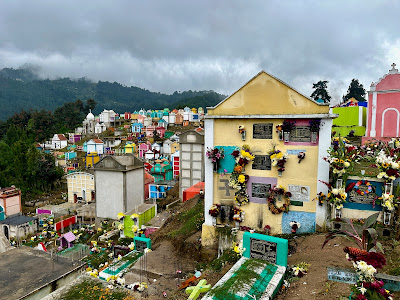
Chichicastenango Cemetery

The rain was off and on for most of the day, though for the most part I was quite dry.  I visited the cemetery which looked very colorful and exotic.  The locals are if Mayan descent and have retained many of the Mayan practices and rituals.  There seems to be a bit of a fusion of the Mayan and Catholic religions with Mayan ceremonies being performed at the gravesites and in the churches.

Chichicastenango Cemetery

The brightly colored tombs were quite a wonder to behold.  The Mayan ceremonies of burning offerings while chanting prayers were occurring at several grave sites.

Iglesia de Santo Tomas, Chichicastenango

Back in the market I continued exploring.  There were a couple of churches in the middle of the market area.  In both of them Mayan rituals of burning offerings to the dead were being performed outside the church.  Inside there was a lot of kneeling and prostrating before small low altars at the side of the church.  They like their incense too.

Flower sellers outside Santo Tomas Church

Tortillas, Chichicastenango Market

The market was a wonderful experience.  Such a colorful place that while it does invite some tourists is still clearly a local market for produce and fabrics and the like.  Like the rest of Guatemala there were many, many shops selling touristy trinkets.  I just don’t know how they can all survive selling basically the same thing.  

Chichicastenango Market

I did peruse the masks at one particular stall and, of course, got engaged with the vendor.  He said that he would sell me one I was looking at for 400 Quetzales.  I wasn’t really wanting to buy a mask even though it was quite nice.  I started to walk away and he said he could let me have it for 300Q.  I wasn’t tempted and continued to walk away.  He dropped the price to 200Q and so I came back to examine it.  Again I decided I didn’t need it and he dropped the price one more time to 100Q.  Well while I didn’t really need a wooden dog mask, a drop from 400 to 100Q was not to be passed up.  I closed the deal and gave him 100Q (around $12).  He seemed quite pleased with the deal.

Chichicastenango

Back on the bus we left the town and drove back to Panajacel.  Just before arriving in Panajacel we stopped at an overlook above Lake Atitlan.  The weather had cleared up and the sun was even shining.  While there was still a remnant of clouds over the tops of the volcanoes, you could clearly see them.  Quite impressive.

Lake Atitlan

Back in town I dined at Guajimbos yet again.  At the adjacent table was a Korean lady, Sugoi I believe, who had been on the same bus to Chichi.  We started talking and she told me her story - Korean born, trained as a nurse, living in New York, solo traveler.  We went for a coffee further up the street, a Korean coffee shop.   I must say it was an excellent coffee they had and they had a device that uniformly tamped the coffee in the puck too.  First time I have seen that.  I left her in the coffee shop and continued my walk stopping for ice cream and a cup of hot chocolate on the way.

The next day, a Monday morning, I had breakfast at the hotel before being picked up for my ride back to Antigua.  It was an easy ride with no hold ups and we were back in Antigua, at my hotel, the Posada del Angel in a couple of hours.

Hill of the Cross, Antigua

After a second breakfast at the Cafe Viejo I walked up to the top of the hill where there is a wooden cross and an overlook over the city.  While there were clouds in the sky there were far fewer than before and you got a sense of how spectacular the view might be on a blue sky day.  

I wandered around a little more and then went for dinner at the Casa de Santo Domingo again.  Another fine meal.  I went to bed early as I had a 3:30 am pick up for my 6 or 7 hour ride to Honduras.

I was awake before the alarm at 3:00 and ready to be picked up at 3:30.  Alas it was nearly 4:00am when the driver arrived.  I was the first passenger and we picked up a couple of other folks before leaving Antigua for the drive to Guatemala City and on to the Honduran border.  One was an English lady, Alex, a trainee lawyer, and the other a Kiwi, Charles, retired like me.

There was an accident outside of Guatemala City but once that was passed we had a fairly easy ride.  The time passed fairly quickly chatting with my fellow passengers.  We stopped for bad coffee near Rio Honda and then turned south off the main highway to Zacapa and Chiquimula and eventually the border at El Florida.

It was a relatively easy border crossing - passport stamp out of Guatemala, 35 Quetzales entry visa for Honduras and we were on our way again.  

Copan Ruinas, Honduras

It was a relatively short drive from the border to Ruinas Copan the town adjacent to the Mayan Ruins.  I was dropped off at my hotel at 11:00 am, a mere 7 hour ride.  It wasn’t as long as it sounds.

The hotel, Hotel Terra Maya, was quite simple but clean.  I checked in and then set off for the ruins.  As I walked through to the main square it started to rain, quite hard.  I ducked into a restaurant for a light lunch.  

The rain eased off and I continued the 1km walk to the ruins.  There was a US $20 entry fee for foreign tourists at the site.  Alas it started to rain yet again.  I continued on under my umbrella getting damper and damper.  

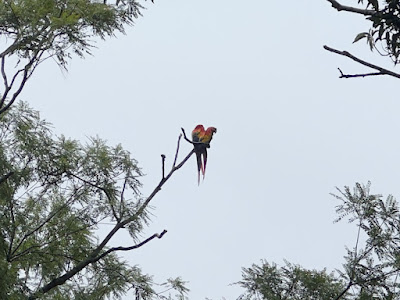
Crimson Macaws

I was surprised to hear the cackle of some big birds in the trees and low and behold I looked up and there was a pair of Crimson Macaws sitting in the top of a tree - what spectacular birds.  What I didn’t know at that time was that there were many of these birds around the park.  

Crimson Macaw

There is a Macaw Sanctuary near by and they have been rearing these birds and releasing them into the local area.  There was a park office where there were at least half a dozen of these birds sitting on a fence and they were quite accustomed to humans.

One of the many carved stelae

This particular Mayan site is famous for its hieroglyphic carvings.  There are a lot of steles with fairly elaborate and intricate carvings scattered around the main plain of the site.  Some have called it the Paris of the Mayan World.  


Yours truly getting quite wet

It was no fun walking around in the rain so I decided to take refuge for a while under the trees.  Standing under a tree wasn’t great either so I eventually set off again.  The rain lessened and I finally could put away the umbrella.  


There is a game court wheere the Mayan game of Tlatctli was played, an ornamented  staircase with hieroglyphic carvings, apparently quite unique, and several stone pyramids.  Climbing up the rain slickened steps of the pyramids was a bit precarious and potentially dangerous but somehow I survived.  

Hieroglyph Staircase

View down from the top of a pyramid

After completing at least one pass through every structure of the site I left, passing though the Macaws on the fence and a little agouti scrounging around in the grass.

An Agouti

In the town of Ruinas Copán I stopped for a coffee and a cake in the main square before returning to the hotel.  There wasn’t much to the town a small square, a few restaurants and bars, and of course tourist souvenir shops.  

In the evening it was raining again so I went to a close by restaurant for dinner, a German restaurant, with nice beer and a great schnitzel.  

The next morning, it was a 6:00 am pickup for the 6 hour ride to Guatemala City.  There was only one other passenger, a German lady, or rather girl, Bibi, who had just finished High School, and was traveling around Central and South America.  She was a traveling on a budget, being careful about expenditures and volunteering at hostels and hotels for free board.  She spoke perfect English and was also fluent in Spanish.  Quite accomplished and wise to the ways of the world for someone so young.

It was a relatively easy drive to Guatemala City and they dropped me off at a Shell gas station as they headed on over to Antigua.   I called up  an Uber for the ride into the center of Guatemala City and my hotel.  I splurged with a last night at the Intercontinental Hotel.

Metropolitan Cathedral, Guatemala City

After lunch at the hotel I set off to explore the town.  I got an Uber to the central plaza in the Historical District (Centro Historico).   I was deposited in the main square where there is the very fine Metropolitan Cathedral and the Palace of Culture.  They were constructing some kind of Christmas celebration structure in the square and access to the square was restricted.  

Palace of Culture, Guatemala City


Old Post Office Building, Guatemala City

Torre del Reformador

I walked back towards the hotel passing the Torre del Reformador, Guatemala's Eiffel Tower.  Not quite as magnificent as Eiffel's creation but different for this city.

Iglesia Yurrita

There was also an interesting church, the Iglesia Yurrita, a red brick baroque extravaganza with a crooked cross on top, apparently displaced in a recent earthquake - most interesting architecture.  

Signs of a Troubled Past

Near the central square there were signs of the troubled past of Guatemala.  Posters on walls depicting photos of individuals who had gone missing during the 1960 to 1996 Civil War.  Some estimate as many as 45,000, mostly Mayan, people were removed by the government and have not been seen or heard of since.  It is doubtful they are still alive but their family members would like answers.

I continued my walk back along the Avenida La Reforma.  It was getting dark and you are not supposed to walk the streets of Guatemala City at night, as a tourist.  I didn't have any issues however and I arrived safely at my hotel.

Dinner in the hotel and an early night after what was quite a long day.

The next morning I had a few hours before my flight departed.  I wanted to go to the Railway Museum and I thought I would get a better look at the Yurrita church in the daylight so I took an Uber into the center.   The church, built in the 1920's, is certainly one of the more interesting ones.  Unfortunately I arrived too early and I could not get inside.

I walked on from the church to the Museo de Ferrocarril.  The path took me in some more sketchy areas where I was careful not to hang around or look too touristy.  There was one area where there were quite a few homeless people living by the street.

Plaza Barrios and the Railway Museum

When I got to the Railway Museum I found it was closed for the day.  They were having some sort of meeting or convention that day and they were not open.  That was a fruitless journey.  I grabbed another Uber back to the hotel.

Hotel View, Guatemala City

I packed my bags and took another Uber to the airport with the same driver that I had got earlier in the day to visit the church.  What are the chances of that.

United Airlines had kindly upgraded me to First Class for the flight back so I had a nice visit to the lounge and a comfortable flight back to Houston and on to Sacramento.