I just finished reading a most interesting book – Piano by James Barron. It describes the making of a Steinway Concert Grand Piano from start to finish in the Steinway factory in New York – also included is a bit of history of the Piano itself, and a history of the Steinway family business (a business built up by German émigrés to New York in the early 1800’s). I found it fascinating how this blend of craftsmanship, established company traditions, modern manufacturing techniques (or the lack thereof) and the forces of the modern marketplace interplay to produce what must be a magnificent musical instrument (I have never seen one up close).
Anyone who has a love of music and can appreciate fine craftsmanship will find it a great read.
Sunday, August 27, 2006


Friday, August 25, 2006
The new LDS Temple
The Latter Day Saints folks (The Mormons) have just built a new temple here in Sacramento and before it is consecrated they have opened it up to the masses - to those non-believers and heathens, like me. So being curious about what Mormonism is all about, I went along for the tour.

The new structure is quite impressive from a distance - it sits on the top of a hill just outside Folsom with a gold statue on the top of its spire. However, up close and inside, I did not find it nearly so impressive (IMHO). The statue on top is apparently a representation of the Angel Moroni – the messenger that passed along the Book of Mormon, allegedly on gold plates, to James Smith the church's founder back in 1823.
I expected that the tours would be a low key affair with only a few people wanting to visit. I was totally unprepared for the crowds of people that I found there. There was a steady stream of cars going up the hill, overflow parking in an adjacent field, long lines to “check in” for the tour, and groups of 25 or so leaving every 4 or 5 minutes to go inside "the temple". I have no explanation for such a level of interest.
As you may now I am not a Christian, and I find the whole story of the LDS church very dubious, but each to his/her own and we certainly don’t need to go into that here. All the Mormons I have ever known have been fine people, but judging by the protesters and pamphleteers at the entrance to the temple, not everyone feels so friendly to the LDS church.
That aside, there were a few things that surprised me about the LDS Temple. First, I was expecting to see one large space for communal worship but the temple was divided into many small rooms for maybe 30 or so people at the most. So the temple is not a place for everyday worship, just a place for smaller ceremonies like weddings, christenings, etc. The main worship takes place elsewhere, but still in relatively small groups at an allotted time slot based on your area of residence.
The decor inside the temple was also a little strange - lots of sofas and upholstered chairs. The most sacred room of the temple, The Celestial Room, was just like a large living room – a huge chandelier hanging from the ceiling, 3 or 4 couches and some chairs – honestly, it would not have been out of place in Las Vegas. Needless to say, I couldn’t quite get the feeling of reverence or sanctity that the tour guides were saying they felt.
Of course the Mormons are very much into "The Family" and their belief that a wedding between two people is not for this lifetime, but for eternity - weddings in the church take place in a "Sealing Room" (again a type of small room in the temple).
I didn’t feel the welcoming hand being extended to us poor single folk. What is worse is that they believe you can be baptized as a surrogate for one of your antecedents, so say if I were to be a church member, I could be baptized for myself, and then I could be baptized for my father, my grandmother, etc and they could retroactively become church members and be spared eternal damnation or whatever (presumably that is why the Mormons are so big into keeping genealogical records). Unfortunately for me that means I am completely screwed; having no heirs, I will have no one to bring me into the fold and save me from my fate. Oh dear…
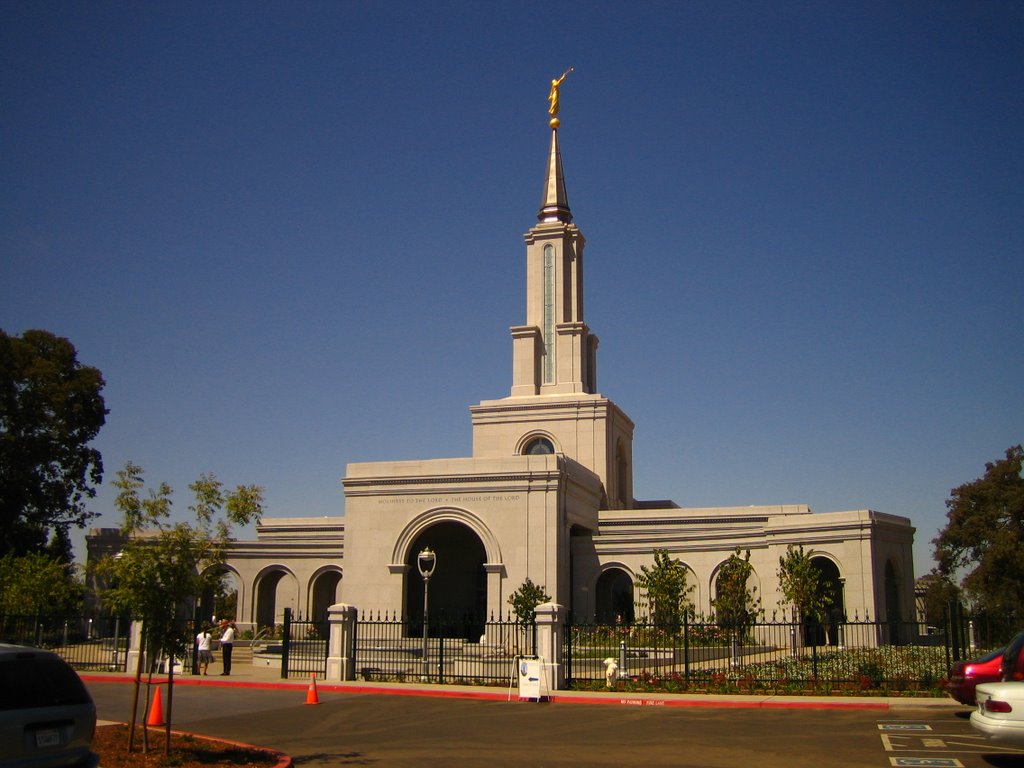
The new structure is quite impressive from a distance - it sits on the top of a hill just outside Folsom with a gold statue on the top of its spire. However, up close and inside, I did not find it nearly so impressive (IMHO). The statue on top is apparently a representation of the Angel Moroni – the messenger that passed along the Book of Mormon, allegedly on gold plates, to James Smith the church's founder back in 1823.
I expected that the tours would be a low key affair with only a few people wanting to visit. I was totally unprepared for the crowds of people that I found there. There was a steady stream of cars going up the hill, overflow parking in an adjacent field, long lines to “check in” for the tour, and groups of 25 or so leaving every 4 or 5 minutes to go inside "the temple". I have no explanation for such a level of interest.
As you may now I am not a Christian, and I find the whole story of the LDS church very dubious, but each to his/her own and we certainly don’t need to go into that here. All the Mormons I have ever known have been fine people, but judging by the protesters and pamphleteers at the entrance to the temple, not everyone feels so friendly to the LDS church.
That aside, there were a few things that surprised me about the LDS Temple. First, I was expecting to see one large space for communal worship but the temple was divided into many small rooms for maybe 30 or so people at the most. So the temple is not a place for everyday worship, just a place for smaller ceremonies like weddings, christenings, etc. The main worship takes place elsewhere, but still in relatively small groups at an allotted time slot based on your area of residence.
The decor inside the temple was also a little strange - lots of sofas and upholstered chairs. The most sacred room of the temple, The Celestial Room, was just like a large living room – a huge chandelier hanging from the ceiling, 3 or 4 couches and some chairs – honestly, it would not have been out of place in Las Vegas. Needless to say, I couldn’t quite get the feeling of reverence or sanctity that the tour guides were saying they felt.
Of course the Mormons are very much into "The Family" and their belief that a wedding between two people is not for this lifetime, but for eternity - weddings in the church take place in a "Sealing Room" (again a type of small room in the temple).
I didn’t feel the welcoming hand being extended to us poor single folk. What is worse is that they believe you can be baptized as a surrogate for one of your antecedents, so say if I were to be a church member, I could be baptized for myself, and then I could be baptized for my father, my grandmother, etc and they could retroactively become church members and be spared eternal damnation or whatever (presumably that is why the Mormons are so big into keeping genealogical records). Unfortunately for me that means I am completely screwed; having no heirs, I will have no one to bring me into the fold and save me from my fate. Oh dear…
Tuesday, August 22, 2006
Private Willard's Grave
Just south of Sacramento is the little town of Franklin (I paid a visit there this weekend). It is a small town, real small, but it has at least one distinction; it is the last resting place of the penultimate surviving member of the Lewis and Clark expedition – one Private Alexander Hamilton Willard. Now perhaps that is not the greatest of distinctions, but understand that Franklyn is a very small place.
Apparently Private Willard was not the best of soldiers – during the early part of the expedition he was caught sleeping on guard duty one night. That offence was in those days an act punishable by death but, fortunately for the Private, he was spared death and given a hundred lashes instead. He made the entire journey to the west coast and back with Lewis and Clark and then, after the expedition, he married, fathered 12 children and, in his 75th year, joined a wagon train and went west again to California. He died in Franklyn at the ripe old age of 86. Quite a life I would imagine.
 While the graveyard in Franklin has some quite impressive tombstones, Private Willard’s grave very modest indeed.

Apparently Private Willard was not the best of soldiers – during the early part of the expedition he was caught sleeping on guard duty one night. That offence was in those days an act punishable by death but, fortunately for the Private, he was spared death and given a hundred lashes instead. He made the entire journey to the west coast and back with Lewis and Clark and then, after the expedition, he married, fathered 12 children and, in his 75th year, joined a wagon train and went west again to California. He died in Franklyn at the ripe old age of 86. Quite a life I would imagine.
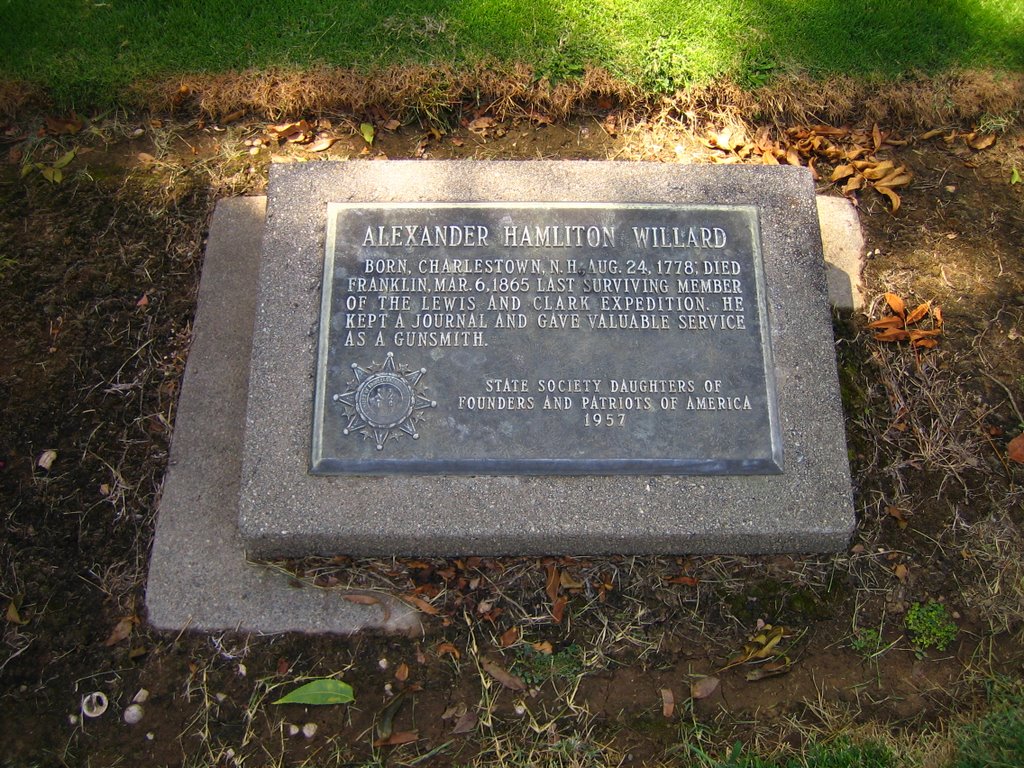 While the graveyard in Franklin has some quite impressive tombstones, Private Willard’s grave very modest indeed.
Sunday, July 30, 2006
One more time, some more mountain flowers.
Alright so I know this is getting a bit tedious, more mountain hiking, more pretty flowers. But this is the last, I promise. My hiking buddies are going on a long backpack trip next weekend and after that the flowers will all be over. And also there is another purpose to all this flower identification thing – I need some reference so that next year when I hike again and I see these flowers I will know what they all are (the memory is not what it used to be, and it wasn’t all that good at its best). So for the sake of my memory and perhaps someone’s enjoyment, here we are on the road to Wright’ Lake in the Desolation Wilderness.

Brian, Allison, Mike and myself.

Tiger Lilly - quite a wonderful thing to behold.

I am not sure what the proper name for this one is, but it's smell gives it the knickname - Smelly Socks - pretty nasty smelly socks too.

This is fireweed (Epilobium angustifolium) which takes its name not from its color, but from its opportunistic ability to quickly colonize areas devastated by fire. In England it is called the Rosebay Willow Herb or when I was a lad we called them "tip" flowers, because, in the same opportunistic way, they were one of the few things that colonized the coal tips around the area.
Alright - no more flowers.
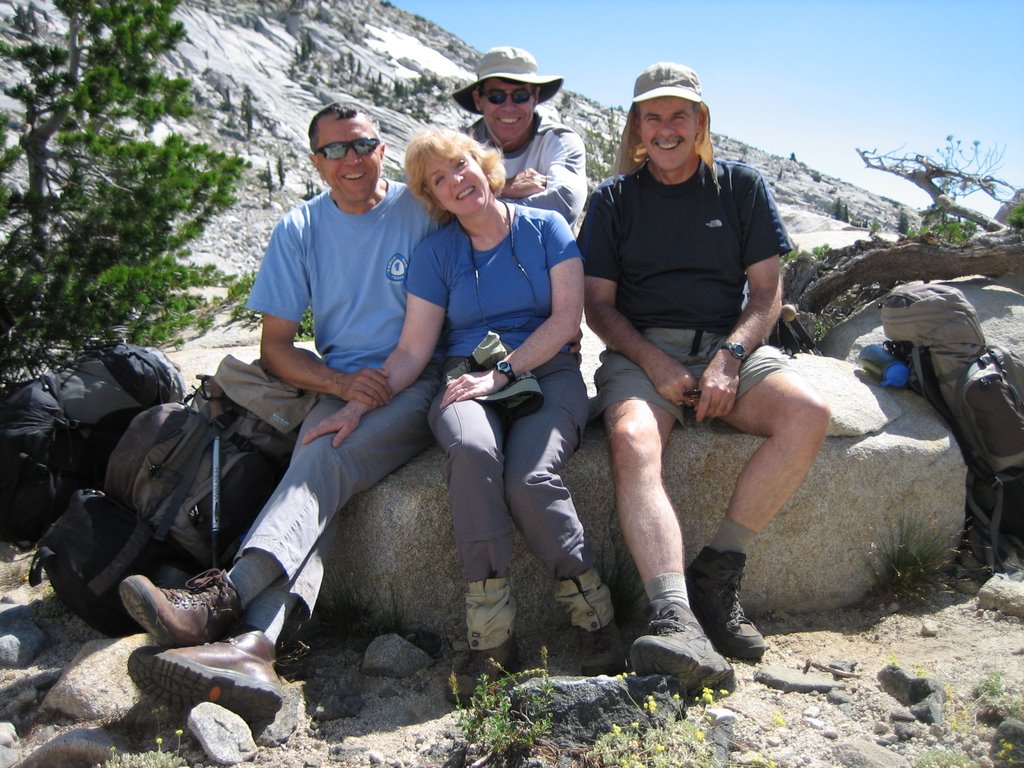
Brian, Allison, Mike and myself.

Tiger Lilly - quite a wonderful thing to behold.
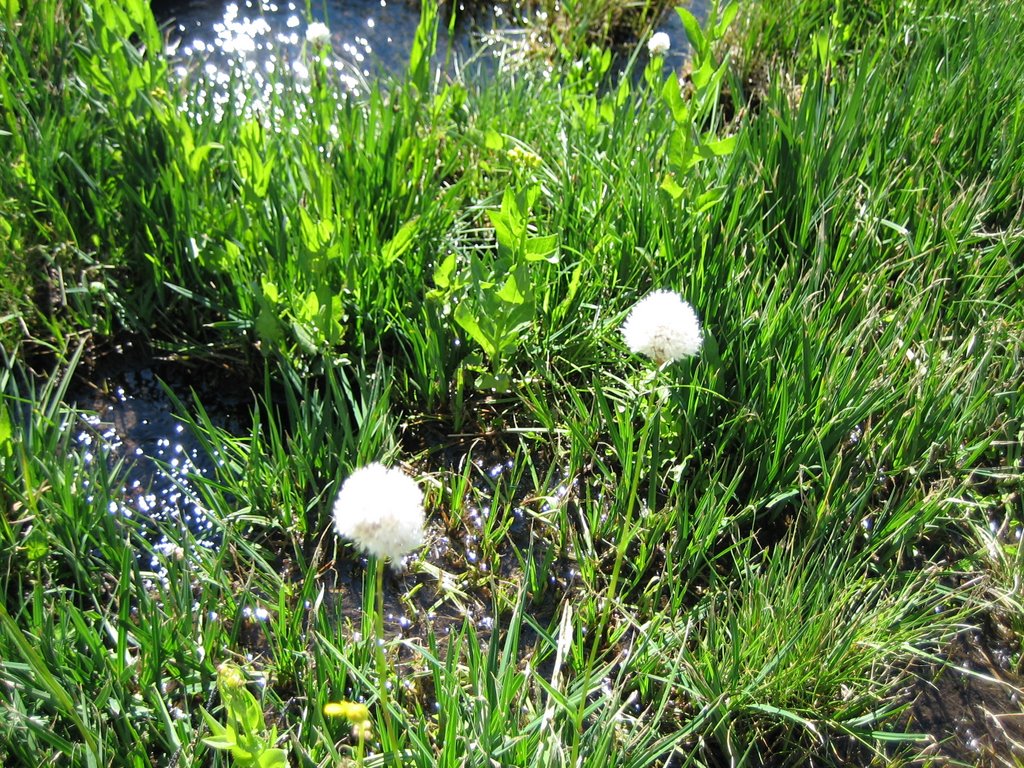
I am not sure what the proper name for this one is, but it's smell gives it the knickname - Smelly Socks - pretty nasty smelly socks too.

This is fireweed (Epilobium angustifolium) which takes its name not from its color, but from its opportunistic ability to quickly colonize areas devastated by fire. In England it is called the Rosebay Willow Herb or when I was a lad we called them "tip" flowers, because, in the same opportunistic way, they were one of the few things that colonized the coal tips around the area.
Alright - no more flowers.
Monday, July 17, 2006
More Sierra Flowers
Another hike up in the Sierras this weekend. This time to Thunder Mountain which lies above Kirkwood Meadows (the ski resort), and where, again, the flowers were just wonderful. I think I could quite get into this flower indentification thing. Allison, who hiked with us, knows quite a bit about such things and she was eductating me on the way. My problem, of course, is remembering these things from one week to the next, not to mention from one season to the next.
Here is the view from the top of Thunder Mountain looking south.

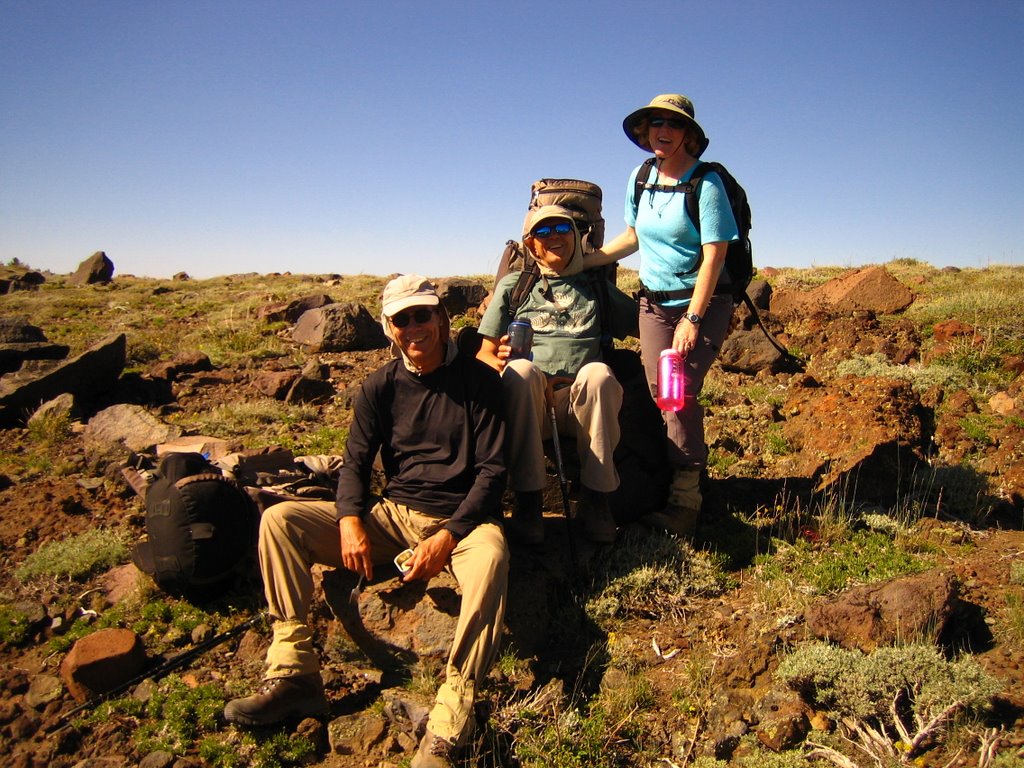
Here are Mike, Brian, and Allison languishing in the afternoon sun (where is Paul?).

And here, as I stop and smell the roses along the way, are some of the wildflowers we encountered.


Wallflower

Forget Me Not

Sierra Primrose
Here is the view from the top of Thunder Mountain looking south.

Here are Mike, Brian, and Allison languishing in the afternoon sun (where is Paul?).
And here, as I stop and smell the roses along the way, are some of the wildflowers we encountered.


Wallflower

Forget Me Not

Sierra Primrose
Saturday, July 15, 2006
The Bees continued….
In the continuing saga of my bees, there has been a change of events. Last time I reported that the bees had absconded and left the hive to the Wax Moths and I was resolved to having to find another swarm from somewhere. Well, this week my caretaker of the bees (they are temporarily at my friend Doug’s house), reported there was bee activity in the hive again. Yesterday, I went along to inspect and see what could be done and indeed the hive was occupied by bees and they were in the process of cleaning out all the damage caused by the wax moths. I talked to someone who knows far more than I do about beekeeping (Fred from the Bee Shop) and he thinks that a passing swarm decided to take up residence. So without me having to do anything, I have some bees again (or actually as Doug pointed out are they my bees or his bees, since it was in his back yard that they squatted in my hive – we will have to resolve the ownership later).
Doug and I cleaned up the hive, and replaced any frames that were too damaged by wax moth activity. We also removed a lot of debris and squished a lot of wax moth larvae (sorry wax moths). Apparently, wax moth larvae are highly prized by fishermen – they drive the trout crazy. Perhaps we should have gone into business selling larvae to fishermen; certainly we would have had more grubs than we will have honey to harvest this year.
Doug and I cleaned up the hive, and replaced any frames that were too damaged by wax moth activity. We also removed a lot of debris and squished a lot of wax moth larvae (sorry wax moths). Apparently, wax moth larvae are highly prized by fishermen – they drive the trout crazy. Perhaps we should have gone into business selling larvae to fishermen; certainly we would have had more grubs than we will have honey to harvest this year.
Tuesday, July 11, 2006
The Omnivore's Dilemna
I just finished reading The Omnivore’s Dilemna by Michael Pollan – a fascinating book about the things that we, as omnivores, choose to eat. And a disturbing tale of what we are doing to ourselves by going along with industrial food production as the major source of our inputs. I will not look at a farm in quite the same way again, and I will certainly be more mindful and wary as I decide what goes into my grocery cart.
It opened my eyes so many things about today’s industrial farming processes and what a road to ruin it appears to be. It is amazing how a series of small and likely well meaning decisions has led us away from small self-contained and relatively sustainable farming to the large scale agricultural monocultures that we have today. One part of the country is growing either corn or soy beans with the help of vast amounts of artificial petroleum based fertilizers, and the other part raising vast numbers of identical animals (pigs, chickens or cattle) in absolutely horrible conditions with the aid of lots of antibiotics and feed (corn) that many of these animals (the cattle at least) weren’t even designed to eat (they are ruminants).
Nevermind that the food produced may not be the best, from an environmental standpoint it is a disaster. One part of the country is suffering from toxic run off from over-fertilized fields while the other is floating in lagoons of excrement that we don’t know what to do with.
Anyway, a very good book (as was his previous book – The Botany of Desire), that I highly recommend. Check out Bill Maher’s interview with Michael Pollan on Amazon.com’s Fishbowl program.
It opened my eyes so many things about today’s industrial farming processes and what a road to ruin it appears to be. It is amazing how a series of small and likely well meaning decisions has led us away from small self-contained and relatively sustainable farming to the large scale agricultural monocultures that we have today. One part of the country is growing either corn or soy beans with the help of vast amounts of artificial petroleum based fertilizers, and the other part raising vast numbers of identical animals (pigs, chickens or cattle) in absolutely horrible conditions with the aid of lots of antibiotics and feed (corn) that many of these animals (the cattle at least) weren’t even designed to eat (they are ruminants).
Nevermind that the food produced may not be the best, from an environmental standpoint it is a disaster. One part of the country is suffering from toxic run off from over-fertilized fields while the other is floating in lagoons of excrement that we don’t know what to do with.
Anyway, a very good book (as was his previous book – The Botany of Desire), that I highly recommend. Check out Bill Maher’s interview with Michael Pollan on Amazon.com’s Fishbowl program.
Sunday, July 09, 2006
The flowers of Castle Peak

Another little hike in the Sierras this weekend – this time up Castle Peak which is another one of those easy access freeway hikes (you literally park by the off ramp from Interstate 80 and the first few hundred yards are accompanied by the roar of passing trucks).

Most of the snow had gone by now, and the flowers were just going wild. I am not sure what all these different kinds are, but to follow are some photographs that I will try and identify – help anyone?
I think I have them all named now, thanks to Allison Spreadborough, who put identified them all for me.

This is a Sierra Onion surrounded by Phlox.

and this is one of the lupines, which one I am not quite sure.

This is what I call Indian Paintbrush. But then I call everything that's red Indian Paintbrush.
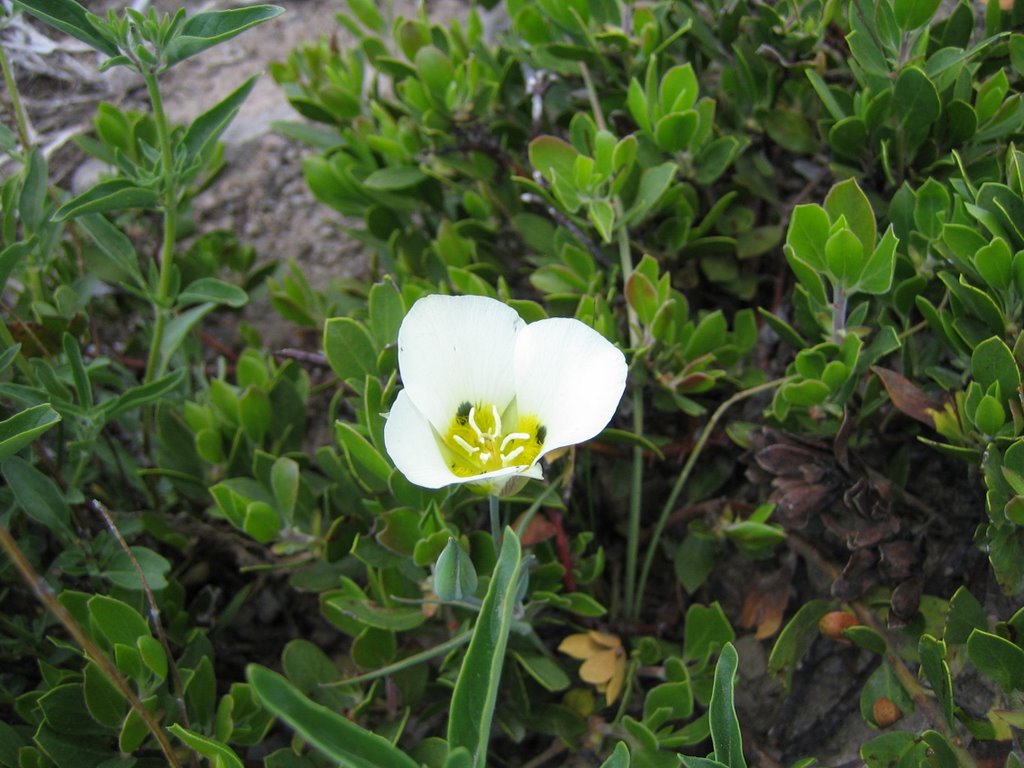
This I thought was the Mariposa Lily (Calochortus Invenustus) - my favourite. Actually Allison tells me this is the Sego Lily. Same family, different species.
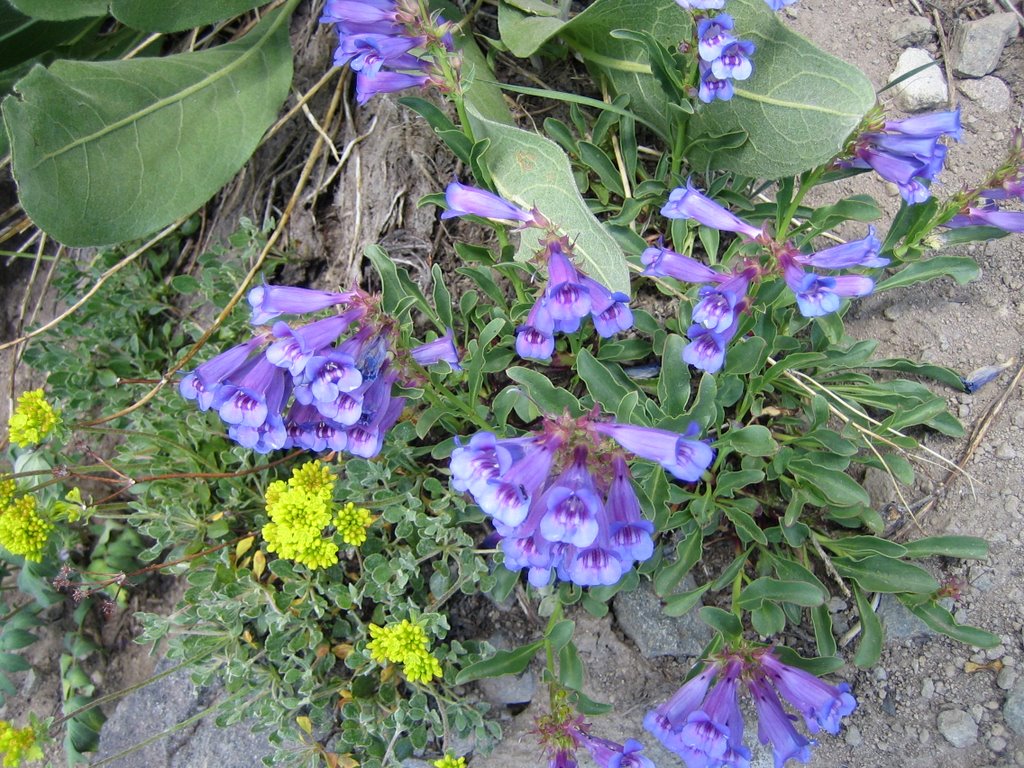
Above is the Penstemon.

And finally the Scarlet Gilia.
Friday, July 07, 2006
The bees are gone....
As you may know, I had moved my bees over to a friend’s house while I had some work done on my back yard. All was going well for a while, but there were some signs that the hive was perhaps weakened - the bees had some difficulty in preventing ants entering the hive. Well the other day I got the call that the activity level at the hive was down – way down.
On opening the hive, it became evident that the hive had become invaded by wax moths. Normally, a healthy hive can cope with wax moths – chasing them out of the hive and destroying their eggs. However, if the hive is weak, then the wax moths or rather their larvae get the upper hand and the bees leave for better conditions elsewhere. The larvae are extremely destructive as they feed on the wax and pollen and as they move around the hive they create these strange silken tubes in which they travel. The damage just looks awful. No wonder the bees gave up.
At this late time of year, I cannot buy any replacement bees so I will likely have to wait until next spring before repopulating the hive. However, in order to try and re-establish the hive before next spring, I put my name on the callout list for anyone needing help in removing a swarm from their property.
What usually happens when someone finds a swarm of bees on their property is that they call the local beekeeper’s association and then one of the beekeepers comes out to retrieve the swarm. I have always thought that it would be interesting to go and retrieve a swarm in the “wild” so to speak so I am hoping to get a call. However, I could imagine that it could turn into a bit of a debacle if things don’t go according to plan and I would imagine there many ways things could diverge from the plan (whatever the plan is). Stay tuned…
On opening the hive, it became evident that the hive had become invaded by wax moths. Normally, a healthy hive can cope with wax moths – chasing them out of the hive and destroying their eggs. However, if the hive is weak, then the wax moths or rather their larvae get the upper hand and the bees leave for better conditions elsewhere. The larvae are extremely destructive as they feed on the wax and pollen and as they move around the hive they create these strange silken tubes in which they travel. The damage just looks awful. No wonder the bees gave up.
At this late time of year, I cannot buy any replacement bees so I will likely have to wait until next spring before repopulating the hive. However, in order to try and re-establish the hive before next spring, I put my name on the callout list for anyone needing help in removing a swarm from their property.
What usually happens when someone finds a swarm of bees on their property is that they call the local beekeeper’s association and then one of the beekeepers comes out to retrieve the swarm. I have always thought that it would be interesting to go and retrieve a swarm in the “wild” so to speak so I am hoping to get a call. However, I could imagine that it could turn into a bit of a debacle if things don’t go according to plan and I would imagine there many ways things could diverge from the plan (whatever the plan is). Stay tuned…
An Inconvenient Truth
I finally got around to seeing Al Gore’s film on global warming – An Inconvenient Truth. It is definitely a worthwhile film that seems to get the facts right and presents them in a reasonably accessible format. But, I was a little surprised with the how much it was about Al himself. After all the fuss about him inventing the Internet, it almost seemed like he was responsible for recognizing global warming. I would have preferred it to be a bit more focused on global warming theory, and a little less about Al. But perhaps, this movie is as much about Al reinventing and repositioning himself for another run in the political arena (I would vote for him).
Subscribe to:
Posts (Atom)