After almost a year of Covid quarantine restraints I decided that I needed to get back to the UK. However, the UK were slow at relaxing their quarantine requirements for vaccinated travelers so I looked at alternatives and found that I could travel to a lot of places in Europe without quarantine. Vienna and Odessa were on my list so I decided to visit those countries before arriving in the UK, hoping that the UK entry would sooner or later open up.
On August 2, I flew from San Francisco to London and then immediately flew out to Vienna arriving there late in the evening of the next day. There was no fuss with immigration. I just showed a negative Covid certificate and proof of double vaccination and I was allowed in. I took a taxi from the airport to my hotel, the quite luxurious old Hotel Bristol on the Ringstrasse.
 |
| The Opera House |
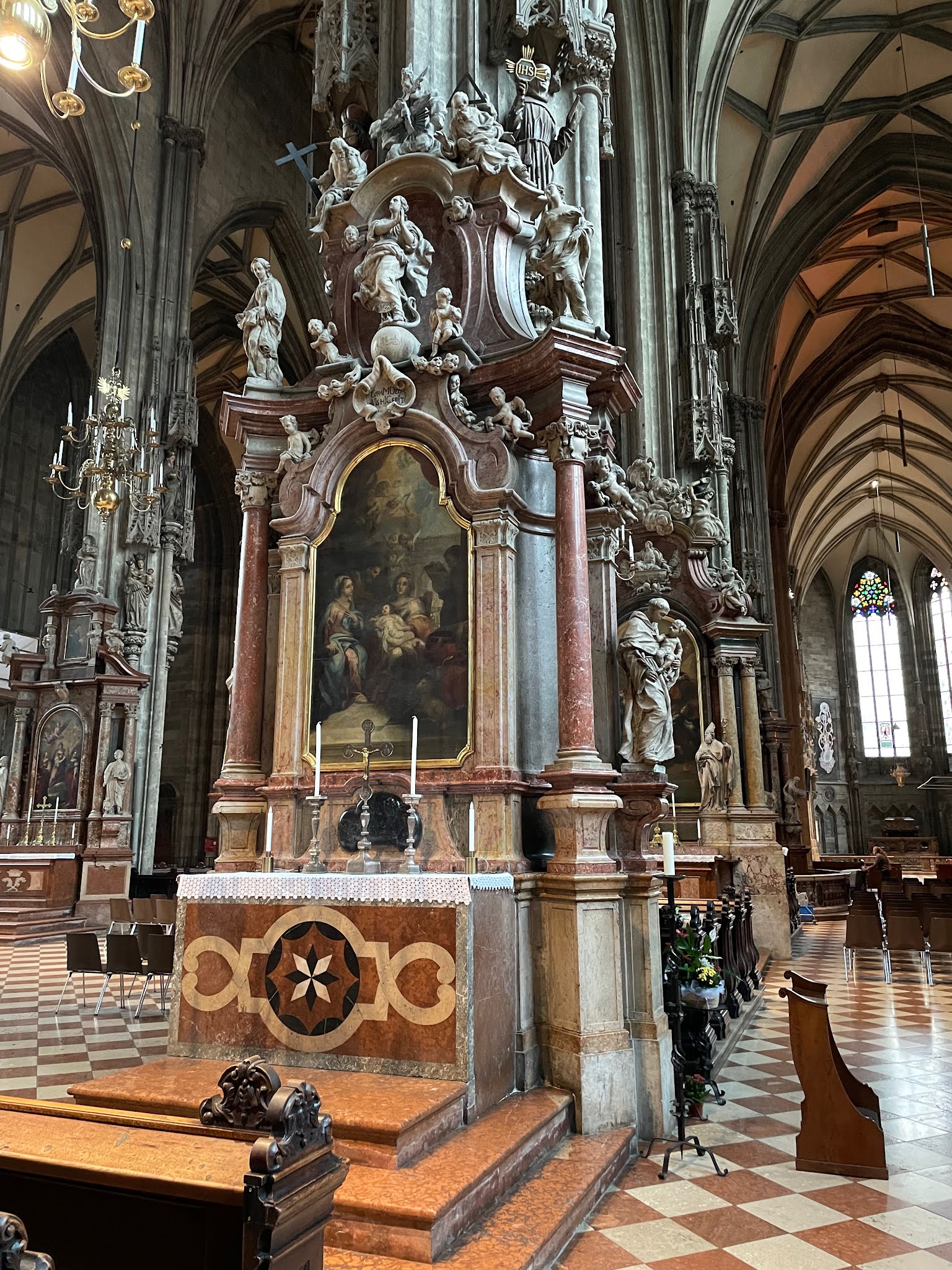
The next morning I was up early for walk around the city. My hotel was on the Karntner Ring right next to the most impressive Vienna Opera House. After taking in the grandeur of the Opera House, I walked northwards towards St Stephen's Cathedral. The Cathedral and it's square are one of the highlights of Vienna - a spectacular church in a spectacular square. It was early in the morning and not too many people were around and surprisingly the cathedral was open so I got to go in when there were very few people around. The interior, of course, was just as spectacular as the outside.
 |
| St Stephen's Cathedral |
 |
| Interior of St Stephen's Cathedral |
Back to the hotel for breakfast which was nice but perhaps not the best buffet breakfast I have had. Then it was off again to see the sights. The city, or at least this central part of the city, is one amazing building after the next - museums, palaces, churches, shops, even the regular office buildings - everything is a work of art.
 |
| The Ferris Wheel in The Prater |
I walked down to the Danube at Schwedenplatz and then walked on the north bank out towards the Prater, the big park where the giant ferris wheel sits. The ferris wheel, of course, was made famous by the film, The Third Man. There was quite a line to ride it so I didn't bother to take the trip.
 |
| Hundertwasser Museum |
After the Prater Park, I walked over to the other side of the river where there is the Hundertwasser Museum. I was only a little bit familiar with his painting, and did not realize that he also designed buildings. The museum is in one of his buildings - a colorful mosaic like building. Inside was just as weird as the outside with floors sloping and rising and beautiful colored tiles everywhere. Even the toilet was decorated in his characteristic style.
 |
| The Spittelau Incinerator |
After enjoying the museum I set off to find another Hundertwasser house in the same neighborhood. This one was not as dramatic as the museum but nevertheless quite nice. I was so impressed with Hundertwasser that I set off to find his other masterpiece in Vienna, the Spittelau Incinerator. This was quite a way up the Danube but it was pleasant walk along the river. The incinerator complex is quite amazing - an industrial waste processing plant that is a treat for the eyes and truly a work of art.
 |
| The Opera House Interior |
I caught the very clean and very efficient subway back to the center of town and joined a tour of the Opera House. The Opera House was not open for performances because of Covid but they were providing guided tours of the interior. As expected it is just as amazing on the inside as it is on the outside. Gustav Mahler was the director of the Opera for some 10 years. He converted from Judaism to Catholicism just to get the job.
 |
| Cafe Sperl |
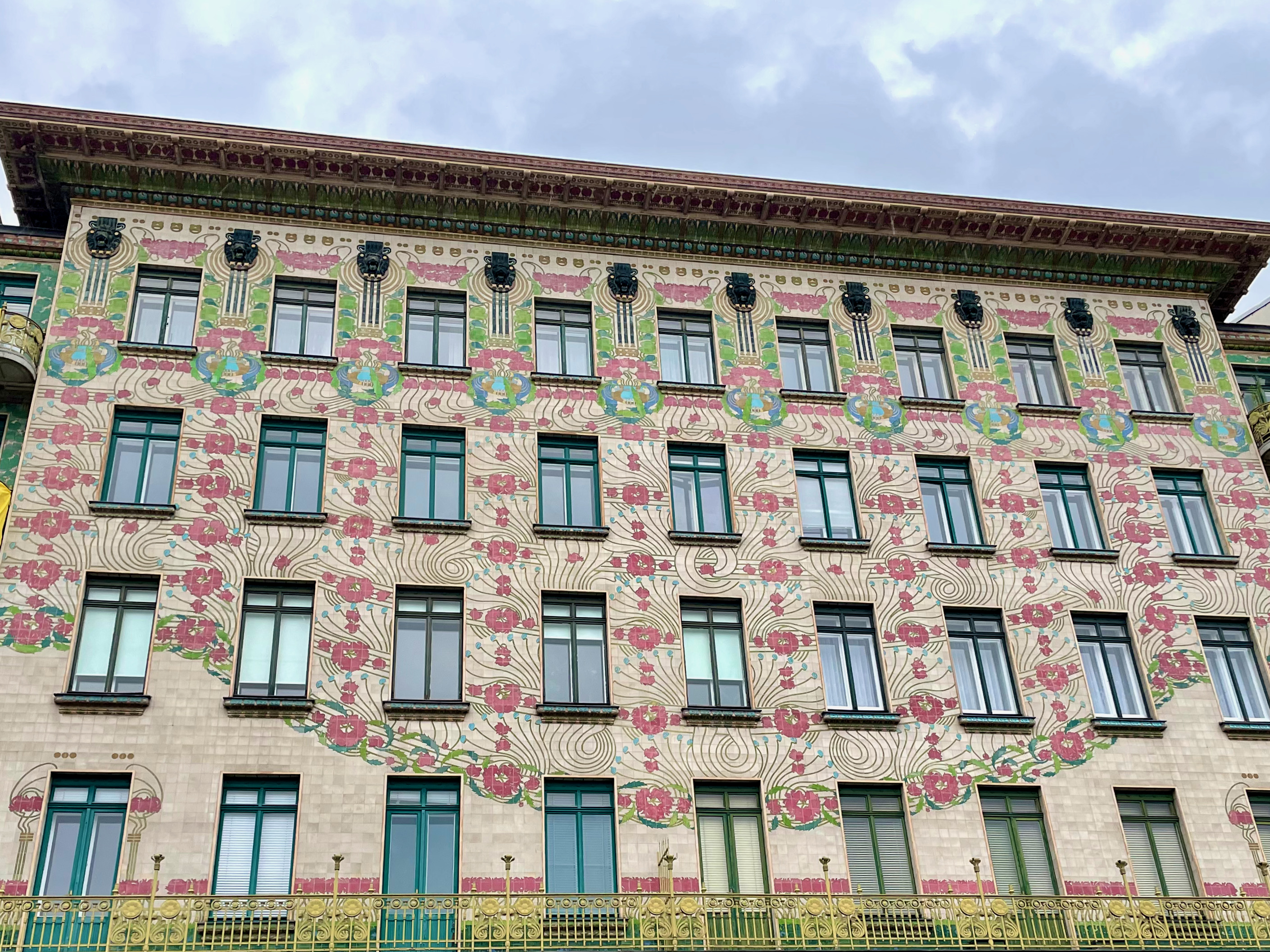
That evening I dined at the Cafe Sperl (a recommendation of my friend Nico) and then went to look at some nice art nouveau buildings on Linke Wienzelle - the Majolikahaus of Otto Wagner and its neighboring buildings.
 |
| The Majolikahaus |
The next day, Thursday, I decided to take a trip to Bratislava in Slovakia. Ideally I had wanted to go by boat down the Danube but alas the boats only run at the weekend. So it was the train - just over an hours journey with trains leaving every hour. As the train left Vienna we passed the group of four gas storage tanks that had been converted into residences. Quite a novel usage of these old relics.
It was a grey and damp day and as we neared Bratislava it started to rain. It was not the best of times to see Bratislava but I donned my rain jacket and set out to walk into town. The city did not look that inviting, particularly in the rain and particularly after the splendor of Vienna but I enjoyed the walk into the old town.
 |
| The Primatial Palace, Old Town, Bratislava |
In the old town one of the first things I stumbled across was the "sewer man" - a brass sculpture of a worker emerging from a manhole cover in the street - most interesting.
 |
| The Bratislava Sewer Man |
The Main Square is old and very well preserved but obviously Bratislava was not as affluent as Vienna was. I slipped into a coffee shop to wait until the rain abated which it eventually did. Then I walked over to St Martin's Cathedral and took a look inside - a nice but relatively simple church at least by Catholic standards.
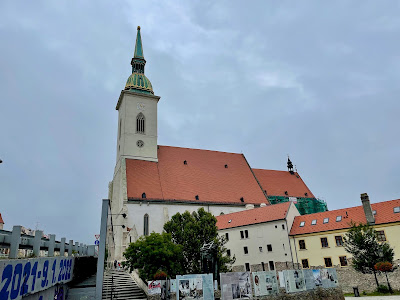 |
| St Martin's Cathedral, Bratislava |
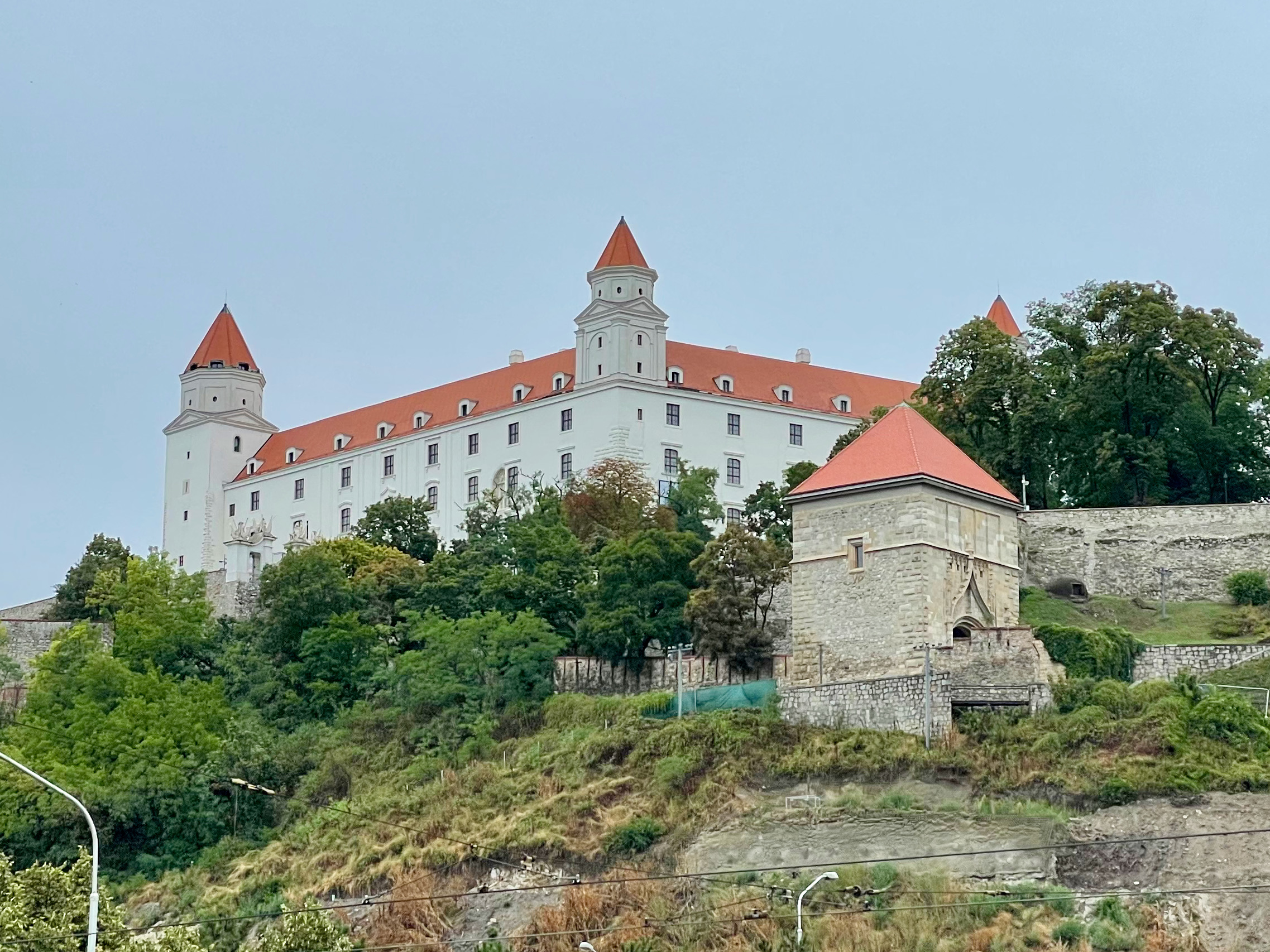
I then walked down to the Danube where there is a modern bridge across the river. At the far end of the bridge is a flying saucer shaped structure on top of a tower. This houses a restaurant with nice views back over to the city. Above the Danube by the bridge is Bratislava Castle up on top of the hill. I didn't walk up the hill to investigate.
 |
The UFO Bridge across the Danube
|
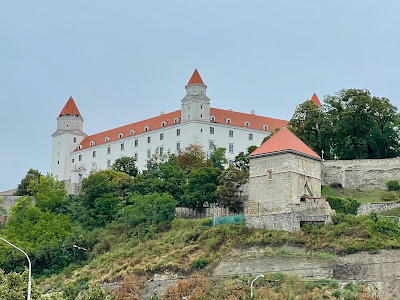 |
Bratislava Castle
|
I walked down Hviezdoslavovo Park (named after a poet) and then on to the Blue Church - a beautiful Catholic church in a nice pale blue color.
 |
The Blue Church
|
Back towards the center of town there were several nice murals. Something I always enjoy stumbling across. As I moved out of the old town I became aware of a demonstration going on. There was lots of speeches and cheering and as I reached the Presidential Palace I saw quite a crowd in the square in front of the Palace. The riot police were also present, looking very threatening with their helmets, shields and batons. I asked a passerby what was the demonstration about thinking it must be some kind of anti government thing but actually no, it was an anti vaccination demonstration.
 |
| Protesters Outside the Parliament Building |
 |
| The Police at the Demonstration |
I watched the demonstrators for a while before walking over to the Freedom Square - the dry fountain and lake makes Freedom Square look a bit sad. Further on there is the rather interesting upside down building of Slovak Radio - most peculiar.
 |
| The Slovak Radio Building |
 |
| A Colorful Motel |
Back at the railway station I had time before my train to explore a bit more. There is a rather interesting looking hotel behind the station. Not a place I would necessarily stay at but quite the colorful curiosity.
Back in Vienna I again walked through the old part of town. I visited the Am Hof, a square surrounded by wonderful buildings. Mounted to the outside of one of these buildings is the Turkenkugel, a cannonball fired the building on this site back in the Turkish siege of the 1680's. The cannonball has been gilded and mounted to the wall.
I again marveled at the buildings and sculptures outside of the buildings of Michaelerplatz (possibly the Spanish Riding School).
 |
| One of the sculptures on Michaelerplatz |
I happened upon a plaque on the wall of a coffee shop that recognized Franz Kafka and his friend Max Brod had stayed there.
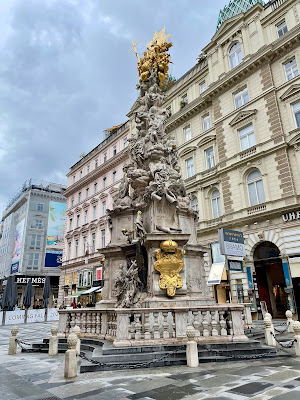 |
| The Plague Column |
I passed by the weird and very ornate Plague Column, built to commemorate the 1679 plague epidemic.
 |
| The Ankeruhr Clock |
There is a wonderful clock outside the old Anker Insurance building, the Ankeruhr clock. Built in 1914 it has 12 figures that rotate around one per hour throughout the day. At midday all 12 figures appear. Like everything else in this city it is a wonder to behold.
 |
The Kunsthistoriches Museum
|
 |
| The Natural History Museum |
The next morning, Friday, I made an early morning walk around the Ringstrasse, the road that runs around the historical center of the town. It is one wonderful building after the other - the Opera House, the Kunsthistoriches Museum, the Natural History Museum, the Parliament Building, the Rathaus (City Hall), the University, the Votivkirche. The road runs down to the Danube and runs along Franz Josefs Kai along the river before turning south back into the city once more. There was a wonderful art deco post office building in the middle of being renovated.
 |
| The old Post Office |
After breakfast I went out to explore a few museums and art galleries. First there was the Clock Museum - a small museum dedicated to timepieces. They had some wonderfully old clocks as well as a display of more modern pocket watches and wristwatches. Apparently there was a period when paintings of churches and the like would have clock mechanisms in place of the clock embedded into the painting. That's one way to spoil a nice painting.
 |
The Clock Museum
|
After the clock museum I went over to the Globe Museum. There they had a collection of ancient globes, the earliest from around 1536. There were globes from a little later by Coronelli and Mercator.
The next place was the Esperanto Museum. As you can imagine there is not a lot to show in a museum for a language that is not anyone's native language. It was basically a series of posters and photographs from the annual Esperanto Congress, a meeting that is still held today.
 |
The National Library
|
 |
| The National Library |
A more spectacular museum was the National State Library in the Baroque State Hall. Never mind the books which I am sure were treasures by themselves, the building itself was a work of art - beautiful painted on the ceilings, marble columns, carved statues and ornate wooden bookshelves. The most beautiful interior that I visited while in Vienna.
The next stop was the Albertina, the home to an immense collection of prints and drawings - possibly the largest in the world. It is also the home to a significant collection of Impressionist paintings and that's what I was interested in. A wonderful museum and because of Covid it wasn't too crowded. I can only imagine how busy it must be in non-pandemic times.
 |
| The Museum of Modern Art - Mumok |
 |
| One of the fine (?) exhibits in the Mumok |
I took in one more museum before I called it a day, the Museum of Modern Art or Mumok a very modern building in the Museum District. Sometimes I don't quite get some of the modern pieces but it is always good to examine what we are creating these days.
 |
| Vienna School of Art |
After a day of museums I had reached my limit so I spent the rest of the day walking around. There is always something interesting around every corner - the Mozart statue, the Art School where Hitler was not accepted as a student (a shame, it might have been a different world now), the pedestrian traffic lights that show two people holding hands (with hearts), the business man standing on the edge of the roof.
 |
Romantic Pedestrian Traffic Lights
|
 |
| Man on the Roof |
The next day Saturday, I left Vienna for a short flight to Lviv in the Ukraine. What a remarkable city Vienna is. I am sure I only scratched the surface. Certainly I only really saw the center of town. It deserves more time than I gave it. I will try and return.