Monday, July 17, 2006

More Sierra Flowers

Another hike up in the Sierras this weekend. This time to Thunder Mountain which lies above Kirkwood Meadows (the ski resort), and where, again, the flowers were just wonderful. I think I could quite get into this flower indentification thing. Allison, who hiked with us, knows quite a bit about such things and she was eductating me on the way. My problem, of course, is remembering these things from one week to the next, not to mention from one season to the next.

Here is the view from the top of Thunder Mountain looking south.


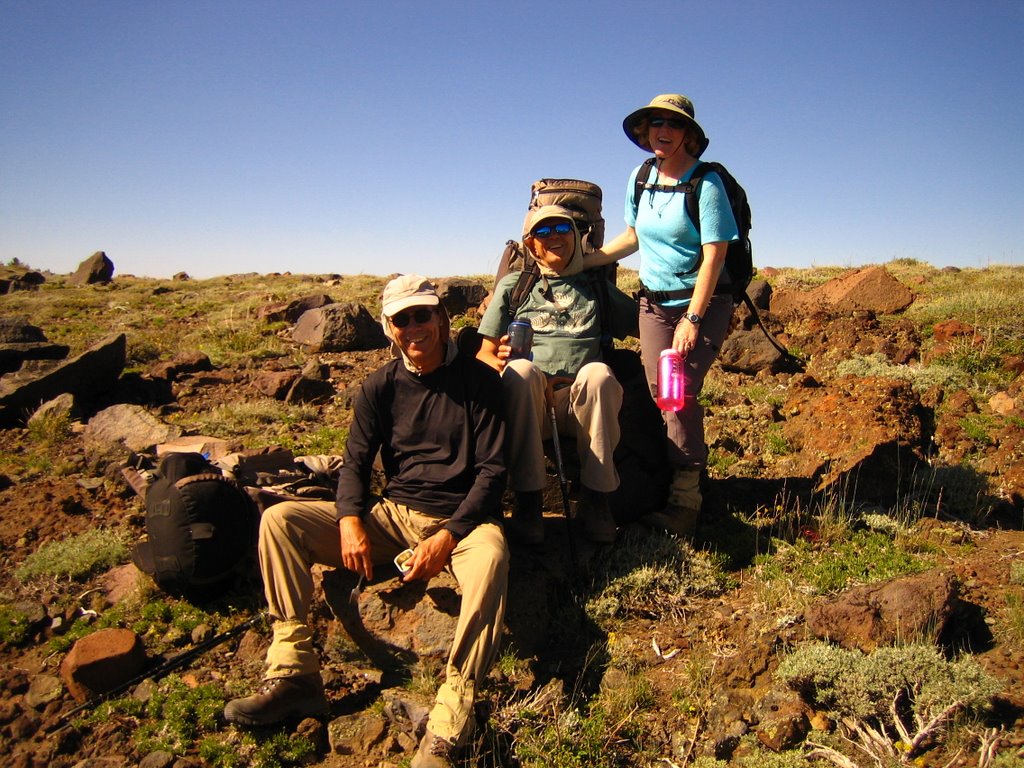
Here are Mike, Brian, and Allison languishing in the afternoon sun (where is Paul?).


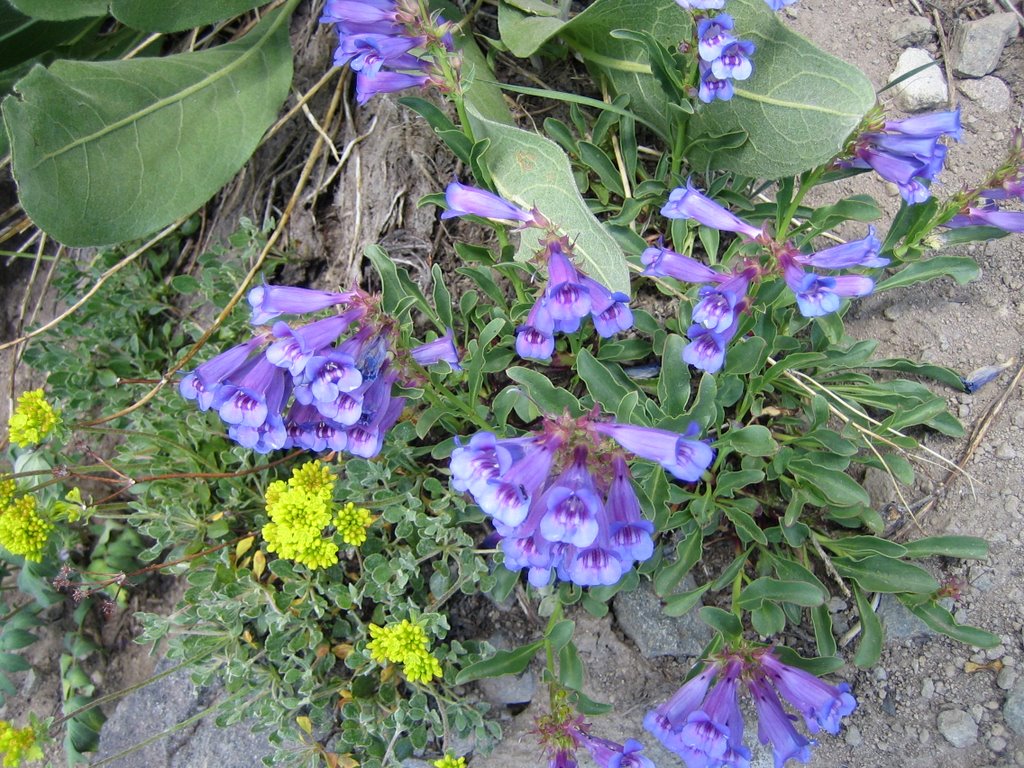
And here, as I stop and smell the roses along the way, are some of the wildflowers we encountered.


Wallflower


Forget Me Not


Sierra Primrose

Saturday, July 15, 2006

The Bees continued….

In the continuing saga of my bees, there has been a change of events. Last time I reported that the bees had absconded and left the hive to the Wax Moths and I was resolved to having to find another swarm from somewhere. Well, this week my caretaker of the bees (they are temporarily at my friend Doug’s house), reported there was bee activity in the hive again. Yesterday, I went along to inspect and see what could be done and indeed the hive was occupied by bees and they were in the process of cleaning out all the damage caused by the wax moths. I talked to someone who knows far more than I do about beekeeping (Fred from the Bee Shop) and he thinks that a passing swarm decided to take up residence. So without me having to do anything, I have some bees again (or actually as Doug pointed out are they my bees or his bees, since it was in his back yard that they squatted in my hive – we will have to resolve the ownership later).

Doug and I cleaned up the hive, and replaced any frames that were too damaged by wax moth activity. We also removed a lot of debris and squished a lot of wax moth larvae (sorry wax moths). Apparently, wax moth larvae are highly prized by fishermen – they drive the trout crazy. Perhaps we should have gone into business selling larvae to fishermen; certainly we would have had more grubs than we will have honey to harvest this year.

Tuesday, July 11, 2006

The Omnivore's Dilemna

I just finished reading The Omnivore’s Dilemna by Michael Pollan – a fascinating book about the things that we, as omnivores, choose to eat. And a disturbing tale of what we are doing to ourselves by going along with industrial food production as the major source of our inputs. I will not look at a farm in quite the same way again, and I will certainly be more mindful and wary as I decide what goes into my grocery cart.

It opened my eyes so many things about today’s industrial farming processes and what a road to ruin it appears to be. It is amazing how a series of small and likely well meaning decisions has led us away from small self-contained and relatively sustainable farming to the large scale agricultural monocultures that we have today. One part of the country is growing either corn or soy beans with the help of vast amounts of artificial petroleum based fertilizers, and the other part raising vast numbers of identical animals (pigs, chickens or cattle) in absolutely horrible conditions with the aid of lots of antibiotics and feed (corn) that many of these animals (the cattle at least) weren’t even designed to eat (they are ruminants).

Nevermind that the food produced may not be the best, from an environmental standpoint it is a disaster. One part of the country is suffering from toxic run off from over-fertilized fields while the other is floating in lagoons of excrement that we don’t know what to do with.

Anyway, a very good book (as was his previous book – The Botany of Desire), that I highly recommend. Check out Bill Maher’s interview with Michael Pollan on Amazon.com’s Fishbowl program.

Sunday, July 09, 2006

The flowers of Castle Peak


Another little hike in the Sierras this weekend – this time up Castle Peak which is another one of those easy access freeway hikes (you literally park by the off ramp from Interstate 80 and the first few hundred yards are accompanied by the roar of passing trucks).


Most of the snow had gone by now, and the flowers were just going wild. I am not sure what all these different kinds are, but to follow are some photographs that I will try and identify – help anyone?

I think I have them all named now, thanks to Allison Spreadborough, who put identified them all for me.


This is a Sierra Onion surrounded by Phlox.


and this is one of the lupines, which one I am not quite sure.


This is what I call Indian Paintbrush. But then I call everything that's red Indian Paintbrush.


This I thought was the Mariposa Lily (Calochortus Invenustus) - my favourite. Actually Allison tells me this is the Sego Lily. Same family, different species.


Above is the Penstemon.


And finally the Scarlet Gilia.

Friday, July 07, 2006

The bees are gone....

As you may know, I had moved my bees over to a friend’s house while I had some work done on my back yard. All was going well for a while, but there were some signs that the hive was perhaps weakened - the bees had some difficulty in preventing ants entering the hive. Well the other day I got the call that the activity level at the hive was down – way down.

On opening the hive, it became evident that the hive had become invaded by wax moths. Normally, a healthy hive can cope with wax moths – chasing them out of the hive and destroying their eggs. However, if the hive is weak, then the wax moths or rather their larvae get the upper hand and the bees leave for better conditions elsewhere. The larvae are extremely destructive as they feed on the wax and pollen and as they move around the hive they create these strange silken tubes in which they travel. The damage just looks awful. No wonder the bees gave up.

At this late time of year, I cannot buy any replacement bees so I will likely have to wait until next spring before repopulating the hive. However, in order to try and re-establish the hive before next spring, I put my name on the callout list for anyone needing help in removing a swarm from their property.

What usually happens when someone finds a swarm of bees on their property is that they call the local beekeeper’s association and then one of the beekeepers comes out to retrieve the swarm. I have always thought that it would be interesting to go and retrieve a swarm in the “wild” so to speak so I am hoping to get a call. However, I could imagine that it could turn into a bit of a debacle if things don’t go according to plan and I would imagine there many ways things could diverge from the plan (whatever the plan is). Stay tuned…

An Inconvenient Truth

I finally got around to seeing Al Gore’s film on global warming – An Inconvenient Truth. It is definitely a worthwhile film that seems to get the facts right and presents them in a reasonably accessible format. But, I was a little surprised with the how much it was about Al himself. After all the fuss about him inventing the Internet, it almost seemed like he was responsible for recognizing global warming. I would have preferred it to be a bit more focused on global warming theory, and a little less about Al. But perhaps, this movie is as much about Al reinventing and repositioning himself for another run in the political arena (I would vote for him).

Friday, June 30, 2006

The Western States 100

Last weekend was the Western States 100 mile run. No, I didn’t participate – it is way beyond my capabilities. But I did go up to help at one of the aid stations and as always I am in awe at these folk that can run in such difficult conditions (not only 100 miles but 18,000 ft. vertical gain and 23,000 vertical drop).

This year’s race was more difficult than most as we had a heat wave with temperatures way over 100 degrees. There were a record number of drops as people felt the effects of the heat (399 started, 188 dropped and only 211 finished).

The other remarkable thing about this years race was that the first person across the finish line arrived in the stadium (the last 300 yards is around the High School track in Auburn), and then proceeded to fall down or perhaps collapse might be a better word. In fact he did it several times. He was helped to his feet each time and somehow managed to cross the finish line after 18 hrs. Unfortunately, although he was 12 minutes before the next runner, the fact that he was assisted over the last few yards was enough to disqualify him. How tragic is that? The lad seems to have a good attitude towards it – saying that it was the right decision by those that helped him and by those that disqualified him. But still – after 99.8 or 99.9 miles and a 12 minute lead he must be a little miffed.

Friday, June 23, 2006

Mt. Ralston


After spending the last few weeks in England and again becoming enchanted by the English countryside, it was nice this last weekend to get out into the California countryside and do some hiking in the Sierra Nevadas. While back in England, I had made several trips through the Peak District (a National Park near my home in England) and had once again become struck by the beauty of it all. Now, back in the US and in the middle of the mighty Sierras, I realize how wonderful that is too. Its different, of course, everything is on a much grander scale here, big dramatic mountains, not the more subtle hills of England.

Anyway four of us went up Mt Ralston on Saturday, one of the smaller and more accessible peaks on south east side of Tahoe. It was a bit of a slog up the 2,600 ft of elevation gain but it was well worth it when we reached the top – great views of the Tahoe Basin, the Central Valley and the high Sierras to the south.

Friday, June 09, 2006

Mr Straw's House

The other day I visited an old Edwardian house in the nearby town of Worksop now owned and operated by the National Trust. The house was previously owned by a couple of brothers who were grocers in the town and it has been preserved as a kind of museum to early 20th Century life in Britain. Though quite well off for their day, the brothers did not live an extravagant lifestyle and in many ways they were very frugal. The house was originally owned by their parents and when they died in the 1930’s the brothers did hardly anything to change or modernize the house. When the last brother died in the late 1980’s the house was a snapshot of how people lived in the early part of the 20th Century.

I found it quite fascinating - not the usual National Trust property (usually they are the grander stately homes), and more of something that I could relate to (though I/we did not live like that, I am sure there were people in my home town that did).

It was just like stepping back in time 60 years and to think as recent as 1985 someone was living in the home - no telephone, no TV, lead plumbing, original 1910 wallpaper and paint, calendars on the wall from the 1930's, cans in the pantry from the same period ...

Well worth a visit.

Tuesday, June 06, 2006

Stockholm

Last weekend I went over to Stockholm to run the Stockholm Marathon (and to have a nice relaxing weekend in Sweden). While the marathon was, yet again, one of my less stellar performances, the weekend was great. Stockholm is a lovely city – lots of water, lots of bridges, lots of ferries, beautiful old buildings (and a few less inspiring more modern ones), and, as expected, it was all very, very clean.

The marathon was one of the better organized races I have participated in. Some nice touches that I have not seen before – color coded cups at aid stations (water in blue cups, electrolyte in clear cups), bagged food and drink at the finish so that everyone gets the same and those earlier finishers don’t get to scarf it all, and, the most unusual thing I have ever seen, pickled gherkins at one of the aid stations. I cannot imagine why anyone would want a pickled gherkin in the middle of a marathon but if you do then Stockholm’s your place. I tried one but its not for me. Judging by the number of squashed gherkins on the pavement, it wasn't for a lot of other either.

The finish of the marathon was a lap around the Stockholm Olympic stadium and that nearly made all the pain and suffering worthwhile. The stadium was built for the 1912 Olympics and has the honor of being the location where 83 Track and Field World Records have been broken (that in itself is a record for a single location). Alas my performance was not quite so record breaking – actually it was a personal worst!

I have a new rule now - no more marathons unless I train for them - train properly that is.