It was somewhat interesting to see what happened to a visitor from England in Atlanta the other day. It was made even more interesting by the fact that the poor soul was a visiting professor from my alma mater, Queen Mary College. I don't hear much about Queen Mary College these days so its good to see them getting at least some recognition even if it is only for one of their professor's being arrested.
The poor guy was wrestled to the ground and carted off to jail for jaywalking. Something that is completely legal in the UK and in many other 'civilized' countries. But quite illegal here in America and in some other places like Australia.
So those Australians have another thing in common with the Americans - the other being a failure to ratify the Kyoto Agreement. Don't get me started on that one but did you see that Daimler Chrysler's chief economist said that Global Warming was way in the future and still uncertain. So much for Chrysler's recent moves into the green world - perhaps its not so heartfelt.
Thursday, January 11, 2007


Friday, December 22, 2006
The Office Christmas Lunch….
Yesterday we, the employees of Infostat that is, went out for our celebratory Christmas lunch. Actually it was a combination Christmas celebration and software release celebration (we have been working on a new release of our software for what seems like ages now and we finally got something that we are comfortable with releasing this week).
So here we are getting about as wild and crazy as we get these day.

So here we are getting about as wild and crazy as we get these day.

Sunday, December 17, 2006
A very happy Christmas to all....
Well it is Christmas time again and the very best of Christmas wishes to one and all. In my Christmas Card again this year I said – no Christmas letter, just go here to my blog, if you want to catch up on what I have been doing. Well that is perhaps not a reasonable thing to do – there is a lot of stuff here for the past year, most of it pretty trivial and meaningless stuff and I couldn’t expect anyone to wade through it all. So, just in case you followed the instructions in the Christmas Card and ended up here – here is the abridged version.
Too much running – I ran the 50 Km Way Too Cool run in March, then the American River 50 Miler in April, and then because a marathon seems like a lot less than a 50 mile run, I ran the Stockholm Marathon in June (its still 26 miles and when the guy on crutches passed me at mile 24, I realized I need to train more for these things). There was a fairly quiet summer with a little bit of hiking thrown in and a visit from my mother, who at 87 made another trip across the Atlantic. Finally, to finish the year, there was a vacation in Chile (the highlight of the year) and now its Christmas. Oh and did I mention work – there was a lot of that, while so many of you out there seem to be retiring already you lucky lot.
That’s it -my 2006 in a nutshell. I hope you all have a great Christmas and I wish you the best for 2007.
Too much running – I ran the 50 Km Way Too Cool run in March, then the American River 50 Miler in April, and then because a marathon seems like a lot less than a 50 mile run, I ran the Stockholm Marathon in June (its still 26 miles and when the guy on crutches passed me at mile 24, I realized I need to train more for these things). There was a fairly quiet summer with a little bit of hiking thrown in and a visit from my mother, who at 87 made another trip across the Atlantic. Finally, to finish the year, there was a vacation in Chile (the highlight of the year) and now its Christmas. Oh and did I mention work – there was a lot of that, while so many of you out there seem to be retiring already you lucky lot.
That’s it -my 2006 in a nutshell. I hope you all have a great Christmas and I wish you the best for 2007.
Wednesday, December 13, 2006
More Chile Trip Photos
I decided to post the photographs of my recent Chile trip to a SmugMug site. It seems to be a reasonable means of sharing photos with friends without having to have them log on or create accounts so I will give it a try for a while.
However, one of the problems with digital photography and large memory cards is that you can end up taking so many pictures of more or less the same thing in the hope that at least one will turn out to be really good and worth saving. Of course, that’s exactly what I did – armed with a 2 GB card I was never in danger of filling it up and as a result, when I got home, I had lots of different shots of the same mountain range from every possible angle and a dozen shots from the funicular railway in Valparaiso, not to mention the desert landscapes – way too many brown rocks.
So if you just want the highlights of the trip you can visit the Best Of Chile Vacation gallery, if you have more time to kill, or if you were on the the Torres Del Paine hike, you can visit the Patagonia gallery. If you want to see everything from the Atacama Desert trip then there is the San Pedro de Atacama gallery and if you want to see what Valparaiso is like go here.
However, one of the problems with digital photography and large memory cards is that you can end up taking so many pictures of more or less the same thing in the hope that at least one will turn out to be really good and worth saving. Of course, that’s exactly what I did – armed with a 2 GB card I was never in danger of filling it up and as a result, when I got home, I had lots of different shots of the same mountain range from every possible angle and a dozen shots from the funicular railway in Valparaiso, not to mention the desert landscapes – way too many brown rocks.
So if you just want the highlights of the trip you can visit the Best Of Chile Vacation gallery, if you have more time to kill, or if you were on the the Torres Del Paine hike, you can visit the Patagonia gallery. If you want to see everything from the Atacama Desert trip then there is the San Pedro de Atacama gallery and if you want to see what Valparaiso is like go here.
Tuesday, December 05, 2006
Valparaiso
I think I mentioned that Santiago was relatively clean, modern city that is somewhat unremarkable. Well Valparaiso the port town adjacent to Santiago is just the opposite - a bustling and shabby port town with a lot of character. I thoroughly enjoyed my time there on the last day of my trip.
The town has a flat business section near the ocean (El Plan) and then a hillside section consisting of a jumble of old houses of all shapes and sizes and colors overlooking the bay. The hillsides are quite steep and the roads are narrow and sinuous. To facilitate getting up and down the hills there are some 15 or so funicular railways (ascensores) around the town. These are all very old and dilapidated pieces of equipment indeed and they look like they would never pass any modern safety standards. Nevertheless, they work and they are a lot of fun.

Looking downhill from Ascensor Florida.
One of the things I did in Valparaiso was to visit Pablo Neruda's house there. Mr. Neruda, the Chilean poet and Nobel Laureate, while very much a supporter of the socialist movement and the poor and downtrodden of this world also lived a fairly comfortable life and had three houses in Chile - all of which are now museums. He was a great collector and the house in Valparaiso was full of interesting stuff that he had been given or that he had collected in his travels. I enjoyed it so much that when I got back to Santiago later that afternoon, I went to his house there to see what he had accumulated there. An interesting character indeed.

Neruda's House in Valparaiso - La Sebastiana (he named his houses)
The town has a flat business section near the ocean (El Plan) and then a hillside section consisting of a jumble of old houses of all shapes and sizes and colors overlooking the bay. The hillsides are quite steep and the roads are narrow and sinuous. To facilitate getting up and down the hills there are some 15 or so funicular railways (ascensores) around the town. These are all very old and dilapidated pieces of equipment indeed and they look like they would never pass any modern safety standards. Nevertheless, they work and they are a lot of fun.

Looking downhill from Ascensor Florida.
One of the things I did in Valparaiso was to visit Pablo Neruda's house there. Mr. Neruda, the Chilean poet and Nobel Laureate, while very much a supporter of the socialist movement and the poor and downtrodden of this world also lived a fairly comfortable life and had three houses in Chile - all of which are now museums. He was a great collector and the house in Valparaiso was full of interesting stuff that he had been given or that he had collected in his travels. I enjoyed it so much that when I got back to Santiago later that afternoon, I went to his house there to see what he had accumulated there. An interesting character indeed.

Neruda's House in Valparaiso - La Sebastiana (he named his houses)
The Astronomy Tour
One of the more interesting things that I did in the Atacama region was to go on an Astronomy Tour. The Atacama Desert is a prime location for star gazing. The climate is dry, there are few clouds, it is relatively high altitude, and the high atmospheric winds are laminar and consistent - all good things for observing the heavens. There are many large scientific telescope installations in the area and the largest radio telescope in the world is currently being built up there (the Atacma Large Millimetre Array).
A French Astronomer and his wife live just outside San Pedro and they run nightly tours of the night sky. It was very educational - the guy was so passionate about astronomy and he certainly had a knack for explaining how we fit into the solar system, our galaxy and the universe. He used a laser pointer to identify different areas of the sky and he had about 6 different telescopes in the back yard of his house that he focused on different areas so that we could "ooh and aah" about the moon, the constellations, star clusters, nebulae and the like. For a couple of hours I was completely enthralled.
Below is my picture of the moon taken through on of his telescopes.

A French Astronomer and his wife live just outside San Pedro and they run nightly tours of the night sky. It was very educational - the guy was so passionate about astronomy and he certainly had a knack for explaining how we fit into the solar system, our galaxy and the universe. He used a laser pointer to identify different areas of the sky and he had about 6 different telescopes in the back yard of his house that he focused on different areas so that we could "ooh and aah" about the moon, the constellations, star clusters, nebulae and the like. For a couple of hours I was completely enthralled.
Below is my picture of the moon taken through on of his telescopes.

San Pedro de Atacama
The second part of my trip was to the Atacama Desert in Northern Chile. A totally different landscape - one of the driest on the planet. A lot like Death Valley in California but on a much grander scale. I stayed in the little town of San Pedro de Atacama - a town that was discovered first by the hippy/back-packer crowd and, in more recent times, by the more well-healed traveler set (to which I suppose I belong these days). It seems to be totally reliant on the tourism industry these days but, as they say, don't drink the water - since there is so little of it here and as it leaches through all sorts of nasty stuff before it gets to town, the local water has a very high concentration of arsenic.
This part of the trip was not so strenuous as the Patagonia part with just little day trips out to see different things like geysers, salt flats, interesting rock formations, etc. Nothing quite as spectacular as Patagonia, but a nice place to take it easier for a while.

The Iglesia San Pedro - quite a nice church in the town square of San Pedro.

Sunset in the Valle De La Luna, just outside San Pedro. Everyone goes there to watch the sun go down - with the mandatory Pisco Sours of course.

The Geysers at El Tatio. This is up in the altiplano around 13,000 ft so the air is a bit thin. The geysers are more dramatic in the early morning when the air is cold and there is more condensation of the steam, by 9 or 10 there is not much to see anymore. You can boil your eggs and heat your milk for coffee in the geysers and have breakfast among all the hissing and gurgling steam.

Flamingos on the salt flats at Laguna Chaxa in the Salar de Atacama (Atacama Salt Flats) - the one with the black tail feathers is an Andean Flamingo, the one without the black tail feathers is a Chilean Flamingo - just in case you were wondering.
This part of the trip was not so strenuous as the Patagonia part with just little day trips out to see different things like geysers, salt flats, interesting rock formations, etc. Nothing quite as spectacular as Patagonia, but a nice place to take it easier for a while.

The Iglesia San Pedro - quite a nice church in the town square of San Pedro.

Sunset in the Valle De La Luna, just outside San Pedro. Everyone goes there to watch the sun go down - with the mandatory Pisco Sours of course.
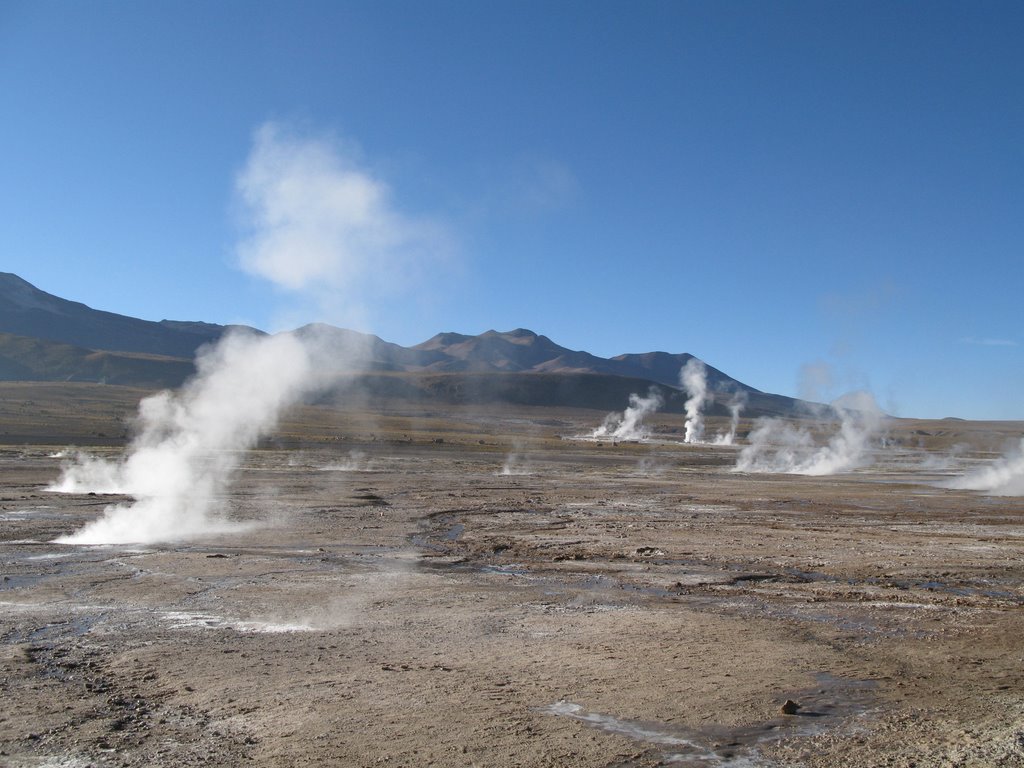
The Geysers at El Tatio. This is up in the altiplano around 13,000 ft so the air is a bit thin. The geysers are more dramatic in the early morning when the air is cold and there is more condensation of the steam, by 9 or 10 there is not much to see anymore. You can boil your eggs and heat your milk for coffee in the geysers and have breakfast among all the hissing and gurgling steam.

Flamingos on the salt flats at Laguna Chaxa in the Salar de Atacama (Atacama Salt Flats) - the one with the black tail feathers is an Andean Flamingo, the one without the black tail feathers is a Chilean Flamingo - just in case you were wondering.
Hiking the "W"
The purpose of my trip was to hike the so-called "W" around the base of the Torres del Paine. The "W" is a trail that takes its name from its outline on the map and it takes about 4 days to complete. The folks with more time and energy hike the entire Paine Circuit which is more like a 10 day trip and it goes all the way around the Torres.
The nice thing about the "W" is that you can stay each night in a Refugio (Hostel) where there is a bunk, food, hot showers and, the other essential component, a plentiful supply of Pisco Sours. On the Paine Circuit you have to resort to tents for accomodation and a more austere lifestyle.
There were lots of great experiences and sights during this part trip -
- the aquamarine blue of the glacial lakes.
- the vibrant red of the firebush which was in blossom everywhere.
- the Andean Condors. Magnificent birds and relatively common in this area.
- the many different shades of blue of the Grey Glacier which we got to see up close on our boat trip.
- the power and noise of the avalanches cascading, at a safe distance, down the opposite side of the French Valley.
- and of course the Torres themselves which were different from each perspective but always impressive even when shrouded in cloud or mist.


The nice thing about the "W" is that you can stay each night in a Refugio (Hostel) where there is a bunk, food, hot showers and, the other essential component, a plentiful supply of Pisco Sours. On the Paine Circuit you have to resort to tents for accomodation and a more austere lifestyle.
There were lots of great experiences and sights during this part trip -
- the aquamarine blue of the glacial lakes.
- the vibrant red of the firebush which was in blossom everywhere.
- the Andean Condors. Magnificent birds and relatively common in this area.
- the many different shades of blue of the Grey Glacier which we got to see up close on our boat trip.
- the power and noise of the avalanches cascading, at a safe distance, down the opposite side of the French Valley.
- and of course the Torres themselves which were different from each perspective but always impressive even when shrouded in cloud or mist.


Monday, November 27, 2006
In Patgonia
To get down to Patagonia I flew down to Punta Arenas in the south. It is the most southerly outpost in Chile and apparently it is a bit of a windswept and bleak place but I wouldn't know as I was escorted north from the airport to Puerto Natales - the gateway to the Torres Del Paine National Park - my destination.
This province of Chile has been given the name Ultima Esperanza - Last Hope - I wonder what they were thinking when they named it that.
The countryside here is sparsely populated but there were few interesting things to see on the way into the park. We stopped to visit the Milodon Cave - a Milodon is a, now extinct, prehistoric sloth which used to inhabit the cave. A useless piece of trivia about the Milodon Cave is that it was a piece of skin from a mummified Milodon found in the cave that inspired Bruce Chatwin to go to Patagonia and write his classic travel book - In Patagonia. I have always liked Bruce Chatwin's writing and it was that book that inspired me to go to Patagonia - except it took me a long time to get there - I read it when I was in my 20's.
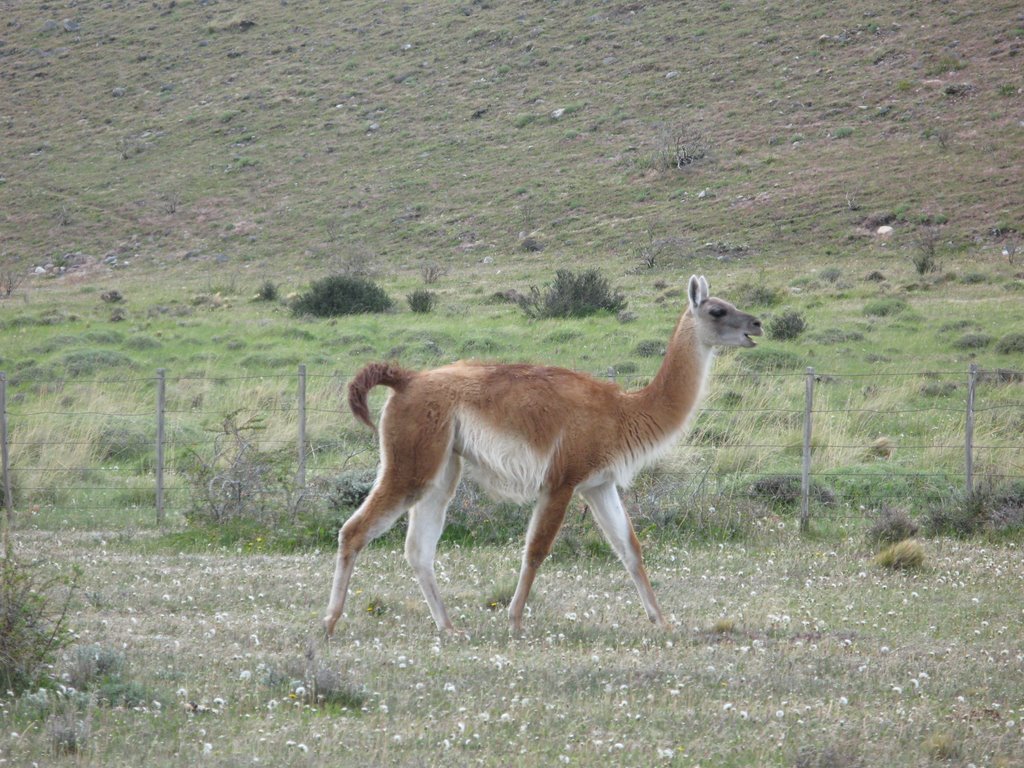
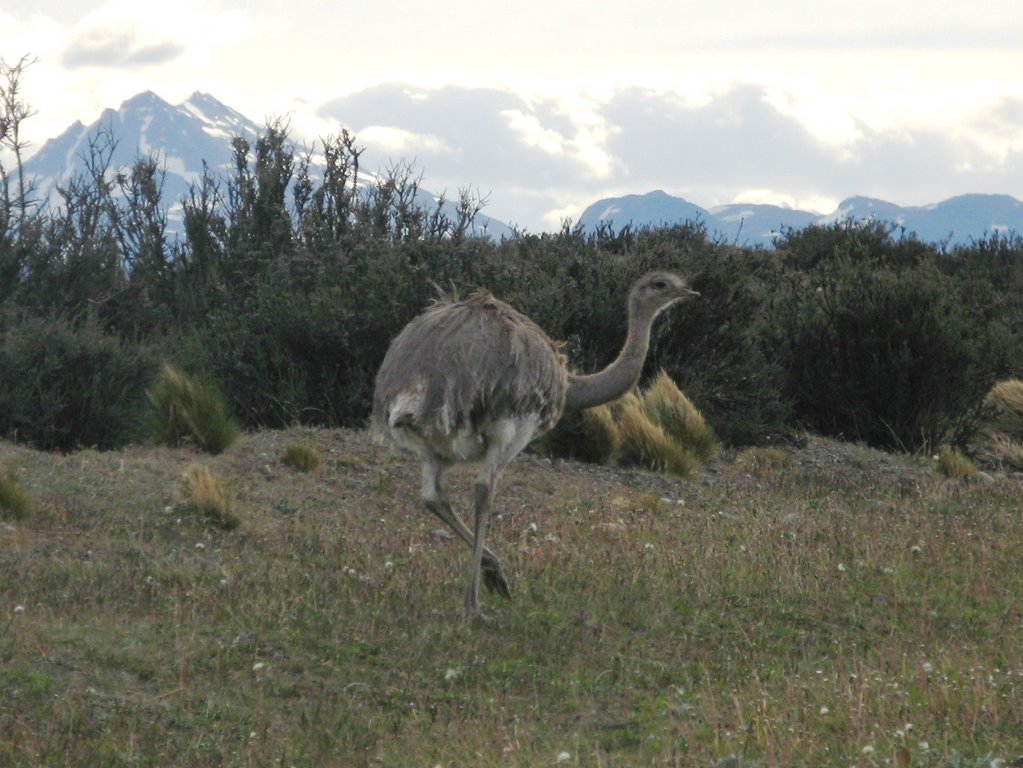
On the drive north there was some new and interesting wildlife (for me anyway). Below are the Guanaco and the Rhea.


And then finally as we approached the park the first glimpses of the Torres - very dramatic indeed. The Torres Del Paine - (The Towers of Blue from the name of the granite spires that dominate the area and the blue glacial lakes that are around them) are the classic mountains of Patagonia - they are the granite spires you see on the classic images of the area and they are spectacular.

On arriving in the park I met up with my fellow travelers. We were a group of 10 Australians, 1 Dutchman, myself and our two Chilean guides. By the end of the trip we were all the best of friends.
This province of Chile has been given the name Ultima Esperanza - Last Hope - I wonder what they were thinking when they named it that.
The countryside here is sparsely populated but there were few interesting things to see on the way into the park. We stopped to visit the Milodon Cave - a Milodon is a, now extinct, prehistoric sloth which used to inhabit the cave. A useless piece of trivia about the Milodon Cave is that it was a piece of skin from a mummified Milodon found in the cave that inspired Bruce Chatwin to go to Patagonia and write his classic travel book - In Patagonia. I have always liked Bruce Chatwin's writing and it was that book that inspired me to go to Patagonia - except it took me a long time to get there - I read it when I was in my 20's.
On the drive north there was some new and interesting wildlife (for me anyway). Below are the Guanaco and the Rhea.
And then finally as we approached the park the first glimpses of the Torres - very dramatic indeed. The Torres Del Paine - (The Towers of Blue from the name of the granite spires that dominate the area and the blue glacial lakes that are around them) are the classic mountains of Patagonia - they are the granite spires you see on the classic images of the area and they are spectacular.

On arriving in the park I met up with my fellow travelers. We were a group of 10 Australians, 1 Dutchman, myself and our two Chilean guides. By the end of the trip we were all the best of friends.
Chile
Well I am back in the USA after a great trip to Chile. I got to see quite a lot of the country and was very impressed - being so long and thin Chile has a lot of different climate zones and has quite a lot to offer as a tourist destination. I got to see the bit at the bottom (Torres Del Paine in Patagonia) and the bit at the top (the Atacama Desert) with a quick look around Santiago and Valparaiso in the middle.

I arrived in Santiago after a tiring trip (via Los Angeles and Atlanta) and had a quick look around the city on the afternoon of my arrival. It is a clean and modern city but in many ways unremarkable. On a clear smog free day, the view would be spectacular as the high Andes are quite close to the city but as you can see below, it was not really that clear. Surprisingly there does not seem to be a lot of historical sites or many colonial buildings - perhaps as a result of it being the recipient of some serious earthquakes (in 1960 Chile had the largest earthquake ever instrumentally recorded - 9.5 on the Richter Scale).
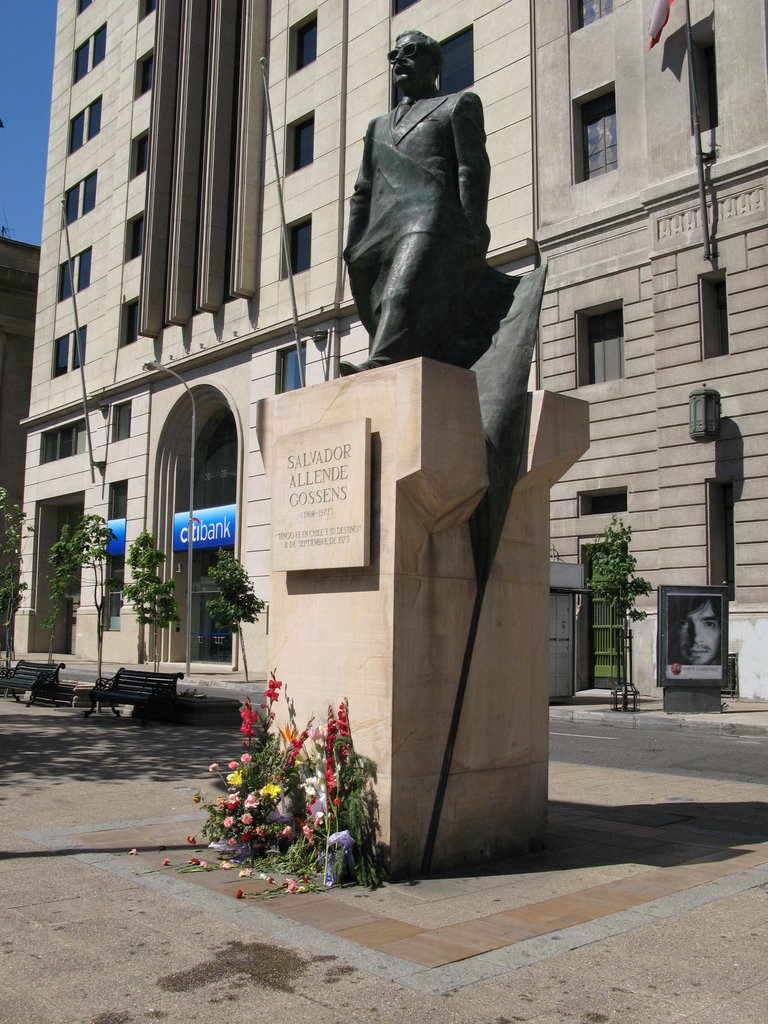
For me the most interesting place was the Palacio De La Moneda, where Salvador Allende allegedly committed suicide under siege by the army back in 1973. The palace suffered aerial bombardment during the coup but there were no signs of that now. Since that time and the restitution of democracy they have erected a statue to Senor Allende and there were many fresh flowers around laid at the statue's base. It is still an issue that is contentious in the country after all these years.

Of course as I write this, the main perpetrator of the coup (not counting the US government that is) General Augusto Pinochet has suffered a heart attack.
So after an afternoon in Santiago, it was on to Patagonia - a lot more interesting area which I will write about later in the week.

I arrived in Santiago after a tiring trip (via Los Angeles and Atlanta) and had a quick look around the city on the afternoon of my arrival. It is a clean and modern city but in many ways unremarkable. On a clear smog free day, the view would be spectacular as the high Andes are quite close to the city but as you can see below, it was not really that clear. Surprisingly there does not seem to be a lot of historical sites or many colonial buildings - perhaps as a result of it being the recipient of some serious earthquakes (in 1960 Chile had the largest earthquake ever instrumentally recorded - 9.5 on the Richter Scale).
For me the most interesting place was the Palacio De La Moneda, where Salvador Allende allegedly committed suicide under siege by the army back in 1973. The palace suffered aerial bombardment during the coup but there were no signs of that now. Since that time and the restitution of democracy they have erected a statue to Senor Allende and there were many fresh flowers around laid at the statue's base. It is still an issue that is contentious in the country after all these years.
Of course as I write this, the main perpetrator of the coup (not counting the US government that is) General Augusto Pinochet has suffered a heart attack.
So after an afternoon in Santiago, it was on to Patagonia - a lot more interesting area which I will write about later in the week.
Subscribe to:
Posts (Atom)